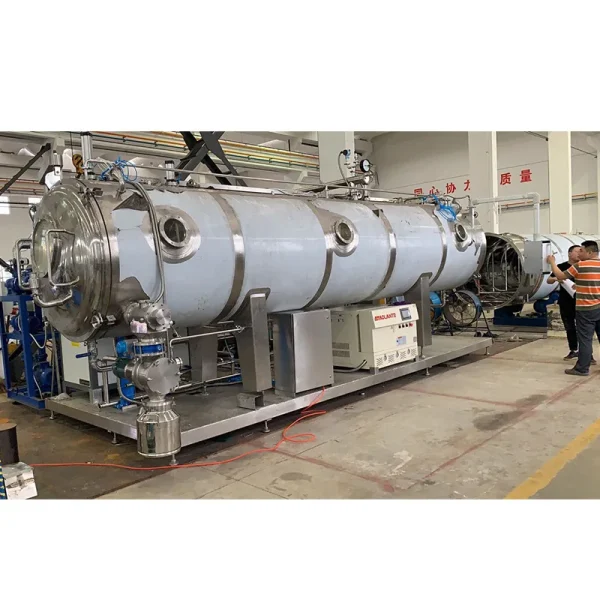


Vacuum Belt Dryer 200 kg/h

Continuous dryer that carries product on a belt through a vacuum chamber, where heated plates supply the drying energy and the low pressure lets water leave at a temperature far below its normal boiling point.
How it works
Product is spread as a layer on a conveyor belt inside a sealed chamber. The chamber is evacuated to a controlled pressure, and the belt passes over heated plates — or between heated zones — that conduct or radiate heat into the layer. Water boils off at the reduced pressure, vapour is drawn to a condenser, and the condensate is collected. Dried product discharges through a vacuum lock at the outlet.
Low pressure is the point: water leaves at 30-70 °C instead of at atmospheric boiling, so the product never sees the temperatures that drive browning, flavour loss and vitamin degradation. Product foams and puffs as it dries, which is why vacuum belt drying is the usual route to a crispy dried fruit piece without frying.
Suitable for
Heat-sensitive fruit and berry purées and pieces where colour and flavour define the price; high-value extracts and concentrates dried to powder; product whose volatile aroma is the selling point; premium dried fruit snacks with a puffed structure; plants replacing freeze drying where the freeze-dried quality is not strictly required and the capital cannot be justified.
Not suitable for
Product where a low-temperature process is not needed — hot air drying is far cheaper per kg of water removed; very high volumes, because vacuum drying is capital-intensive and throughput-limited by the chamber; product that does not form a stable layer on the belt; operations without vacuum and condensing infrastructure and the maintenance that goes with it.
Material & compliance
Chamber, belt and plates in SUS304 (EN 1.4301); SUS316L (EN 1.4404) on request for acidic product. Chamber designed for vacuum service with documented leak rate; belt tracking and tension accessible; chamber and belt arranged for CIP or for strip-down cleaning; vacuum lock designed to avoid product accumulation.
Supplied with CE declaration of conformity and DoC on request; material certificate EN 10204 3.1 available for contact parts.
Selection notes
Ask what the product temperature actually reaches at your target moisture, not what the plate temperature is set to — the gap between the two is the quality margin you are paying for. Request a trial on your own purée or pieces, because foaming behaviour is product-specific and it decides achievable layer thickness and residence time. Check cleaning honestly: a vacuum chamber with a long belt is not a quick clean, and sanitary design here varies enormously between builders.
When you should not buy this machine: If colour and aroma are not your selling points, hot air or a belt dryer does the same water removal for a fraction of the capital and running cost. Also skip it if your volume is high: vacuum drying is a quality process with a throughput ceiling, and scaling it means buying chambers, not pushing a belt faster.
Key specifications
| Parameter | Value |
| Capacity | 50-1000 kg/h feed by model (TYPICAL, confirm with factory) |
| Operating pressure | 10-100 mbar abs by model (TYPICAL) |
| Product temperature | 30-70 °C by product (TYPICAL) |
| Belt width | 400-1200 mm by model (TYPICAL) |
| Residence time | 20-90 min by product (TYPICAL) |
| Contact material | SUS304 (EN 1.4301); SUS316L on request |
| Power supply | 380V/3P/50Hz or 415V/3P/50Hz, customizable |
Specification values are industry-typical ranges for this machine class and are not verified against a specific factory datasheet. Replace them with measured factory data before publication.
FAQ
How is this different from freeze drying?
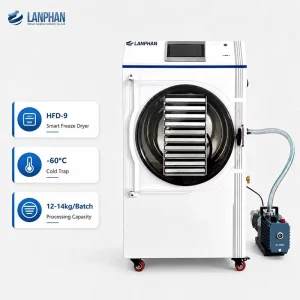
Freeze drying removes water by sublimation from a frozen product and gives the best structure and rehydration. Vacuum belt drying works on liquid or wet product at a somewhat higher temperature, costs less to buy and to run, and lands close on colour and aroma with more shrinkage.
Does the product foam on the belt?
Usually yes, and that is desirable — foaming increases surface area and gives the puffed structure. But foam behaviour is product-specific, which is why a trial matters.
Why is the product temperature not the plate temperature?
Because evaporation cools the layer. As long as water is leaving, the product stays well below the plate, and that difference is exactly the quality advantage you are buying.
Related equipment
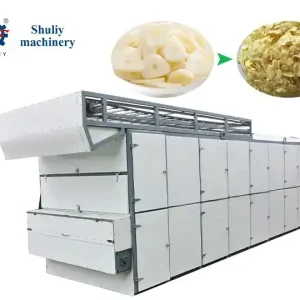
This unit is one stage of a complete processing line. For the full range of drying and dehydration equipment, or to compare this model against the Belt Hot Air Dryer 1 t/h 30 kW, see the complete equipment catalogue. Capacity, material grade and utility requirements can be confirmed through a quote request.
Reviews
There are no reviews yet.