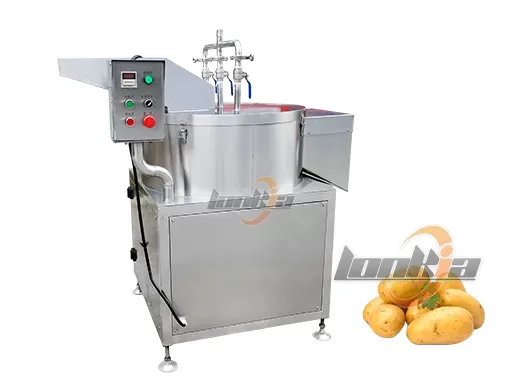
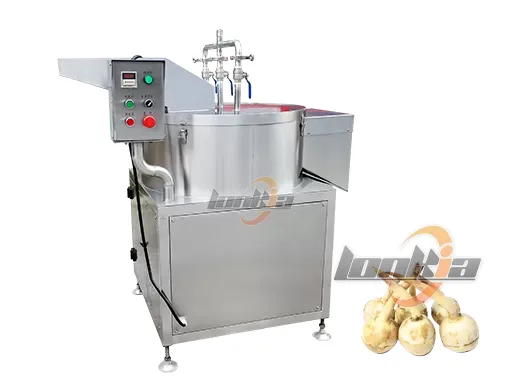
Cassava Washing and Peeling Machine 3000 kg/h
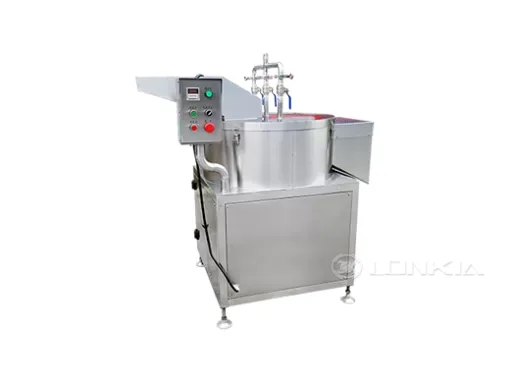
Cassava is the hardest wash-peel job on a root line. It arrives caked in red soil, its skin is a thick corky bark rather than a thin peel, and beneath that bark sits a second peel layer that has to go too before the white flesh can be grated. A brush washer built for potatoes gives up on the bark, and a peeler built for apples gives up on everything. This machine class exists because cassava needs abrasion measured in minutes, not seconds.
How it works
Product is fed into a drum or onto a bed of rotating abrasive rollers. The drum’s inner surface — carborundum-lined or fitted with abrasive segments — scours the bark off as the tubers tumble against it and against each other, while spray bars above wash the abraded material away continuously so the abrasive surface does not blind with starch and grit. The water also carries the loosened soil to a collection channel below. As the outer bark strips, the rollers keep working until the second peel layer is gone and the flesh shows white; feed rate is matched to residence time so nothing leaves half-peeled. Discharge is continuous by screw or by the drum’s own slope.
The machine is judged on two numbers: peel removal rate and flesh loss. Cassava tolerates aggressive abrasion far better than potato, but every minute on the abrasive surface eats flesh as well as bark, and the difference between a well-set machine and a badly set one is several points of yield.
Suitable for
Cassava garri, flour and starch lines as the first process step after harvest intake; sweet potato and taro lines needing the same heavy-abrasion treatment; operations feeding a grater or rasper downstream, where unpeeled bark would contaminate the product and dull the grating surface; rural and semi-industrial plants where peel removal is currently done by hand, and labour cost per tonne is the constraint.
Not suitable for
Thin-skin roots like carrot or beetroot, where abrasive drums destroy far more flesh than they need to — a brush washer is the right machine; operations with no water supply and drainage, because this is a wet abrasive process with significant water use; product sorted poorly enough that stones reach the drum, where they destroy the abrasive surface; anyone expecting peeling without prior destoning, which is a separate machine class and a separate purchase.
Material & compliance
Drum or roller shell, feed hopper and discharge chute in SUS304 (EN 1.4301); abrasive segments in food-grade carborundum, bolted for replacement as a wear item. Frame and base can be painted carbon steel on economy models, but every product-contact surface stays stainless. Drive guarded; drum access interlocked, because an abrasive drum in motion is not a place to reach in after a jam. Water circuit arranged for recirculation with a settling pit, since the effluent carries grit that must not return to the spray bars.
Supplied with CE declaration of conformity and DoC on request; material certificate EN 10204 3.1 available for contact parts.
Selection notes
Ask for peel-removal rate and flesh loss on your root size range, measured, not quoted — the two numbers trade against each other and the supplier’s setting decides where. Ask what the abrasive surface is and how it is replaced, because it is the machine’s consumable and its replacement cost sets your cost per tonne. Check the drive power honestly: cassava takes more torque than any other root, and an undersized motor stalls on wet, heavy product. Check water consumption and whether recirculation with settling is part of the quote.
When you should not buy this machine: If your crop is anything thinner-skinned than taro, you are buying flesh loss for nothing — brush or bubble washing fits. And if your intake has no destoning step upstream, fix that first; one stone can ruin a set of abrasive segments that cost more than the stone ever would.
Key specifications
| Parameter | Value |
| Capacity | 2000-5000 kg/h by model (TYPICAL, confirm with factory) |
| Peeling method | Abrasive drum or roller bed with spray washing |
| Peel removal rate | 90-96 % in a single pass (TYPICAL) |
| Flesh loss | 4-8 % by weight, setting-dependent (TYPICAL) |
| Water consumption | 1-3 m3/h with recirculation (TYPICAL) |
| Main motor | 3.0-7.5 kW by drum size (TYPICAL) |
| Contact material | SUS304 (EN 1.4301) |
| Power supply | 380V/3P/50Hz or 415V/3P/50Hz, customizable |
Specification values are industry-typical ranges for this machine class and are not verified against a specific factory datasheet. Replace them with measured factory data before publication.
FAQ
Can it handle other root crops besides cassava?
Yes — sweet potato, taro and yam with comparable bark all run well, provided the abrasive setting is adjusted. Thin-skin crops like carrot are the wrong product for it; the machine does not know when to stop abrading.
How often do the abrasive segments need replacing?
By tonnage rather than time — typically after several hundred tonnes on a well-maintained machine, sooner on gritty intake. Treat them as a wear item and price them into your cost per tonne from the start.
Is the waste water recyclable?
With a settling pit or pond, largely yes. The effluent carries grit and starch; if it recirculates unfiltered, the spray bars blind with starch in days and the peel quality falls quietly.
Related equipment
This unit is one stage of a complete processing line. For the full range of washing and peeling equipment, or to compare this model against the Brush Roller Peeling Machine 800 kg/h, see the complete equipment catalogue. Capacity, material grade and utility requirements can be confirmed through a quote request.
Reviews
There are no reviews yet.