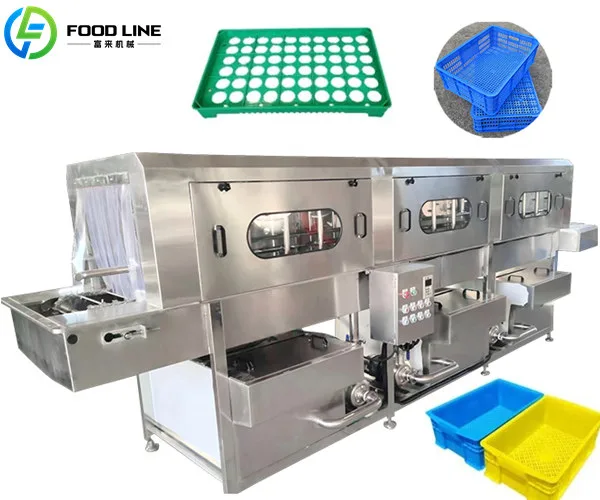
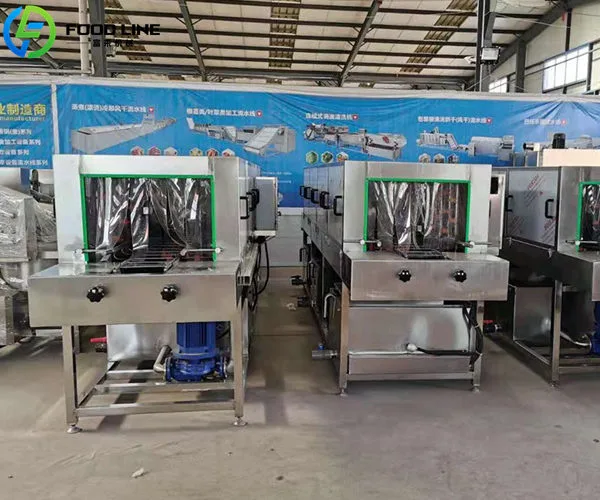
Crate Washing Machine 500 crates/h
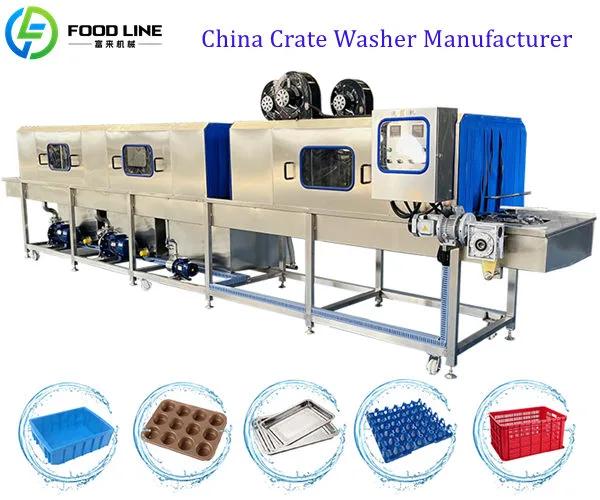
Tunnel washer for the containers that carry product in and out of a packing house. Field crates arrive with soil, plant residue and, on a bad day, the remains of the previous load. Washing them is not a cosmetic step: a dirty crate is one of the more reliable ways to re-contaminate product that has already been cleaned.
How it works
Crates are placed inverted on a conveyor and carried through a tunnel. In the first section, high-pressure nozzles spray recirculated wash water at the crate from several angles, including from below, which is the direction that matters. A heated wash section improves the removal of dried-on residue and of fruit sugars. A final section rinses with fresh water, and a blow-off or drain section removes most of the free water before the crate leaves.
Water is recirculated through a filter or a settling tank, because crate washing uses a lot of it. Solids removal is the maintenance item: if the filter is not cleaned, the wash water becomes the contamination source instead of the cure. Most machines are zoned so the wash section can run hot and dirty while the rinse section stays clean.
Suitable for
Packing houses and processors running a crate or pallet-box circuit; plants returning crates from retail or from the field where the inbound condition is inconsistent; operations where crate hygiene is written into the HACCP plan or required by a buyer; lines wanting to stop hand-washing crates, which uses more water and gives a less consistent result.
Not suitable for
Very low volumes, where hand washing with a pressure washer is cheaper and more flexible; crates with dried-on material that no water pressure will move without soaking — a soak stage has to come first; mixed crate types with very different dimensions, unless the machine is set up for the largest and the smaller ones are handled differently; plants without floor drainage and water treatment capacity for the volume involved.
Material & compliance
Tunnel, tanks and nozzle manifolds in SUS304 (EN 1.4301); nozzles removable for cleaning, because they block. Pipework and pump sized for recirculation; the settling or filtration stage must be accessible for daily cleaning.
Supplied with CE declaration of conformity and DoC on request; material certificate EN 10204 3.1 available for contact parts. Where a sanitiser is dosed into the rinse, the dosing arrangement and the chemical approvals for the destination market need to be specified.
Selection notes
Ask for the throughput measured on your crate size, because crates per hour varies enormously with crate dimensions and with how dirty they arrive. Ask what filtration is included and how it is cleaned; a machine without solids removal just redistributes soil. Check nozzle access and whether the manifold can be removed without tools. Check where the water goes — crate washing produces a wet, dirty effluent that needs a drain and a settlement route.
When you should not buy this machine: If you handle a few dozen crates a day, or if your crates carry heavy dried-on soil, this is the wrong first step — a soak tank or a change in crate handling will do more. Also skip it if you have nowhere to put the water; the machine is straightforward, the drainage is the part that gets forgotten.
Key specifications
| Parameter | Value |
| Throughput | 300-800 crates/h by crate size (TYPICAL, confirm with factory) |
| Wash pressure | 2-6 bar at the nozzles (TYPICAL) |
| Wash water temperature | 40-70 °C with optional heating (TYPICAL) |
| Cycle | Wash, rinse and drain sections |
| Water circuit | Recirculated with filtration; fresh rinse |
| Contact material | SUS304 (EN 1.4301) |
| Power supply | 380V/3P/50Hz or 415V/3P/50Hz, customizable |
Specification values are industry-typical ranges for this machine class and are not verified against a specific factory datasheet. Replace them with measured factory data before publication.
FAQ
Does crate washing actually reduce contamination on the product?
It removes one of the routes. A crate that carried field soil and is put back under washed product reintroduces exactly what the wash line removed. Whether it matters depends on how dirty your crates come back and what happens after washing.
Do I need heated water?
For sugary residue, yes — cold water moves soil but not dried-on fruit sugars. For soil only, cold is usually enough, and heated wash is an energy cost you can avoid.
How much water does it use?
Less than hand washing per crate, because the water is recirculated, but a significant continuous volume. The rinse section uses fresh water; the wash section should run on filtered recirculated water with a defined changeover.
Related equipment
This unit is one stage of a complete processing line. For the full range of washing and peeling equipment, or to compare this model against the Bubble Washing Machine 2000 kg/h, see the complete equipment catalogue. Capacity, material grade and utility requirements can be confirmed through a quote request.
Reviews
There are no reviews yet.