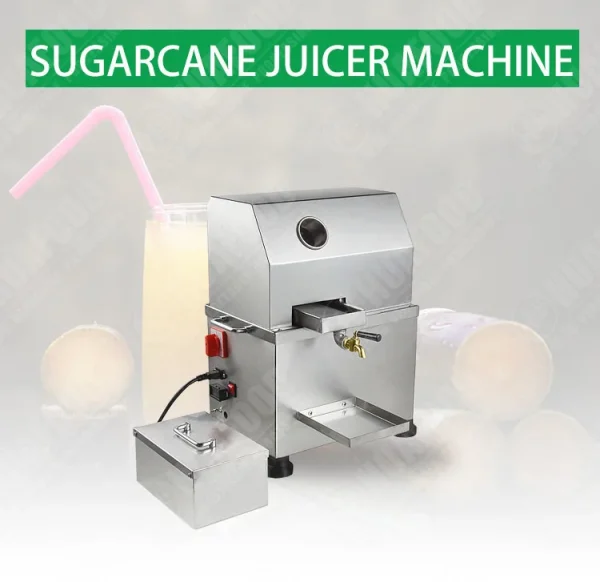
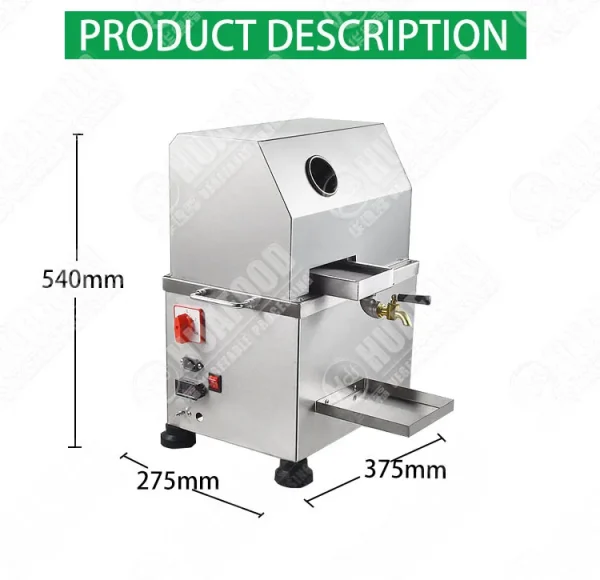



Sugarcane Juice Extractor 500 kg/h
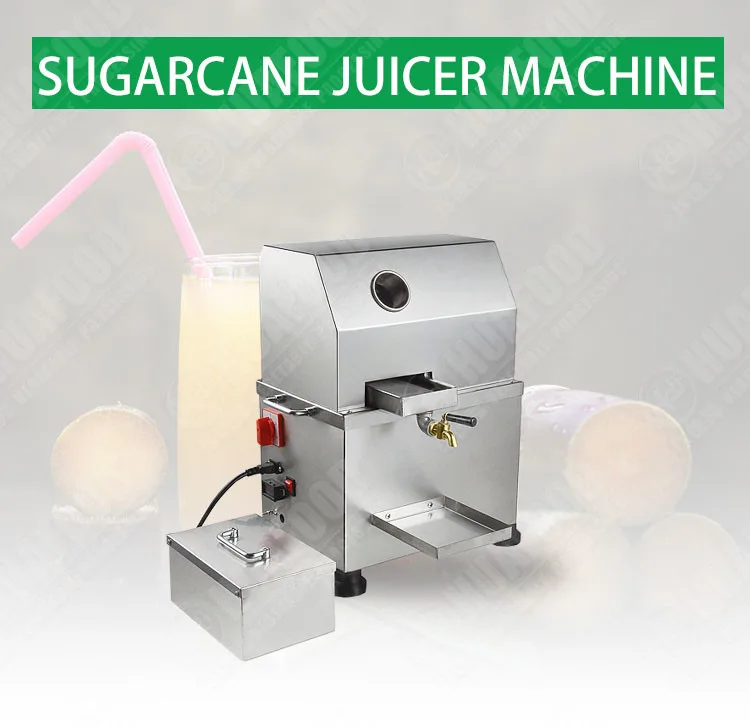
Sugarcane is a rope of fibre wrapped around dilute sugar water, and getting the water out is a squeezing problem, not a cutting one. A sugarcane juice extractor is a mill: grooved rollers that grab the stripped cane, flatten it and press the juice free while the fibre banner exits the far side. The craft is in the roll set — feed grip, first crush, wetting and second crush — and the number that matters is extraction: how much of the juice you took, and how much you fed to the fibre waste.
How it works
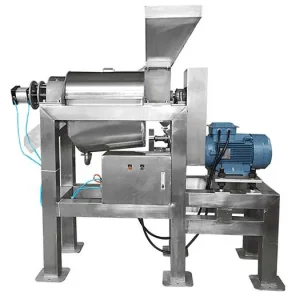
Stripped cane feeds into a set of three or four grooved stainless rollers arranged so the cane is gripped, folded and compressed in sequence. The first nip bursts the rind and expresses the bulk of the juice; a recirculation tray catches it and often wets the fibre before the second nip, which is how a small mill reaches respectable extraction — water added to the bagasse carries out the sugar the first press left. Juice drains to a filtered pan with a coarse screen catching bagasse fines; the crushed fibre exits as damp banner for disposal or as boiler fuel in bigger plants. Roll gap, roll speed and wetting water rate are the three adjustments; feed rate is the fourth discipline.
Suitable for
Fresh-juice stands and juice bars pressing to order, where the machine is the theatre as much as the tool; small bottling lines pasteurising or UV-treating raw cane juice, within a HACCP that knows what raw cane juice demands; jaggery and cane-syrup plants feeding open pans or vacuum cookers; farm-level processing where cane is squeezed within hours of cutting and the freshness is the product.
Not suitable for
Sugar mills — this is a juice machine, not an industrial mill train with clarifiers and evaporators; buyers hoping to store raw cane juice — it browns and sours within hours, and the machine cannot fix that; anyone planning to juice whole unstripped cane, which fights the feed rolls and dirties the juice; operations without immediate chilling or pasteurisation downstream, because the honest name for unchilled raw cane juice is a food-safety complaint waiting to be filed.
Material & compliance
Rolls, feed tray, juice pan and guards in SUS304 (EN 1.4301); rolls machined with deep grooves for grip and re-cut when worn. Drive guarding over nip points is not optional — cane mills are the classic hand-in-the-rolls machine, and modern units carry feed rollers, anti-stall design and emergency stops. Juice-contact surfaces smooth, drainable and hose-down friendly; the juice pan slopes to drain with no dead pockets where fibre and sugar film collect.
Supplied with CE declaration of conformity and DoC on request; material certificate EN 10204 3.1 available for contact parts.
Selection notes
Ask for extraction rate and the assumptions behind it — cane variety, whether wetting water is used and how much. Ask what the juice pan filtration includes and how the pan drains at cleaning. Check the safety package seriously: feed rolls, guards, e-stops, and whether the feed accepts short cane pieces or wants full lengths. Check roll re-grooving service, because grip is a wearing property. If bottling, confirm the machine’s throughput matches your pasteuriser, not your ambition.
When you should not buy this machine: If your product is clarified, bottled juice at shelf-stable lengths, the mill is the easy part and the process around it is the hard part — buy the process first. And if volume is one stand serving cups, a two-roll bench mill is cheaper and honest.
Key specifications
| Parameter | Value |
| Cane capacity | 300-1000 kg/h by roll set (TYPICAL, confirm with factory) |
| Extraction rate | 60-75% with wetting (TYPICAL) |
| Rolls | 3-4 grooved SUS304, 100-250 mm dia class |
| Juice pan | Stainless, coarse screen, drained |
| Wetting system | Recirculation / first-press juice wetting option |
| Contact material | SUS304 (EN 1.4301) |
| Power supply | 380V/3P/50Hz, 2.2-7.5 kW class |
Specification values are industry-typical ranges for this machine class and are not verified against a specific factory datasheet. Replace them with measured factory data before publication.
FAQ
Why does raw cane juice brown so fast?
Polyphenol oxidase and iron contact. Within hours the juice darkens and sours; the mill’s job is extraction, and the process’s job is immediate chilling, pasteurisation orUV treatment. Do not plan a menu around juice that sits.
How much juice per tonne of cane?
Extraction of 60-75% on stripped cane is a fair working range, with variety and milling discipline making the difference. Ask the factory to demonstrate on your cane — juice content varies more between varieties than buyers expect.
Is wetting water cheating?
No — adding a small percentage of water before the second press is standard mill practice that raises extraction and dilutes the juice slightly. Ask what the quoted extraction assumes; a no-wetting number and a wetting number are different claims.
Related equipment
This unit is one stage of a complete processing line. For the full range of pulping and juicing equipment, or to compare this model against the Screw Press Juice Extractor 3000 kg/h, see the complete equipment catalogue. Capacity, material grade and utility requirements can be confirmed through a quote request.
Reviews
There are no reviews yet.