Juice Blending Machine 2 t/h
Pressing decides what juice is; blending decides what the customer tastes. The same pressed juice, blended with a point of acid here and a degree of brix there, becomes a different product on the shelf — and doing that blending by hand in open tanks is how one batch tastes like the poster and the next like an apology. A juice blending machine formalizes the stage: recipe-stored dosing of concentrate, syrup, filtered water and minor additives into a jacketed, agitated blending tank, mixed to homogeneity and discharged to the filler at a steady, recorded composition. It is not a glamorous machine, and it is the reason the fifth batch tastes like the first.
How it works
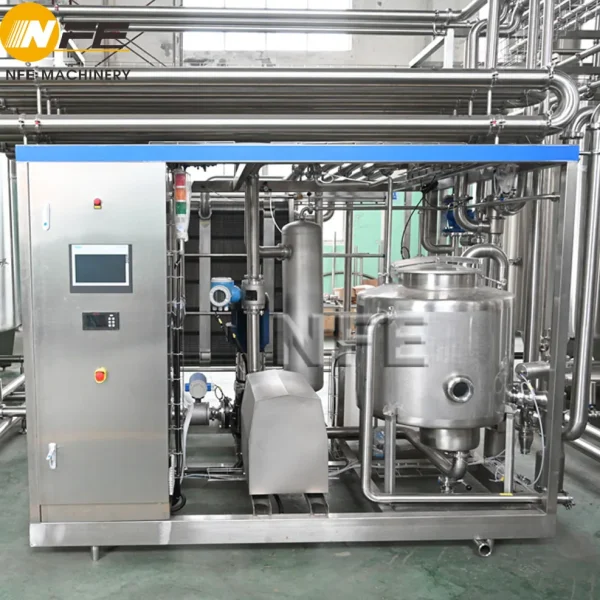
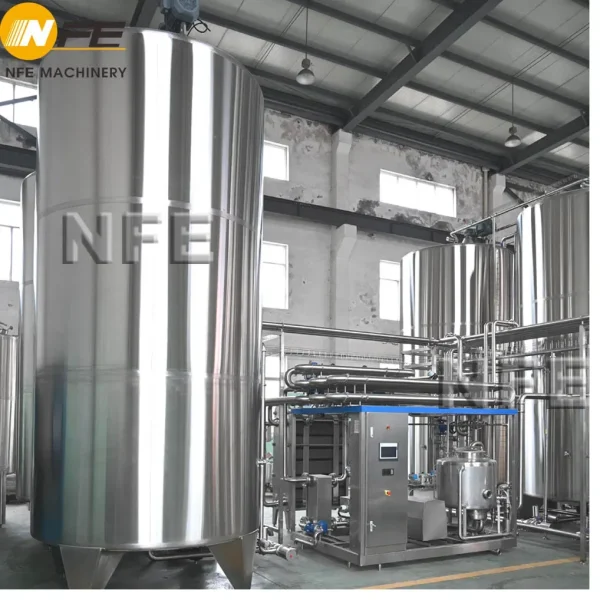
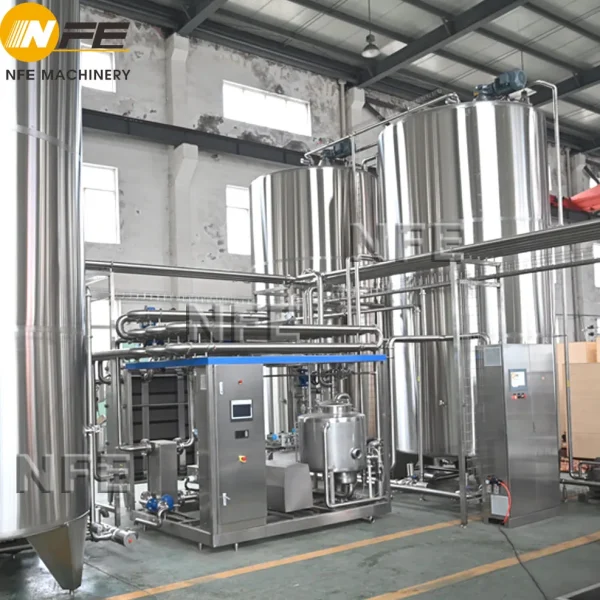
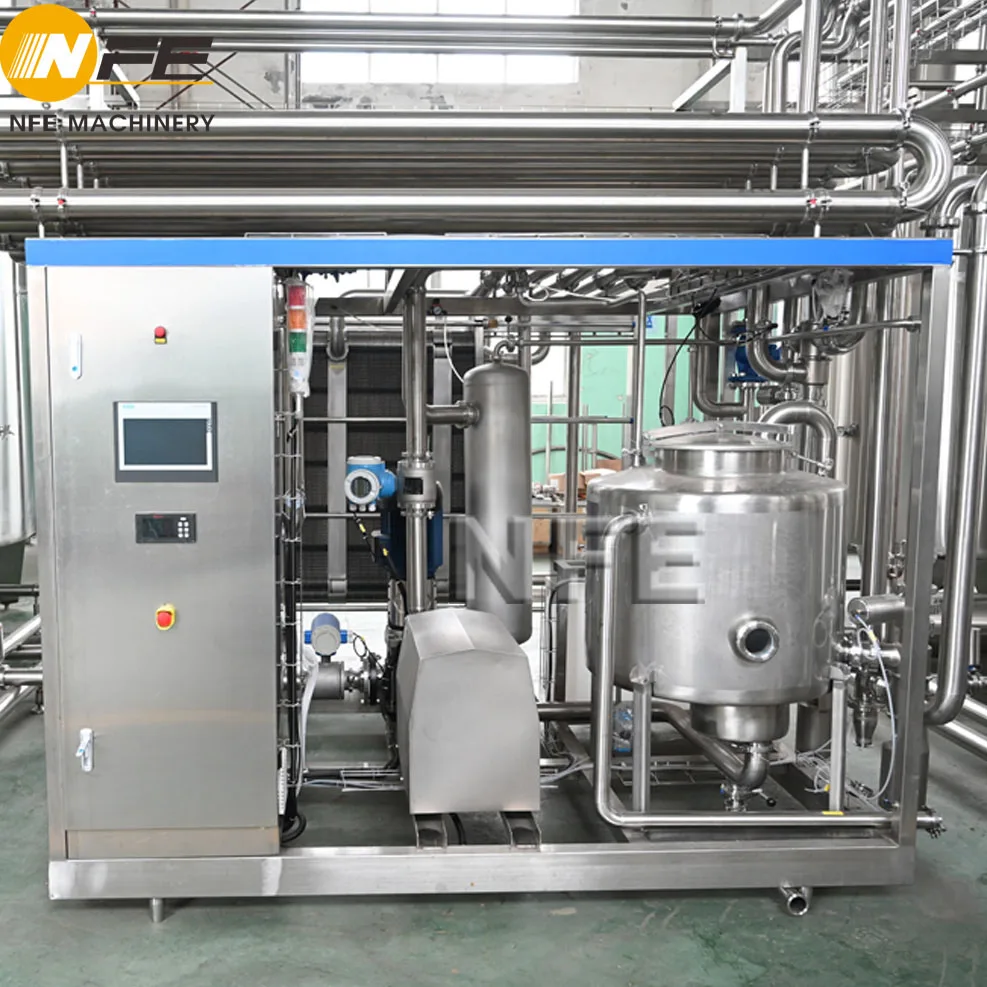
The line is built around one or more jacketed blending tanks with a controlled agitator. Ingredient streams — juice, concentrate, syrup, treated water, and minor dosing like acid or stabilizer — feed through flow meters or weigh-cell dosing to the recipe’s targets; the controller sequences them in order (typically water base, then syrup, then juice, then minors) and holds the agitator speed to a gentle mix that blends without whipping in air. Where the recipe wants it, the jacket warms the batch to dissolve sugar or stabilize the blend; a probe confirms temperature and, on instrumented lines, in-line brix closes the loop on the sugar balance. When the batch reaches spec, it discharges through a bottom valve to a balance tank feeding the filler, and the tank re-sequences for the next recipe. CIP nozzles clean the tank between products.
Suitable for
Juice and nectar plants blending pressed or reconstituted juice to recipe before filling; tea and plant-drink producers mixing extracts with syrup and water; dairy-alternative lines blending plant bases with syrups and flavour systems; jam and sauce makers preparing the liquid phase ahead of the cooking kettle; any producer whose recipe is a list of ratios and whose customer expects the same drink every time.
Not suitable for
Single-strength juice that needs no recipe — straight filling after pressing skips the stage entirely; high-shear emulsions like mayonnaise-type sauces, which need a different agitator class entirely; and buyers expecting it to pasteurize — the blending tank mixes, and the sterilizer downstream is where shelf stability is earned.
Material & compliance
Tank, agitator, pipes and valves in SUS304 (EN 1.4301), with 316L available for high-acid recipes; welds polished to food-grade finish; CIP spray ball standard; flow meters and probes calibrated at delivery.
Supplied with CE declaration of conformity and DoC on request; material certificate EN 10204 3.1 available for contact parts, with 316L documentation where specified.
Selection notes
Start from your recipes, not the tank size — the honest questions are how many ingredients a batch doses, how accurate the minor-additive dosing must be, and how many batches an hour the filler demands, because those numbers size the tank and the metering more than any brochure. Ask whether brix is measured in-line or by operator sample, and what the mix time does to your batch cadence. Check the agitator style against your product: gentle axial flow for juice, different for pulpy or stabilised recipes. Confirm CIP coverage of the full loop — tank, valve cluster and delivery line — and ask for the weld finish in writing. And price the spare probes and meters; on this machine, calibration is the maintenance.
When you should not buy this machine: If you blend one recipe in one tank by hand and the batch tastes right every time, the machine automates a solved problem. And if your volumes are small enough that a simpleagitator tank with a scale does the job, buy the simple tank — the metering and recipe layer earns its price on batch count and recipe count, not on sentiment.
Key specifications
| Parameter | Value |
| Capacity | 1-5 t/h by tank size and cycle (TYPICAL, confirm with factory) |
| Tank | 200-2000 L jacketed, 1-3 tanks per line |
| Dosing | Flow meter / weigh-cell, recipe stored (TYPICAL) |
| Controls | Sequence, temperature probe, optional in-line brix |
| CIP | Spray ball, full-loop cleanable |
| Contact material | SUS304 (EN 1.4301), 316L option |
| Power supply | 380V/3P/50Hz, 3-10 kW class |
Specification values are industry-typical ranges for this machine class and are not verified against a specific factory datasheet. Replace them with measured factory data before publication.
FAQ
Can it handle pulp with fibres?
Yes within limits — axial-flow agitators hold pulp in suspension at blending viscosities, and pulpy nectars are a standard application. Very high-solids pastes are a different regime; ask for a trial with your actual recipe rather than assuming.
How accurate is the brix control?
With in-line measurement the blend closes on your target within instrument tolerance and stays there across batches; with manual sampling, accuracy is an operator habit. Most buyers who care about shelf consistency choose the in-line option and calibrate it on a schedule.
Does the jacket heat the batch enough for hot-fill prep?
The jacket will warm a blend and dissolve sugar, but hot-fill temperatures and holding times belong to the pasteurizer and holding tube downstream. Use the tank for what it is for — accurate, repeatable composition — and let the sterilizer make the shelf-life promise.
Related equipment
This unit is one stage of a complete processing line. For the full range of pulping and juicing equipment, or to compare this model against the Juice Homogenizer 5000 L/h, see the complete equipment catalogue. Capacity, material grade and utility requirements can be confirmed through a quote request.
Reviews
There are no reviews yet.