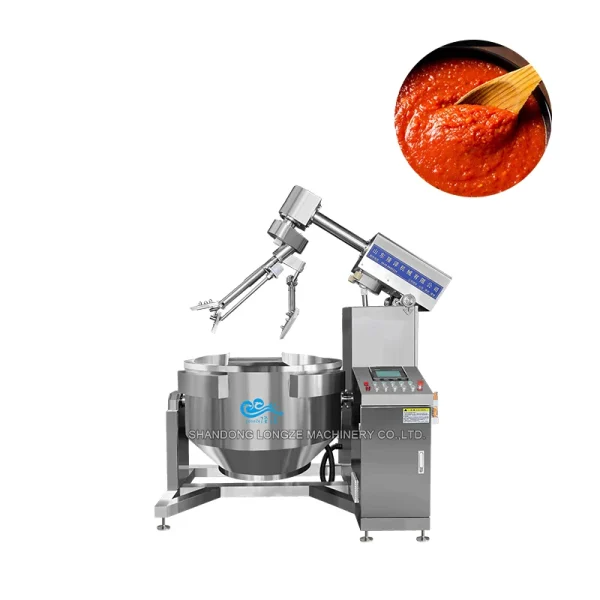
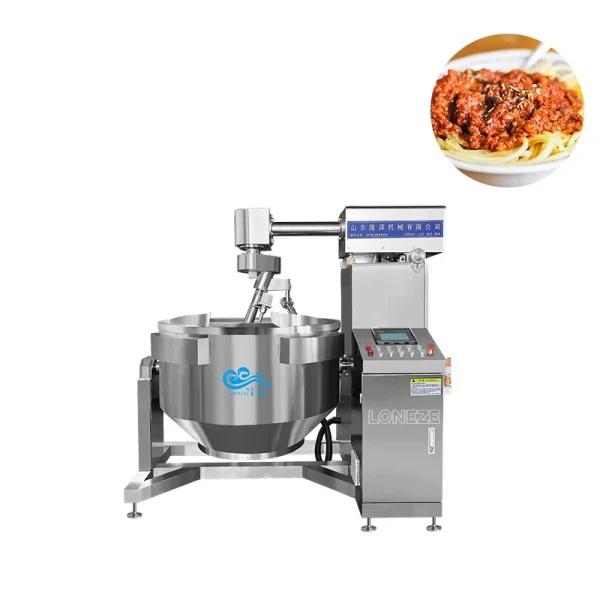
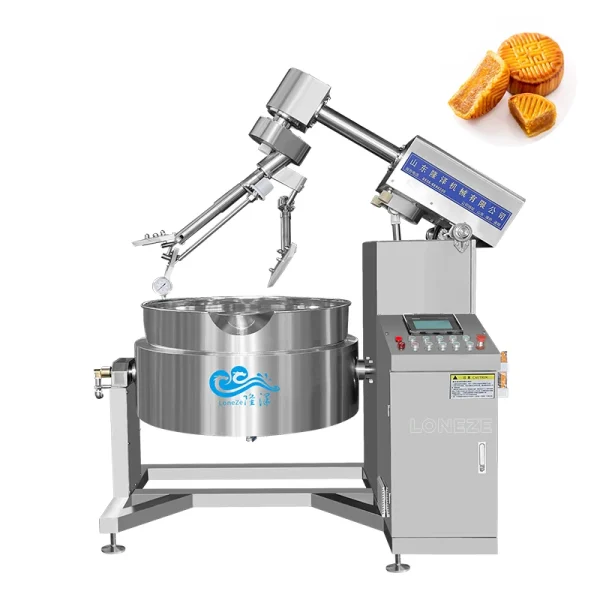
Jam Mixing Tank 500 L
A jam recipe lives or dies at the mixing stage. Pectin set, sugar distribution, fruit piece integrity and brix uniformity all happen — or fail — in the vessel between the pulper and the filler. Cook too hard and the fresh fruit note burns off; stir too fast and you whip in air that foams the filler and oxidises the colour. The jam mixing tank is built around those failures: slow scraper agitation, optional gentle jacket heat, and a vessel that hands the filler a base so uniform that jar one and jar one thousand are the same product.
How it works
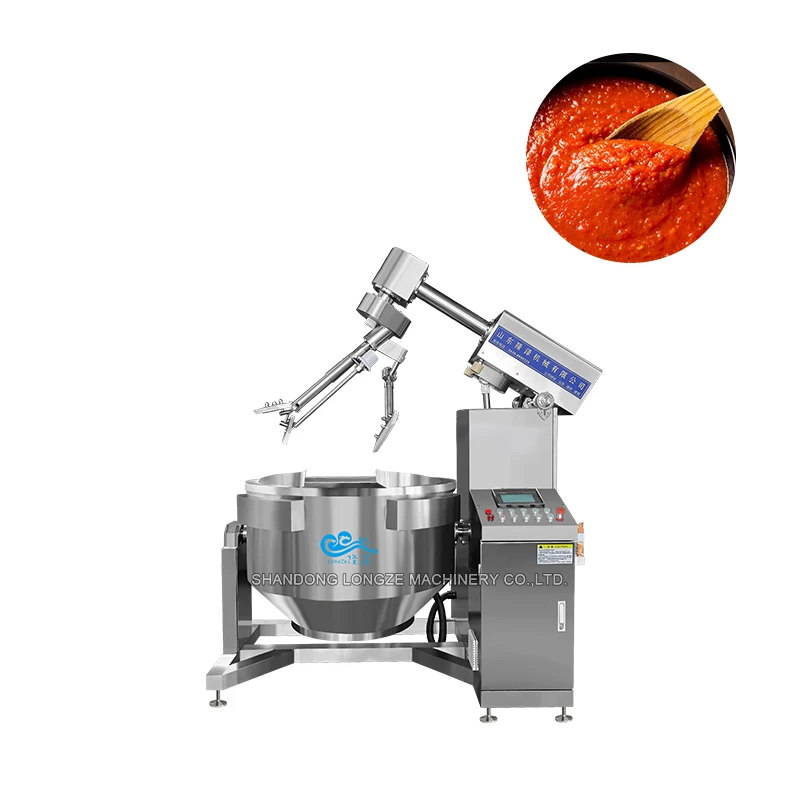
Pulp, sugar solution and dry ingredients charge into the stainless vessel; a low-speed agitator — typically a frame or scraper paddle running at tens of rpm — turns the mass while scraper blades wipe the wall continuously, so sugar does not stratify and nothing scorches onto a hot jacket. Jacketed versions circulate hot water or steam for dissolving and gentle pre-cook phases; the scraper action is what separates this tank from a plain stirred vessel, because jam thickens as pectin hydrates and only a wall-wiping blade keeps the viscosity gradient from stalling the mix. Controls hold temperature and mixing time per recipe; the vessel discharges bottom-out through a wide valve to the filler, or tilts for smaller kitchens. CIP or full-open construction closes the loop.
Suitable for
Jam and preserve plants blending pulp, sugar and pectin ahead of atmospheric or vacuum cooking and filling; sauce and ketchup producers homogenising batches with spice and stabiliser additions; puree and smoothie bases standardising brix before pasteurisation; dairy-adjacent fruit-prep lines feeding yoghurt fruit units; and any operation whose ‘recipe’ currently lives in a paddle and a strong arm and whose buyers have begun comparing jars.
Not suitable for
High-shear emulsifying, which wants a rotor-stator homogeniser instead; continuous inline blending at line rate, which belongs to dosing systems; cooking caramelisation and concentration, which is the vacuum cooker’s job — the mixing tank blends and pre-warms, it does not reduce brix; and dry powder blending, where a ribbon blender does the work better.
Material & compliance
Vessel, agitator, scraper and valve in SUS304 (EN 1.4301), 316L option for acidic high-sugar phases; food-grade shaft seals, polished internal welds; jacket pressure parts certified to destination-market rules where fitted. Full-open or CIP design because sugar residues are yesterday’s gift to tomorrow’s microbes.
Supplied with CE declaration of conformity and DoC on request; material certificate EN 10204 3.1 available for contact parts.
Selection notes
Ask what the scraper-to-wall clearance is and how it adjusts — the wiping action is the machine’s core value and wear changes it. Ask for mixing-time evidence on a jam of your brix and fruit loading, not water. Confirm jacket option versus single-wall honestly against your process: if the cooker downstream handles all heat, a single-wall tank saves money. Check discharge valve size against your filler’s feed rate. Ask about vacuum-lid options if oxidation of colour matters to your product. And price the shaft seal and scraper blades — they are the wear parts that decide running cost.
When you should not buy this machine: If your volumes are a few dozen jars a day, a heavy-bottomed pan and a disciplined cook remain cheaper than stainless and a motor. And if your real need is cooking concentration, buy the vacuum cooking kettle first — the mixing tank serves the line, it does not replace the cooker.
Key specifications
| Parameter | Value |
| Working volume | 200-1000 L by model (TYPICAL, confirm with factory) |
| Agitator | Low-speed frame / scraper, wall-wiping |
| Jacket | Optional hot water / steam, certified |
| Discharge | Bottom valve to filler; tilt option |
| Controls | Recipe time/temperature, probe |
| Contact material | SUS304 (EN 1.4301), 316L option |
| Power supply | 380V/3P/50Hz, 1.5-4 kW class |
Specification values are industry-typical ranges for this machine class and are not verified against a specific factory datasheet. Replace them with measured factory data before publication.
FAQ
Can it cook the jam as well as mix it?
Jacketed versions dissolve and pre-cook gently, and small kitchens do finish simple recipes in them. For honest concentration — where brix must climb and water must leave — the vacuum cooking kettle is the right machine; the mixing tank that tries to do both usually does neither well.
Why a scraper agitator instead of a plain paddle?
Because jam thickens. As pectin hydrates, a centre paddle spins a hole while the wall layer scorches; the scraper renews the wall film continuously, which is what keeps heat transfer honest and the batch uniform from wall to centre.
How do I keep fruit pieces intact?
Low speed, short mixing, and adding fruit late in the cycle after the sugar phase dissolves. Ask the factory to help sequence the recipe — the mechanical answer is gentle speed, the craft answer is timing, and both belong in the recipe card.
Related equipment
This unit is one stage of a complete processing line. For the full range of pulping and juicing equipment, or to compare this model against the Planetary Cooking Mixer 300 L, see the complete equipment catalogue. Capacity, material grade and utility requirements can be confirmed through a quote request.
Reviews
There are no reviews yet.