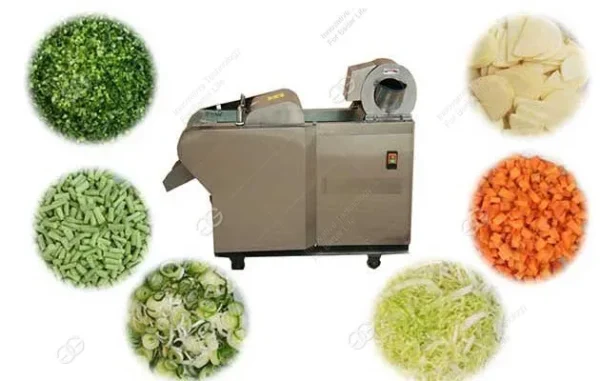
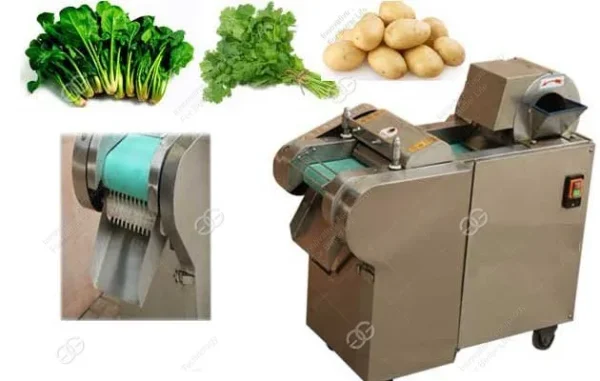
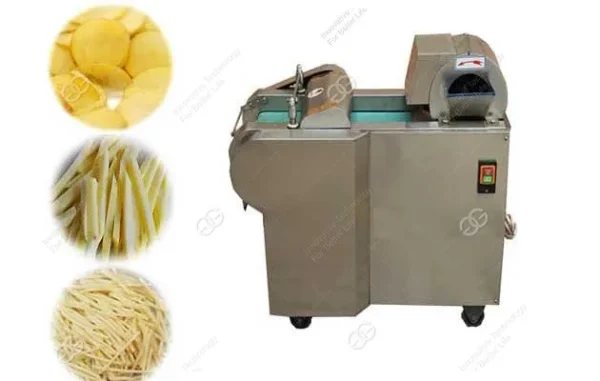
Herb Cutting Machine 300 kg/h
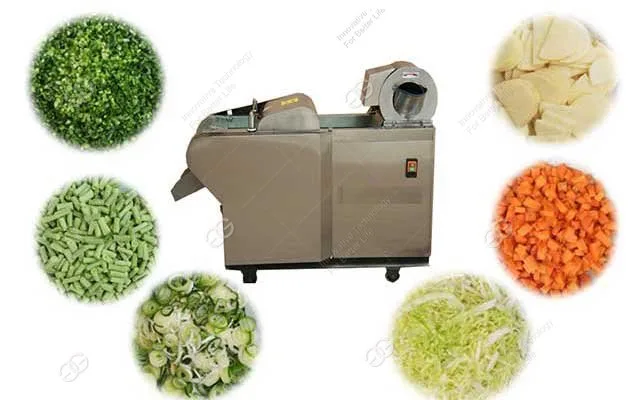
A basil leaf cut by a blunt or fast-spinning blade turns black at the edge within hours; a chive chopped by hand is beautiful and unaffordable. Herb cutting lives in the narrow space between those failures, and the machine that owns the space is the comb cutter — product carried by belt through a reciprocating or rotating blade set that shears against a fixed comb, one clean stroke at a time, at a cut length the operator dials in.
How it works
Washed, drained leaf and stem feed onto a food-grade belt that presents the product flat and overlapping through a cutting head. The head holds a bank of knives moving past a fixed comb bar; the comb holds the bed of product steady while the blades shear through, so the cut is a press-shear against steel, not a slash through air. Cut length equals belt feed per stroke — set 10 mm for chives, 30 mm for basil pack lines, up to 40 mm for dried-leaf feed. Cut product drops to a discharge conveyor with clumps teased apart by a low-air curtain or agitator. Blade sharpness, belt tension and stroke rate are the daily controls; bruising shows immediately as wet, dark cut faces.
Suitable for
Fresh-cut processors supplying washed-and-cut culinary herbs to retail and food service, where cut edge quality decides shelf life; dehydration plants cutting chive, parsley and leek rings before the dryer so uniform pieces dry uniformly; scallion and leek lines ring-cutting for frozen and dehydrated vegetable mixes; food factories cutting leafy greens — spinach, kale, lettuce chiffonade — with the same comb-change logic; small herb farms adding value by selling cut-and-dried leaf rather than bunched fresh.
Not suitable for
Hard root or bulky vegetable cutting — the comb is built for leaf and soft stem, and a carrot stops it; woody-stem herbs like rosemary and thyme demand a different blade geometry and honest testing first; whole-leaf premium basil sold as intact leaves, which no cutter improves; quantities under ten kilos a day, where a good knife and a trained hand still win on cost.
Material & compliance
Belt, comb, blades, housing and discharge in SUS304 (EN 1.4301); blade steel food-grade stainless, tool-quality edge; belt food-grade with release surface so wet leaf does not carry back. Tool-free blade-bank removal for daily honing and washdown, because a machine that is hard to clean collects the one thing herbs cannot survive — old leaf residue.
Supplied with CE declaration of conformity and DoC on request; material certificate EN 10204 3.1 available for contact parts.
Selection notes
Ask for a cutting test on your herb at your cut lengths, and inspect the cut faces wet — under an hour, not the next day, because bruising chemistry starts immediately. Ask how long a blade edge holds at your volume and what honing or replacement costs. Check minimum cut length: some machines cannot honestly hold 5 mm without shredding. Check washdown design around the comb and blade bank — that is where residue hides. Ask for capacity in real wet kilos per hour at your cut, not brochure peak.
When you should not buy this machine: If your herbs go whole-leaf to the dryer, a cutter is a step backwards — cut leaf shrinks unevenly and throws dust. And if your real product is diced onion and your herb is a side job, buy the dicing machine and cut herbs on its gentlest setting only if the factory proves it on your leaf first.
Key specifications
| Parameter | Value |
| Capacity | 100-600 kg/h fresh leaf (TYPICAL, confirm with factory) |
| Cut length | 5-40 mm adjustable (TYPICAL) |
| Cutting action | Reciprocating / rotating blade vs fixed comb |
| Belt width | 200-400 mm by model |
| Blade | Food-grade stainless bank, tool-free change |
| Contact material | SUS304 (EN 1.4301), food-grade belt |
| Power supply | 220-380V, 0.75-2.2 kW class |
Specification values are industry-typical ranges for this machine class and are not verified against a specific factory datasheet. Replace them with measured factory data before publication.
FAQ
Will cut basil still look good after two days in a punnet?
If the cut is clean, the leaf was cold and the pack is honest — yes, and that is exactly why comb cutting exists. Test with your packer: cut in the morning, hold at 2-4 °C, inspect at 48 hours. Edge blackening at 48 hours means bruising at the blade, not fate.
Can it cut chives into fine 5 mm rings?
Machines with a true comb shear and short-stroke control hold 5 mm; cheaper belt-and-blade units shred below 8 mm. Make 5 mm part of the cutting test on your own chives before you buy, not a brochure promise.
Does one machine handle parsley and spinach?
Yes — both are leaf-and-soft-stem, so one comb and adjusted belt speed cover them. Rosemary-family woody herbs are the exception; ask the factory for a tested blade set before committing that product to the same machine.
Related equipment
This unit is one stage of a complete processing line. For the full range of cutting and slicing equipment, or to compare this model against the Vegetable Shredding Machine 800 kg/h, see the complete equipment catalogue. Capacity, material grade and utility requirements can be confirmed through a quote request.

Reviews
There are no reviews yet.