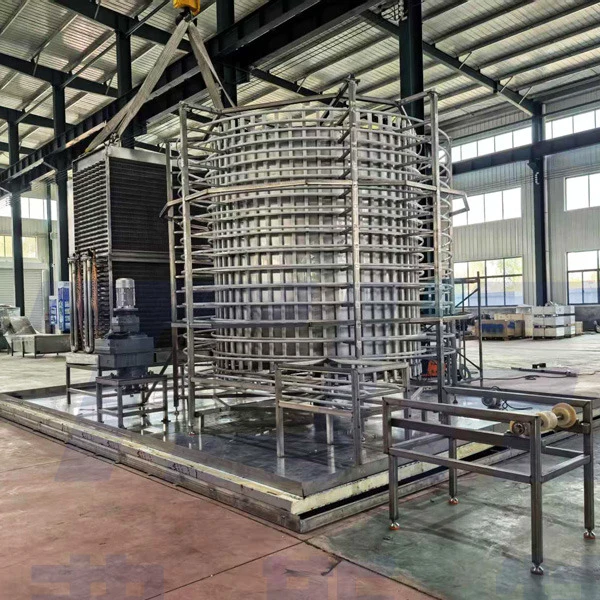
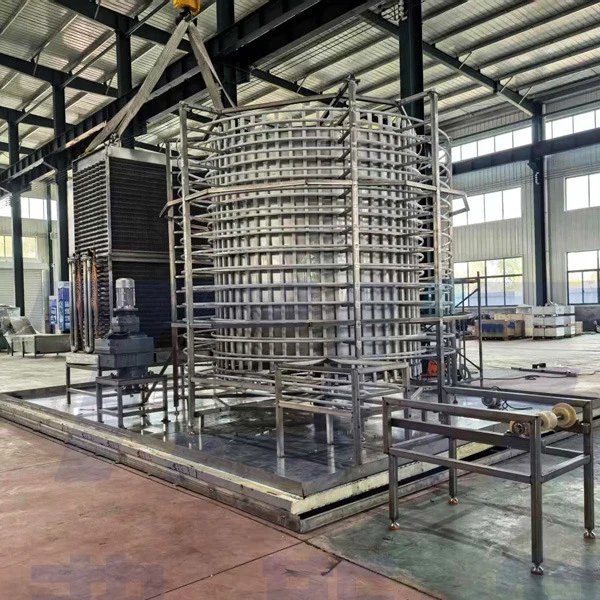
Double Spiral Freezer 3 t/h
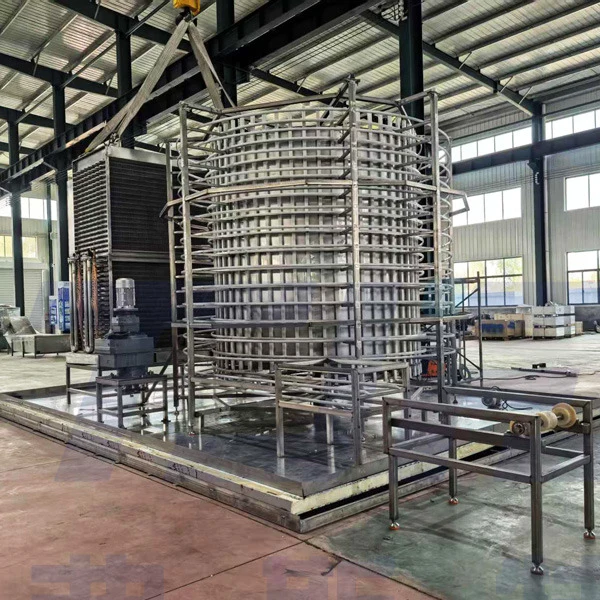
Floor space is the freezer’s real price in most plants. A single spiral freezes well but stacks one tall tower; a tunnel freezes fast but eats the length of the building. The double spiral splits the difference with engineering: two spiral drums stacked in one enclosure, product climbing the first belt and descending the second, tripling residence time inside a footprint a single spiral barely fits. For lines freezing a few tonnes an hour in an existing building, it is usually the freezer that makes the layout work.
How it works
Product enters IQF or tray-fed onto the lower spiral belt; the belt wraps around a rotating drum, climbing turn by turn through the -35 °C class air stream until it transfers to the upper spiral, which carries it back down — doubling the belt length inside the same enclosure. Evaporator coils and fans drive high-velocity air across the open belt faces, and the long residence freezes dice, slices and portions to -18 °C core with the continuous rhythm of the line upstream. Belt speed, air temperature and zone fans are recipe-set by product; a CIP or wash system cleans belts on cycle, and the enclosure’s air management keeps frost and coil fouling on a maintenance schedule instead of a crisis schedule.
Suitable for
Fruit and vegetable plants freezing dice, slices, whole small fruit and portioned product at line rate; ready-meal and component producers freezing filled or cooked items on the same footprint principle; lines where building height or floor area rules out a single tall spiral; processors stepping up from batch freezers to continuous IQF-grade freezing; any operation pairing the freezer with upstream washing, blanching and dicing for a complete frozen line.
Not suitable for
Very low volumes, where a batch blast freezer costs a fraction and the rhythm suits; loose product that needs true individual quick-freeze separation on entry — spirals freeze well but a fluidized-bed or tunnel head is the IQF tool for the loosest products; plants without refrigeration plant capacity for a multi-hundred-kilowatt freezer load; and products needing gas contact or cryogenic speed, which is a different freezer class entirely.
Material & compliance
Enclosure, drums and product zones in SUS304 (EN 1.4301) food-grade finish; belts food-grade modular plastic or stainless spirals with documented clean-in-place or wash cycles; evaporators and fans rated for freezer duty with defrost strategy; controls with zone temperature recording, belt-speed recipes and safety interlocks for the enclosed moving machinery.
Supplied with CE declaration of conformity and DoC on request; material certificate EN 10204 3.1 available for contact parts; refrigeration performance documentation per the compressor package.
Selection notes
Start from the product’s freezing curve, not the tonnage headline: bring your product, entry temperature and target core, and ask for the residence calculation — the double spiral’s selling point is time inside a small footprint, and the calculation proves it for your case. Confirm belt width and loading, because a spiral run half-full freezes half the tonnes. Ask how defrost and coil cleaning are scheduled into production; frost management is the hidden tax of enclosed freezers. Check the wash system — belts that clean themselves on cycle keep hygiene audits boring, which is the goal. And match the refrigeration package to your plant: the freezer is a system with compressors, and the interfaces are where projects slip.
When you should not buy this machine: If your volumes sit below a few hundred kilos an hour, a batch freezer does the same job without the refrigeration plant or the building works. And if your floor plan actually has the length for a tunnel, tunnels beat spirals on the loosest IQF products — buy the geometry your product and building agree on, not the most impressive one.
Key specifications
| Parameter | Value |
| Capacity | 1500-5000 kg/h by product and residence (TYPICAL, confirm with factory) |
| Air temperature | -35 °C class airflow across belts (TYPICAL) |
| Belts | Two stacked spirals, food-grade modular / stainless |
| Residence | 30-90 min by product and belt speed (TYPICAL) |
| Cleaning | Belt wash / CIP on cycle |
| Contact material | SUS304 (EN 1.4301) enclosure and zones |
| Power supply | 380V/3P/50Hz, 15-40 kW class plus refrigeration load |
Specification values are industry-typical ranges for this machine class and are not verified against a specific factory datasheet. Replace them with measured factory data before publication.
FAQ
Double spiral or single spiral — what decides it?
Footprint and height: the double gives you roughly twice the residence in the same floor rectangle by stacking, at some cost in enclosure access and belt complexity. Plants with low ceilings or tight floors almost always land on the double; buildings with headroom often prefer the simpler single tower.
Is spiral freezing true IQF?
For dice, slices and portions loaded in single layer, yes — product freezes individually with the airflow contacting every face. Truly loose, free-flowing products that must not touch at all are the fluidized-bed freezer’s territory; many lines run a fluid bed or tunnel head into a spiral for the long freeze.
What does the refrigeration plant need to be?
A 3 t/h freezer is a multi-hundred-kilowatt-class refrigeration load — compressor capacity, condensing strategy and defrost all size off the freezer’s duty curve. Bring your refrigeration engineer into the purchase early; the freezer and the plant are one system priced together.
Related equipment
This unit is one stage of a complete processing line. For the full range of freezing equipment, or to compare this model against the Spiral Belt Freezer 1500 kg/h, see the complete equipment catalogue. Capacity, material grade and utility requirements can be confirmed through a quote request.
Reviews
There are no reviews yet.