Liquid Nitrogen Freezer 300 kg/h
Mechanical freezing fights thermodynamics with compressors; a liquid nitrogen freezer sidesteps the fight by bringing the refrigerant to -196 °C and spraying it straight at the product. The result is a freeze measured in minutes instead of an hour, ice crystals too small to rupture cell walls, and a berry or dice that thaws looking — and more importantly selling — like it was picked, not preserved.
How it works
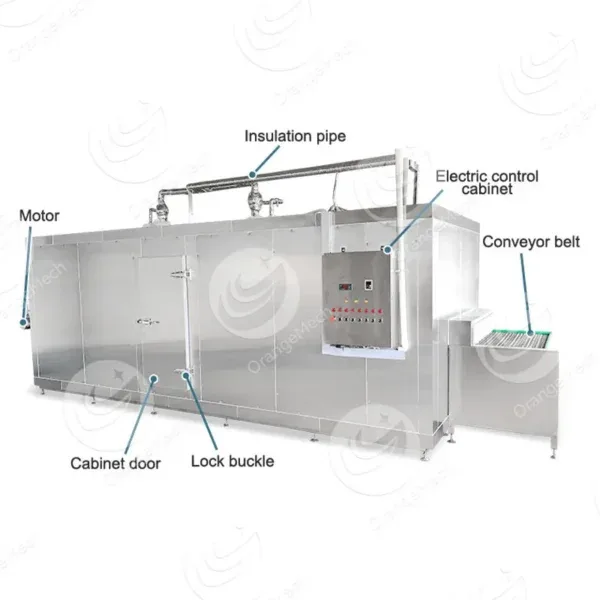
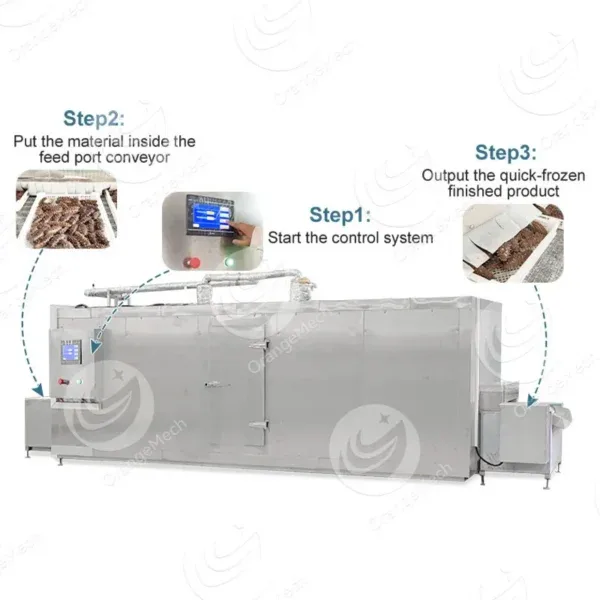
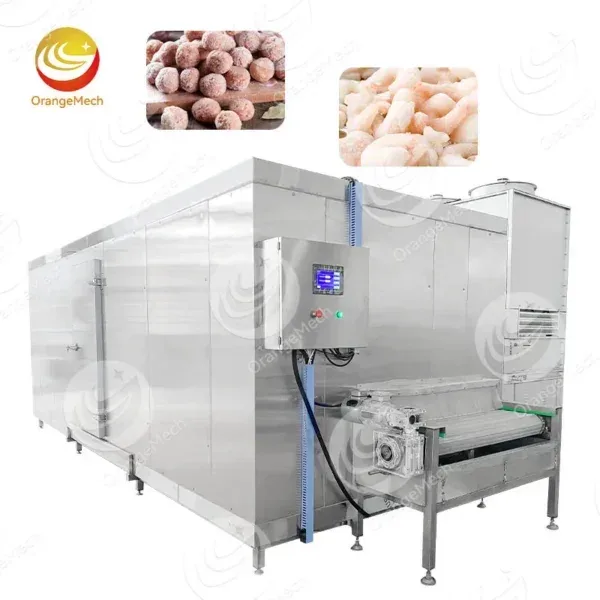
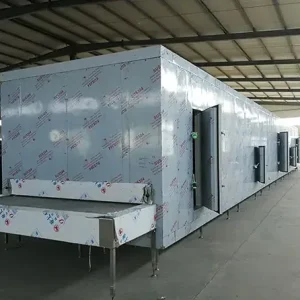
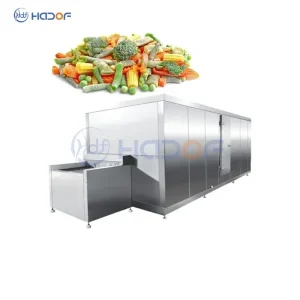
Product spreads in a shallow single layer on a perforated belt entering an insulated tunnel. Directly below the infeed, a bath or cascade zone immerses the surface briefly — crust freezing locks the shape before pieces can weld together. Downstream, banks of spray headers atomise liquid nitrogen onto the moving bed; the LN2 evaporates as it absorbs heat, the exhaust gas fans pull the cold vapour counter-current over the incoming product to pre-cool it, and temperature probes along the tunnel modulate spray valves to hit the target core temperature — typically -18 °C at exit with product centre colder. Nitrogen consumption per kilo of product, not power, is the operating equation: roughly 0.8-1.2 kg LN2 per kg of product depending on infeed temperature and packaging of the tunnel.
Suitable for
Premium berry freezers — raspberry, blueberry, strawberry — where drip loss and shape after thaw decide the price tier; diced and sliced fruit destined for dairy inclusion and bakery, where soft flesh collapses under slow freezing; high-value prepared vegetables and herbs for upscale food service; seafood processors running shrimp and scallop IQF at small-to-medium scale without the capital of a mechanical IQF line; pilot plants and seasonal lines where freezing weeks per year do not justify a compressor hall; and lines needing true IQF fast because product enters at ambient, not after a pre-cool.
Not suitable for
Bulk commodity volumes — above roughly one tonne per hour continuous, LN2 cost per kilo overtakes mechanical freezing and keeps climbing; products needing long frozen storage before sale, where the freeze speed benefit erodes and the cost remains; sites without a reliable liquid nitrogen supply contract, because the machine is only as good as the gas logistics behind it; and buyers expecting low running cost on a 24/7 schedule — this is a premium-speed tool, not a cheapest-kilo tool.
Material & compliance
Tunnel, belt and contact parts in SUS304 (EN 1.4301); insulation panels food-safe and vapour-sealed, because a wet tunnel is an ice tunnel within a shift. Oxygen-depletion monitoring and alarms are integral — nitrogen is invisible and a leaking tunnel is a genuinely dangerous room. Belt washdown access and CIP-friendly headers.
Supplied with CE declaration of conformity and DoC on request; material certificate EN 10204 3.1 available for contact parts.
Selection notes
Ask for LN2 consumption at your product, your infeed temperature and your exit spec — the quoted number on demo product with pre-chilled infeed will flatter the machine by half. Ask how spray valves modulate and what happens when the line stops mid-freeze. Check the oxygen monitoring system by name, its alarm levels and its independent power source. Ask about belt cleaning and whether the tunnel opens fully for washdown. Confirm the local gas supplier’s delivery reliability and tank rental terms before you sign for the machine — the freezer contract is half a contract without the gas contract.
When you should not buy this machine: If your volume justifies a mechanical IQF tunnel — roughly a tonne per hour and steady — buy the compressor line and spend the gas money on power. And if your buyer grades on price per kilo of frozen commodity, nitrogen speed buys a premium nobody in that channel pays.
Key specifications
| Parameter | Value |
| Capacity | 100-800 kg/h by model (TYPICAL, confirm with factory) |
| Refrigerant | Liquid nitrogen, spray + crust-freeze immersion |
| LN2 consumption | 0.8-1.2 kg per kg product (TYPICAL) |
| Freeze time | 5-15 min to -18 °C core (TYPICAL) |
| Exit temperature | ≤-18 °C core, colder centre option |
| Belt width | 600-1200 mm by model |
| Contact material | SUS304 (EN 1.4301) |
| Power supply | 380V/3P/50Hz, fans and controls only |
Specification values are industry-typical ranges for this machine class and are not verified against a specific factory datasheet. Replace them with measured factory data before publication.
FAQ
How does LN2 cost compare to mechanical freezing?
At premium volumes, nitrogen runs roughly three to eight times the energy-equivalent cost of compressors — which is why the machine belongs to high-value product and partial shifts. Run your numbers per kilo frozen, not per hour: LN2 price, consumption at your infeed, and how much extra the market pays for the better cell structure.
Is a nitrogen tunnel dangerous?
Managed, no — unmanaged, seriously. Nitrogen displaces oxygen silently, so the safety case lives in oxygen depletion sensors, alarms, ventilation and interlocked access. Treat the monitor as part of the machine and audit its power independence; that checklist is what separates a premium freezer from a sealed hazard.
Can it freeze packaged product?
Small, uncovered trays yes; sealed retail packs poorly — packaging insulates, and spray freezing works by touching product. Freeze naked, then pack, or accept longer dwell and higher gas use for packed formats.
Related equipment
This unit is one stage of a complete processing line. For the full range of freezing equipment, or to compare this model against the Cryogenic Tunnel Freezer 1000 kg/h, see the complete equipment catalogue. Capacity, material grade and utility requirements can be confirmed through a quote request.
Reviews
There are no reviews yet.