IQF Tunnel Freezer 1500 kg/h
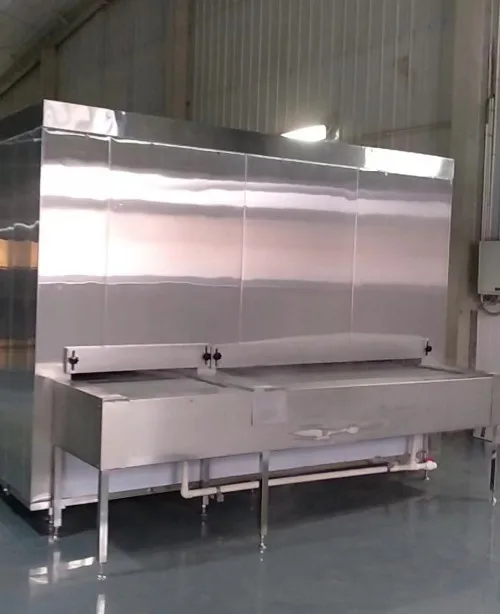
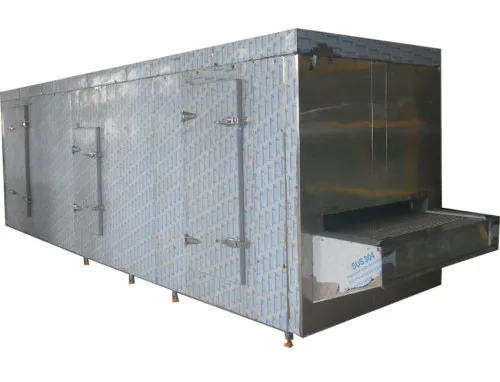
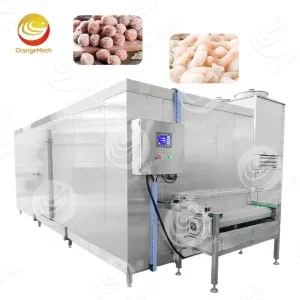
Tunnel freezer that carries product through an insulated enclosure on a belt while high-velocity cold air is driven up through the bed, freezing each piece separately so the product discharges free-flowing rather than as a solid block.
How it works
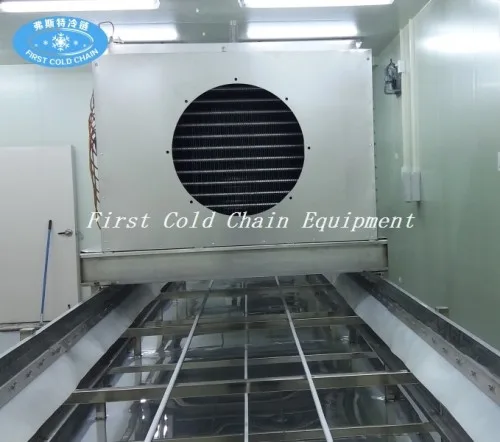
Product is spread evenly across the belt at the infeed and carried into the tunnel. Fans circulate air through an evaporator coil and force it up through the belt and the product bed at speed. The air velocity is high enough to lift and separate the pieces — fluidisation — so every surface is exposed to cold air rather than to neighbouring pieces. Product freezes as it travels, and discharges at the outlet at a frozen core temperature, still separate.
Because each piece is frozen alone, the product stays free-flowing: it can be portioned, weighed and packed without thawing a block. That is what IQF means, and it is the reason a tunnel freezer is specified for berries, diced vegetables and similar piece product.
Suitable for
Berries, diced vegetables, peas, sweetcorn and cut beans; any piece product where free-flowing discharge matters for packing; lines feeding retail bags or food service packs; product that will be portioned downstream; plants replacing plate or block freezing where the customer now wants IQF.
Not suitable for
Product that damages in a fluidised bed — soft, wet or easily abraded pieces; very leafy or light product that blows rather than fluidises; large or heavy pieces the air cannot lift, which should go on a spiral or a belt freezer instead; liquid or purée product; plants without refrigeration capacity for the duty, which is the real constraint on any freezer specification.
Material & compliance
Belt, frame, enclosure panels and evaporator housing in SUS304 (EN 1.4301); insulation panels with food-safe facing and vapour barrier. Enclosure designed for washdown with drainage; belt designed for CIP or washdown; access doors interlocked; evaporator arranged for defrost and drainage.
Supplied with CE declaration of conformity and DoC on request; material certificate EN 10204 3.1 available for contact parts.
Selection notes
Freezing capacity is a refrigeration question before it is a machine question — the tonnage you can freeze is set by the evaporating temperature and the plant’s refrigeration duty, so start there and not from belt length. Ask what the product loses in weight through the tunnel, because dehydration loss in a high-velocity bed is real and it is product you paid for. Check the belt design and how it is cleaned, since freezing is a wet, cold environment where hygiene failures hide.
When you should not buy this machine: If your product is large, heavy or delicate, a fluidised bed will either fail to lift it or damage it — a spiral or a straight belt freezer without fluidisation is the right choice. Also skip it if your refrigeration plant cannot hold the evaporating temperature at peak load: an undersized plant gives you warm product rather than slower freezing.
Key specifications
| Parameter | Value |
| Capacity | 300-6000 kg/h by model (TYPICAL, confirm with factory) |
| Belt width | 600-1600 mm by model (TYPICAL) |
| In-feed temperature | +10 to +15 °C (TYPICAL) |
| Out-feed temperature | -18 °C core (TYPICAL) |
| Freezing time | 5-30 min by product (TYPICAL) |
| Evaporating temperature | -35 to -45 °C by duty (TYPICAL) |
| Contact material | SUS304 (EN 1.4301) |
Specification values are industry-typical ranges for this machine class and are not verified against a specific factory datasheet. Replace them with measured factory data before publication.
FAQ
What does IQF actually guarantee?
That pieces leave the freezer separate and stay separate in the bag. It says nothing about the freezing rate itself, which is a function of air temperature, velocity and piece size.
Why am I losing weight through the freezer?
Dehydration. High air velocity across a wet surface removes water as well as heat; some loss is unavoidable, and excessive loss usually means too long a residence time or too dry an air stream.
Can I run different products in the same tunnel?
Yes, with different belt speeds and temperatures. The limit is bed depth and fluidisation behaviour — light and heavy products need different air handling, and that is what decides whether one tunnel serves both.
Related equipment
This unit is one stage of a complete processing line. For the full range of freezing equipment, or to compare this model against the IQF Fluidized Bed Freezer 1000 kg/h, see the complete equipment catalogue. Capacity, material grade and utility requirements can be confirmed through a quote request.
Reviews
There are no reviews yet.