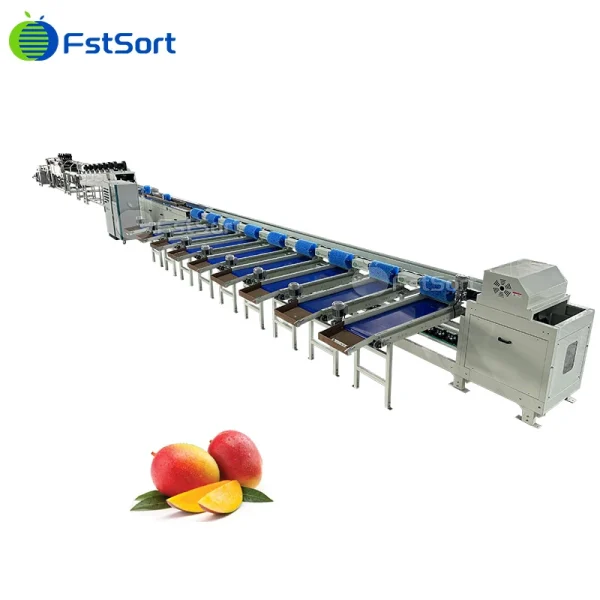
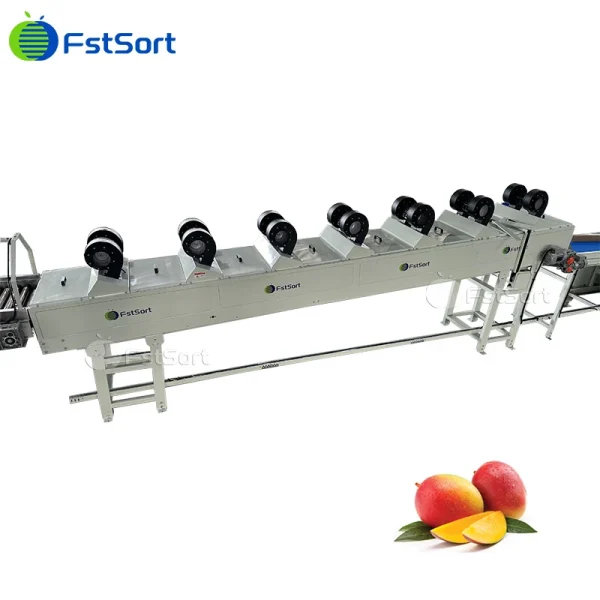
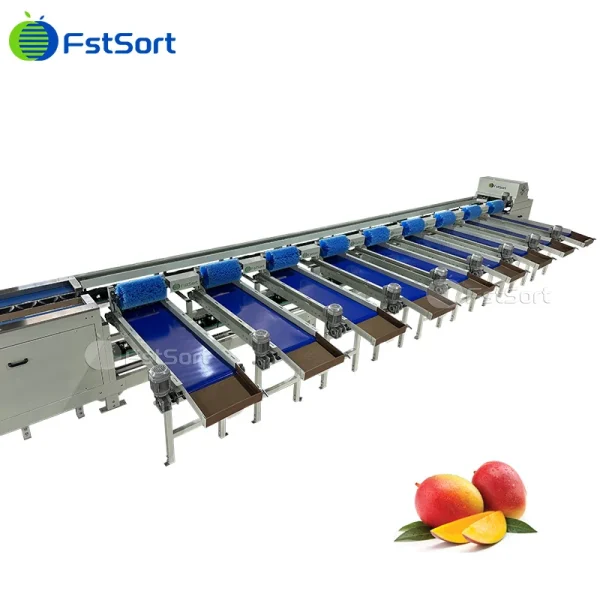
Mango Grading Machine 4 t/h
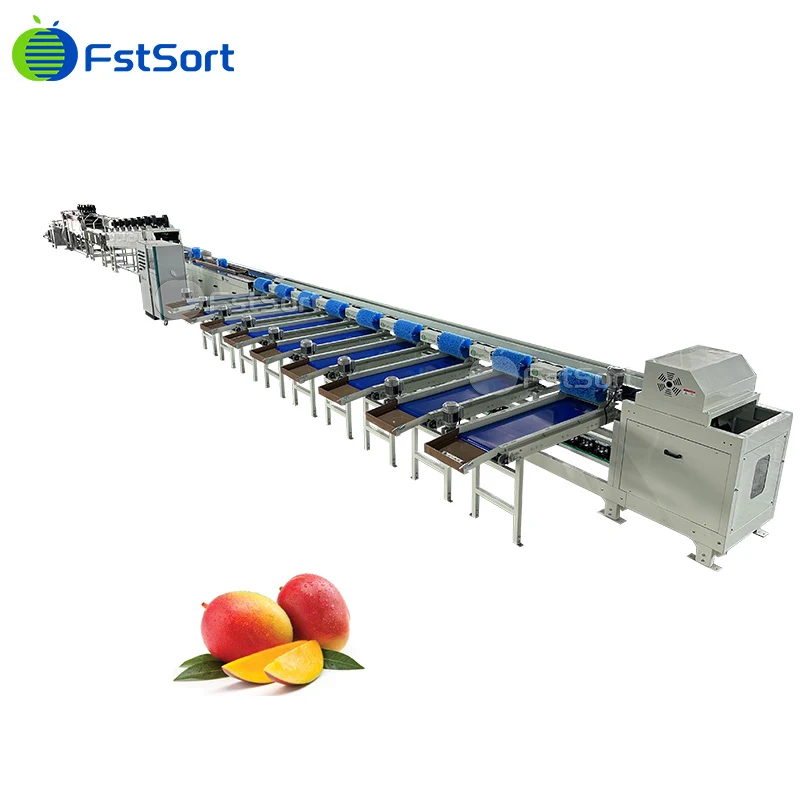
Mango sells by count per tray and bruises by reputation — the two facts that define its grading. Buyers specify tray counts that imply weight classes within grams, while the fruit’s skin and flesh mark at pressures ordinary machinery applies. A mango grading machine threads that needle: soft carriers or weighing cups that present each fruit gently, classes split at the gram-level the tray spec demands, and throughput that clears a harvest peak in a shift instead of a week.
How it works
Mangoes feed single-layer onto the grading bed. Two principles run: carrier systems with shaped soft cups that hold each fruit through staged sizing gates, and electronic weight grading where individual carriers cross a weigh cell that opens the correct lane. Weight grading dominates export mango — tray counts key off grams, and a 10 g error moves the class. Both systems share the same contact logic: soft food-grade surfaces, matched speeds so fruit rolls rather than drags, and cushioned drops into lanes. Classes discharge to packing tables or tray lines, and settings are marked and repeatable across the season’s changing varieties.
Suitable for
Export mango packers meeting strict tray-count specifications; processing intake splitting fruit by size for ripening, cutting or pulping lines; co-operatives consolidating member harvest into uniform buyer lots; multi-crop tropical packhouses re-gapping between mango, papaya and avocado seasons; ripening rooms feeding graded fruit to retail schedules.
Not suitable for
Dirty or wet field fruit — washing and drying come first; quality grading — colour, sap burn and defects need inspection tables or optics upstream; over-soft ripe fruit below any carrier’s bruise tolerance, which belongs in pulp; and small farm-gate volumes where sizing rings and a table remain honest tools.
Material & compliance
Frame, carriers and chutes in SUS304 (EN 1.4301) or food-grade contact surfaces; fruit-contact cups food-grade soft compound with cushioned drops; sealed washdown drives; class settings marked and repeatable; weight-grade electronics with calibration records for trade use.
Supplied with CE declaration of conformity and DoC on request; food-contact declarations for carrier materials.
Selection notes
Decide diameter versus weight first: tray-count buyers need weight classes, and cup sizers that only split diameter will miss the spec by a tray count. Ask for the weigh-cell accuracy and repeatability at your fruit range — grams matter. Confirm carrier size changeover between varieties, since mango spans 150 g to 800 g and a bed that fits one misses the other. Check sap handling — fresh-picked mangoes bleed sap that stains, so washing must precede grading in layout and schedule. And verify throughput on your heaviest fruit, since carrier loading sets the real rate.
When you should not buy this machine: If your mango volume is orchard-gate scale through a short season, sizing rings and trained hands at pack tables cost less than any bed. And if your buyer takes field-run fruit by weight lots, the machine solves a problem nobody pays for.
Key specifications
| Parameter | Value |
| Capacity | 2000-6000 kg/h by fruit size and lanes (TYPICAL, confirm with factory) |
| Fruit range | 150-800 g by carrier set (TYPICAL) |
| Grading | Diameter gates or electronic weight cells (TYPICAL) |
| Classes | 4-8 outlets (TYPICAL) |
| Contact material | SUS304 (EN 1.4301), soft food-grade carriers |
| Power supply | 380V/3P/50Hz, 2-5 kW class |
Specification values are industry-typical ranges for this machine class and are not verified against a specific factory datasheet. Replace them with measured factory data before publication.
FAQ
Weight grading or diameter grading for export mango?
Weight — tray counts are weight-driven, and diameter classes drift by variety. Electronic weight grading costs more but hits the count-per-tray spec directly; diameter beds suit processing split where exact counts matter less. Choose by buyer spec, not by price.
How is sap burn avoided during grading?
Layout: wash or at least de-sap before grading, because fresh sap stains carriers and fruit alike. Machines handle clean fruit; the process owns the sap. Build the wash stage into the line before the sizer.
Can one machine serve papaya and avocado too?
Often yes — weight grading is fruit-agnostic within the carrier range. Confirm carrier sizes, drop heights and throughput per crop at trial, since bruise sensitivity differs more between crops than the mechanics do.
Related equipment
This unit is one stage of a complete processing line. For the full range of sorting and grading equipment, or to compare this model against the Weight Grading Machine 3000 kg/h, see the complete equipment catalogue. Capacity, material grade and utility requirements can be confirmed through a quote request.
Reviews
There are no reviews yet.