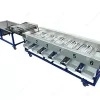
Drum Grading Machine 5000 kg/h
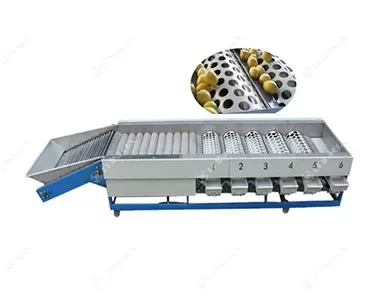
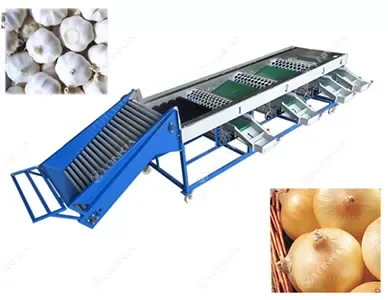
Not every line needs a weight grader. Where product is round, sold by count-size, and volume is high, the rotating perforated drum is the honest answer: fruit enters at the small end, tumbles down a cascade of drums with enlarging holes, and falls through the first hole it fits. No load cells, no software, no calibration drift — just geometry, running.
How it works
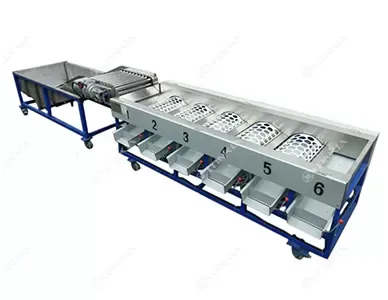
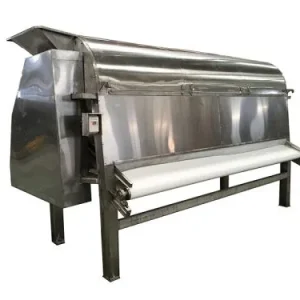
A bank of drums — typically four to six — is mounted on a slight incline, each drum perforated with holes larger than the one before, and each rotating on its own axis. Product is fed into the smallest-hole drum and travels its length, tumbling continuously; pieces smaller than the holes fall through to a collection conveyor beneath that drum, while oversized pieces lift out at the drum’s end and enter the next drum with larger holes. The sequence repeats down the bank, and the final grade — the oversize — leaves the last drum’s end. Grading accuracy is set by hole size and by how cleanly product tumbles rather than bridges; drum speed and brush strips against the drum surface keep the holes clear. Sizes are changed by swapping drum sets.
Suitable for
Apples, onions, citrus, potatoes and tomatoes sold by size count into retail or processing; farm-level and packhouse grading where electronics budget is better spent elsewhere; pre-grading ahead of a weight grader, taking the coarse split off cheaply; any line where simplicity and uptime outrank the last gram of accuracy — a drum grader has essentially one wearing decision (drum sets) and no calibration.
Not suitable for
Elongated or irregular product that can pass a hole end-on at the wrong orientation — potatoes vary enough that drums grade loosely by comparison with a weight grader; operations selling on exact weight specification, where a weight grader is the correct machine; fragile, fully ripe fruit that bruises under tumbling, which suits gentler roller grading; anyone expecting frequent size changes on one drum set — sizes are hardware here.
Material & compliance
Drums, frame, chutes and collection conveyors in SUS304 (EN 1.4301) for product-contact parts; hole edges deburred to prevent skin damage. Drive guards on every drum; emergency stops at feed and discharge. Brush strips food-grade. The design is open by nature — most of the machine is visible and washable, which is one of its quiet advantages.
Supplied with CE declaration of conformity and DoC on request; material certificate EN 10204 3.1 available for contact parts.
Selection notes
Ask what grading accuracy the drum set achieves on your product and size spread, measured on your fruit rather than on onions. Ask how drum sets are specified, priced and swapped — this is the machine’s only real consumable and its only size-change mechanism. Check the tumble action for bruising risk on your fruit’s firmness. Check the collection conveyors’ arrangement against your packing stations. And check the machine’s total width honestly — drum banks are wide, and floor plans underestimate them.
When you should not buy this machine: If you grade by weight for a packhouse contract, buy the weight grader — drums approximate size, contracts specify grams. And if your product is elongated (cucumbers, carrots), a drum will sort it by diameter but the end-on pass-through problem means loose grades; roller or weight grading fits better.
Key specifications
| Parameter | Value |
| Capacity | 3000-10000 kg/h by drum bank size (TYPICAL, confirm with factory) |
| Grades | 4-6 size grades by drum count (TYPICAL) |
| Hole size range | 40-140 mm by product and drum set (TYPICAL) |
| Drum speed | Adjustable per bank |
| Grading accuracy | 90-95 % within grade on round fruit (TYPICAL) |
| Size change | Drum set replacement |
| Contact material | SUS304 (EN 1.4301) |
| Power supply | 380V/3P/50Hz or 415V/3P/50Hz, customizable |
Specification values are industry-typical ranges for this machine class and are not verified against a specific factory datasheet. Replace them with measured factory data before publication.
FAQ
How accurate is drum grading compared with a weight grader?
Looser, and honestly so. On round fruit a well-set drum bank puts 90-95 % of pieces within grade; a weight grader puts essentially all of them there. Whether that difference is worth a weight grader’s cost depends entirely on your sales contract, not on the technology ladder.
Can hole sizes be changed without new drums?
Generally no — the holes are the specification. Some designs use interchangeable drum sections or liners, which softens the cost, but plan on drum sets as a per-product-range purchase and price them at quotation stage.
Does the tumbling bruise fruit?
It can, on fully ripe or thin-skinned fruit. Drum speed and drop heights onto the collection conveyors are the levers, and a good supplier sets both against your fruit’s firmness. The cut test here is a bruise test: run your fruit, then look at it the next day.
Related equipment
This unit is one stage of a complete processing line. For the full range of sorting and grading equipment, or to compare this model against the Roller Size Grading Machine 3000 kg/h, see the complete equipment catalogue. Capacity, material grade and utility requirements can be confirmed through a quote request.
Reviews
There are no reviews yet.