
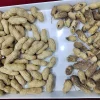
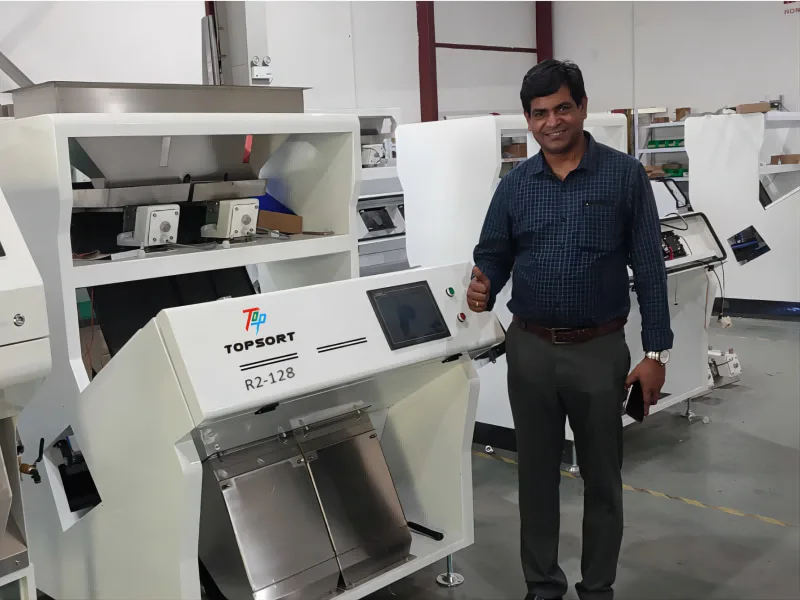
Color Sorting Machine 2 t/h
A sack of dried apple rings, blanched peanuts or dehydrated carrot dices never fails uniformly — it fails in patches, a few browned chips, a bruised kernel, a foreign seed. Sorting those out by hand costs cents per kilo in wages and still misses enough that a buyer rejects the lot. A color sorting machine looks at every single particle, decides in milliseconds and removes the defect with a puff of air, so the leaving grade is a setting, not a hope.
How it works
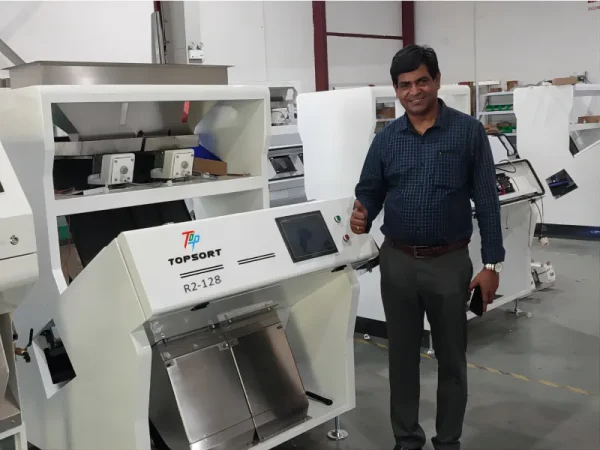
Product is fed by vibrating hopper into machined channels and slides into free fall through an inspection tunnel. High-resolution RGB cameras — one per side, so both faces are judged — illuminate and photograph each particle against a calibrated background; the processor compares hue, brightness and size against a learned acceptance profile in a few milliseconds. Particles that fail trigger an air ejector nozzle array in the ejection zone, which fires a precise blast to knock the reject into a waste chute while accepted product continues to the good outlet. Modern machines re-inspect rejects automatically, so good product blown out by mistake gets a second chance. Chute count sets capacity — a two-tonne-per-hour machine is typically a multi-chute frame running parallel channels.
Suitable for
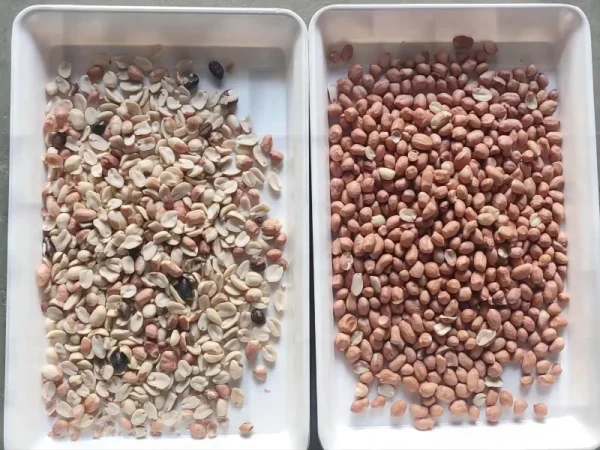
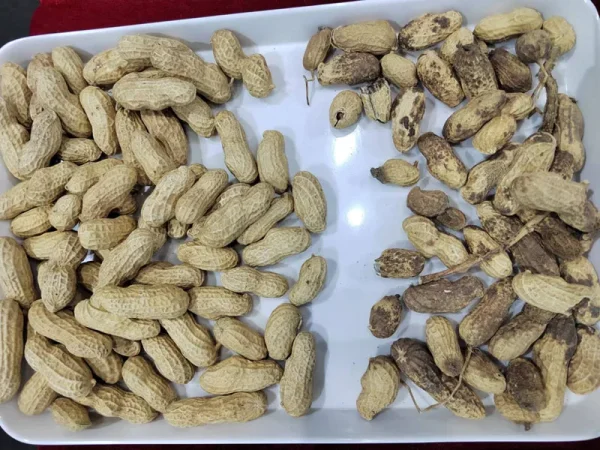
Dehydrated vegetable plants cleaning dices, flakes and rings of browned or scorched particles before packing; nut processors removing shrivelled kernels, shell fragments and discolouration from blanched peanuts, walnuts and almonds; dried fruit lines sorting apple rings, raisins, jujube and berry product where buyer specs name colour deviation explicitly; seed and spice houses separating foreign seed and stalk; any line where the buyer’s contract states a defect tolerance in parts per thousand and you need machine evidence you met it.
Not suitable for
Fresh, wet or washed produce — water film and specular shine blind optical sorters built for dry granular product; particles below roughly two millimetres, where channel flow becomes unstable and air ejectors miss; defects that colour cannot see, such as internal insect damage or hollow kernels — those need X-ray or an inspection conveyor with human eyes; buyers whose only concern is size, which a grader does cheaper.
Material & compliance
Contact surfaces — chutes, hoppers, vibratory pans — in SUS304 (EN 1.4301) with food-safe liners; machine built for dry, dust-laden environments with sealed optics and filtered air supply, because dehydrated-plant dust destroys unprotected cameras. Compressed air touching product must be oil-free and filtered to food-grade standard.
Supplied with CE declaration of conformity and DoC on request; material certificate EN 10204 3.1 available for contact parts.
Selection notes
Ask for a sorting test on your own defect sample, not the factory’s demo material — acceptance curves differ wildly between a pale almond and a dark raisin. Ask what the quoted capacity assumes at which carryover rate, because a sorter pushed past its channel capacity ejects good product with the bad. Check the ejector valve brand, its rated life in cycles and the cost of a replacement set — valves are the consumable. Check dust protection class on the optical box and whether the machine self-cleans lenses. Ask for re-inspection of rejects as standard, not an option; the first-pass carryover number alone understates true yield.
When you should not buy this machine: If your volumes are under a few hundred kilos a day, a sorting table and honest wages remain cheaper than leased optics. And if your defect is dirt and stones rather than colour, a destoner or aspirator does that job for a fraction of the price — buy the sorter for the defects only optics can see.
Key specifications
| Parameter | Value |
| Capacity | 1-5 t/h by chute count (TYPICAL, confirm with factory) |
| Cameras | RGB CCD, dual-side inspection (TYPICAL) |
| Ejector response | ≤1 ms valve, compressed air 0.6-0.8 MPa |
| Carryover (good in reject) | 3:1 to 10:1 with re-inspection (TYPICAL) |
| Sorting accuracy | 99%+ on calibrated defects (TYPICAL) |
| Particle range | 2-25 mm dry granular product |
| Contact material | SUS304 (EN 1.4301), food-grade channel liners |
| Power supply | 220V/1P + clean dry air supply |
Specification values are industry-typical ranges for this machine class and are not verified against a specific factory datasheet. Replace them with measured factory data before publication.
FAQ
Can one machine sort both peanuts and dried apple rings?
Physically yes with a chute change and a new recipe, but each product has its own acceptance profile, capacity point and valve timing. Budget changeover time and confirm your dealer tunes a recipe per product on your samples — a sorter sold as ‘universal’ without tuning disappoints.
How much compressed air does it use?
Air is the main running cost: typically 0.1-0.4 cubic metres per minute per valve bank depending on reject rate, which is why a dirty input stream doubles your air bill. Clean the product with an aspirator and screen first, and the sorter only touches the true colour defects.
What is carryover and why should I care?
Carryover is how much good product ends up in the reject stream. A machine ejecting aggressively shows a high accuracy number while quietly throwing away 5% of your yield. Ask for the paired numbers — accuracy and carryover — on your sample, and make re-inspection standard.
Related equipment
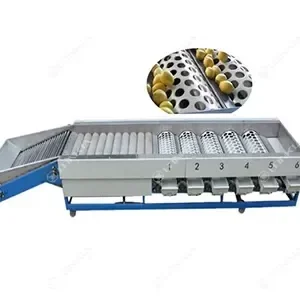
This unit is one stage of a complete processing line. For the full range of sorting and grading equipment, or to compare this model against the Inspection and Sorting Conveyor 1500 kg/h, see the complete equipment catalogue. Capacity, material grade and utility requirements can be confirmed through a quote request.
Reviews
There are no reviews yet.