Plate Freezer
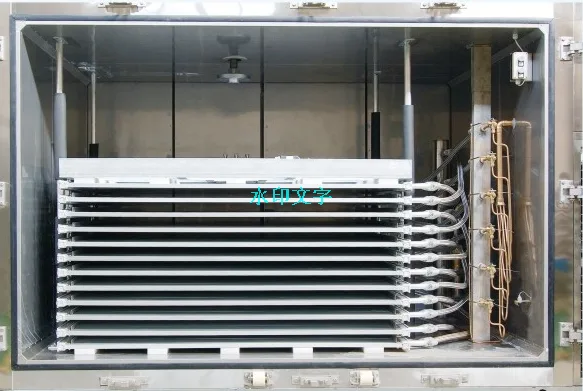
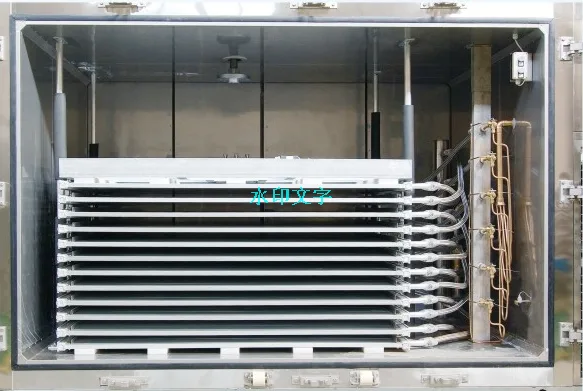
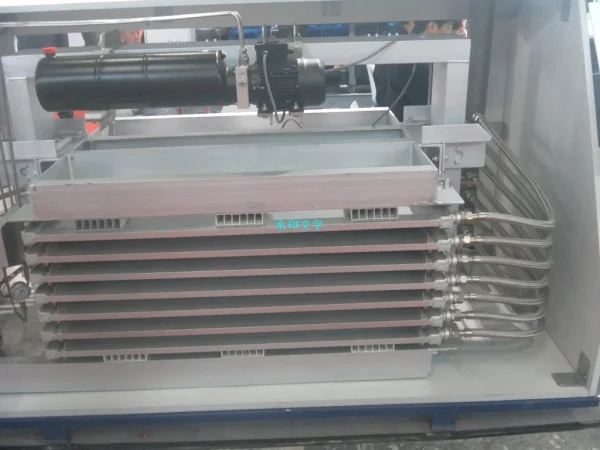
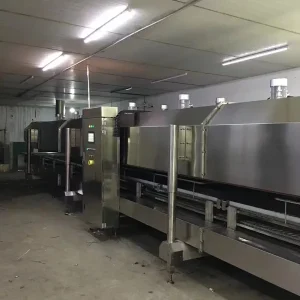
Contact plate freezer that presses product between hollow refrigerated plates, removing heat by conduction rather than by blowing cold air over it.
How it works
Product — usually in cartons, trays or formed blocks — is loaded between horizontal plates. A hydraulic ram closes the stack so the plates contact the product surfaces, and refrigerant circulating inside the plates draws heat out by conduction. Because there is no air gap, heat transfer is far faster than in an air-blast freezer. When the cycle ends, the stack opens and the frozen blocks are unloaded.
Contact is everything: an air gap or a deformed carton insulates the product, and those pieces come out soft.
Suitable for
Packaged blocks of puree, pulp or concentrate; tray-packed berries and vegetables; fish and formed blocks; product where low dehydration loss and a compact footprint matter; plants with limited floor area.
Not suitable for
Individually quick-frozen loose pieces, which need a fluidised bed or a tunnel; irregular or compressible product that will not contact the plates evenly; very high throughput lines where batch loading becomes the bottleneck.
Material & compliance
Plates, frame and product-contact surfaces in SUS304 (EN 1.4301); hydraulic system food-grade where contact risk exists. Refrigerant plant documentation supplied per the selected refrigerant; ammonia systems carry the additional safety documentation required.
Supplied with CE declaration of conformity and DoC on request; material certificate EN 10204 3.1 available for contact parts.
Selection notes
Size on block thickness, not on kg/h — freezing time rises with the square of thickness, so a thicker block costs far more than proportionally more time. Check plate flatness and hydraulic pressure, because uneven loading is the main cause of soft blocks. Ask about defrost and how often the plates need cleaning between product changes.
When you should not buy this machine: If you sell IQF loose pieces, a plate freezer is the wrong tool — it makes blocks. Also skip it if your packaging is not flat and rigid; uneven contact leaves soft spots that will be found at the customer’s end, not yours.
Key specifications
| Parameter | Value |
| Capacity | 300-3000 kg/h by model and cycle (TYPICAL, confirm with factory) |
| Plate size | 600×800 mm to 1200×1000 mm (TYPICAL) |
| Evaporating temperature | -35 to -45 °C (TYPICAL) |
| Freezing cycle | 20-90 min by product thickness (TYPICAL) |
| Refrigerant | Ammonia (NH3), CO2 (R744) or HFC (TYPICAL) |
| Contact material | SUS304 (EN 1.4301) |
Specification values are industry-typical ranges for this machine class and are not verified against a specific factory datasheet. Replace them with measured factory data before publication.
FAQ
Plate freezer or IQF tunnel — which do I need?
If the product must stay free-flowing and individually frozen, use an IQF tunnel or fluidised bed. If it is going into a block, carton or tray and will be re-melted or re-processed later, a plate freezer is faster and more energy-efficient per kg.
Why are some blocks soft in the middle?
Poor plate contact or excessive block thickness. Check carton flatness, loading pattern and hydraulic pressure before lowering the refrigerant temperature — conduction, not air temperature, is the limiting factor.
How much product dehydration occurs?
Very little compared with air-blast freezing, because the product is enclosed and there is no air sweeping over it. That is one of the main reasons to choose contact freezing for high-value puree blocks.
Related equipment
This unit is one stage of a complete processing line. For the full range of freezing equipment, or to compare this model against the Spiral Belt Freezer 1500 kg/h, see the complete equipment catalogue. Capacity, material grade and utility requirements can be confirmed through a quote request.
Reviews
There are no reviews yet.