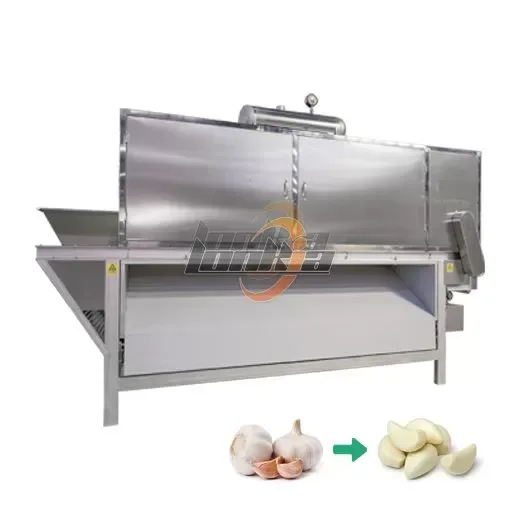

Garlic Peeling Machine 300 kg/h
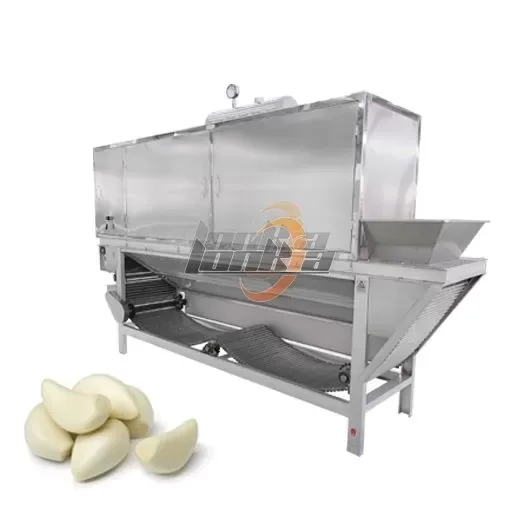
Dry peeling unit that takes skins off separated cloves. It is the machine that turned peeled garlic from a labour operation into a commodity, and it does it without water and without cutting — two facts that decide what the peeled clove is worth downstream.
How it works
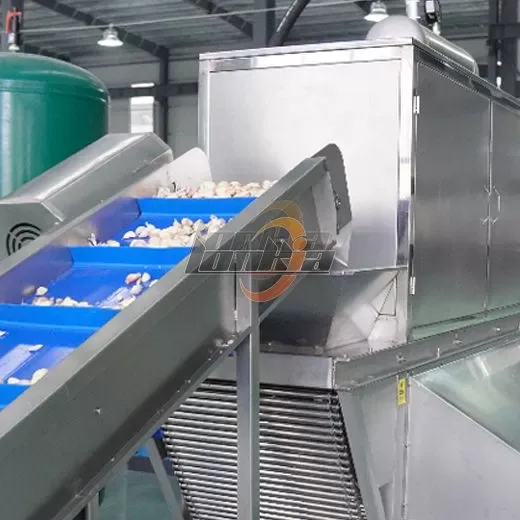
Separated, graded cloves are fed into a chamber where one of two methods runs. The most common is compressed-air blowing: high-velocity air jets shock the skin off the clove and the skin is aspirated away, leaving the clove whole. The alternative is dry friction, where cloves tumble against food-grade rubber surfaces and the skin abrades off. Neither method cuts, which is the point — a cut clove oxidises, loses shelf life and reads as a defect.
The air-blowing route needs a compressor sized to the machine, and that compressor is the largest single cost in the installation. The skin stream is continuous and bulky, and goes to a collection bag or cyclone. Output goes directly to packing, mincing, drying or further processing without a washing step.
Suitable for
Garlic peeling operations feeding fresh peeled-clove packing; garlic lines supplying minced, sliced or paste products; drying lines where peeled cloves go to a dryer for granule or powder production; operations replacing hand peeling at any meaningful volume, because hand peeling of garlic is slow and leaves residue on the clove; plants handling graded cloves with a separator upstream.
Not suitable for
Unseparated bulbs — the machine needs individual cloves, which is what a clove separator is for; wet or poorly cured garlic, whose skins stick and will not blow off; very small or mixed clove sizes without grading, because the air pattern and friction surfaces are set per size class; anyone without compressed air capacity or a route for the skin waste, which is the two things that make this machine work.
Material & compliance
Chamber, feed hopper and discharge chutes in SUS304 (EN 1.4301); friction surfaces in food-grade rubber as a replaceable consumable where friction peeling is used. Air circuit fitted with filtration and a pressure regulator; the machine opens for daily cleaning because garlic dust is hygroscopic and builds up fast. Skin collection by bag or cyclone, routed so dust does not discharge into the workroom.
Supplied with CE declaration of conformity and DoC on request; material certificate EN 10204 3.1 available for contact parts.
Selection notes
Ask for the peeling rate measured on your garlic variety and moisture, not on a demo batch — the gap between 90 % and 98 % is the whole business case at commodity margins. Ask what compressor the machine needs, in free air delivery and pressure, and price that compressor before you sign; it is frequently larger than buyers expect. Check the clove damage rate, because a machine that peels everything and bruises a tenth of it has failed the actual specification. Check the skin collection route and whether the rubber surfaces are stocked as spares.
When you should not buy this machine: If your garlic arrives wet or poorly cured, fix the curing first — no peeling method works against skins that stick. And if your volume is a few bags a day, hand peeling is still honest economics; this machine earns its cost against labour hours, not against garlic.
Key specifications
| Parameter | Value |
| Capacity | 150-600 kg/h peeled cloves by model (TYPICAL, confirm with factory) |
| Peeling method | Compressed-air blowing or dry friction |
| Compressed air | 0.6-0.8 MPa, compressor sized by model (TYPICAL) |
| Peeling rate | 90-98 % by variety and clove size (TYPICAL) |
| Water use | None; dry process |
| Clove input | Separated cloves from a clove separator |
| Contact material | SUS304 (EN 1.4301) |
| Power supply | 380V/3P/50Hz or 415V/3P/50Hz, customizable |
Specification values are industry-typical ranges for this machine class and are not verified against a specific factory datasheet. Replace them with measured factory data before publication.
FAQ
Why is no water used?
Because water turns garlic skins into a sticky paste and adds a drying step plus a microbial load on the peeled clove. Dry peeling leaves the clove surface dry and gives it a longer shelf life, which is why the industry settled on it.
Do I need a clove separator as well?
Yes. The peeler takes individual cloves, not bulbs. A bulb separator runs ahead of it, and the separator’s job is to break the bulb without damaging the clove skin — the two machines are specified as a pair.
What is the real running cost?
Compressed air. Size the compressor to the machine’s stated free air delivery and run the hours; on most installations that dominates the electricity line, ahead of the peeler’s own motor.
Related equipment
This unit is one stage of a complete processing line. For the full range of washing and peeling equipment, or to compare this model against the Onion Peeling Machine 1000 kg/h, see the complete equipment catalogue. Capacity, material grade and utility requirements can be confirmed through a quote request.
Reviews
There are no reviews yet.