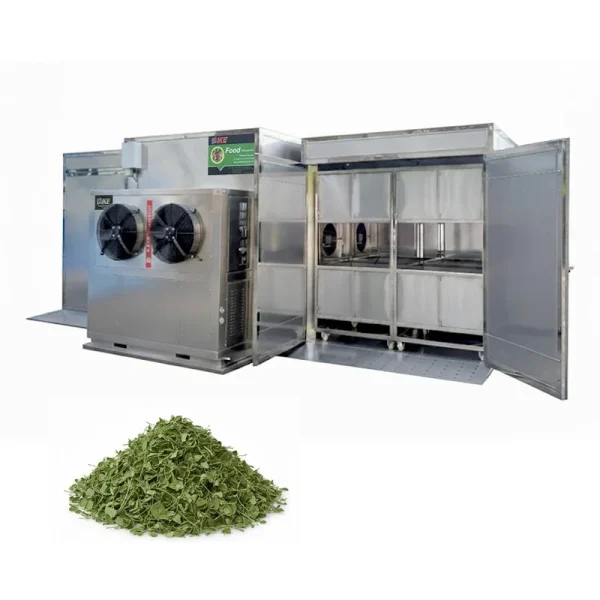
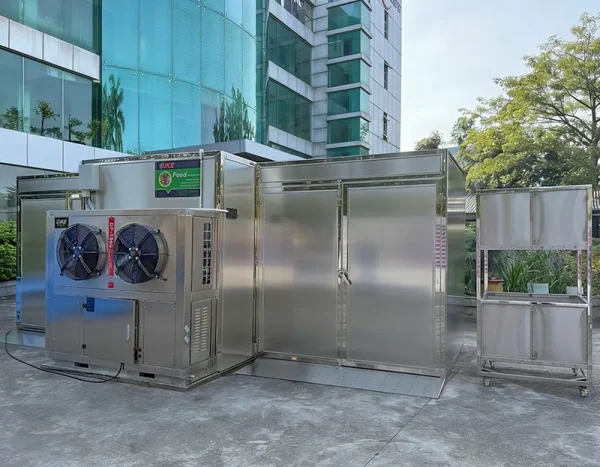
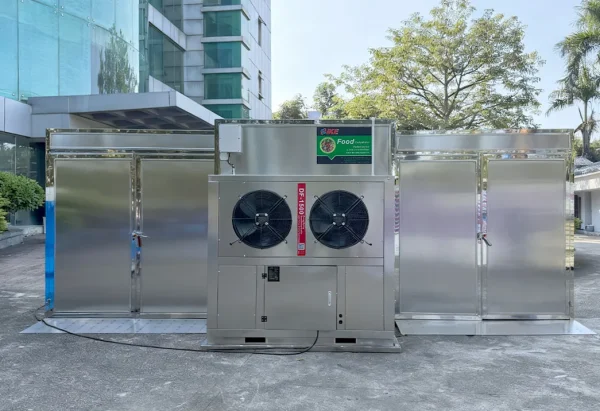
Herb Drying Machine 200 kg/h
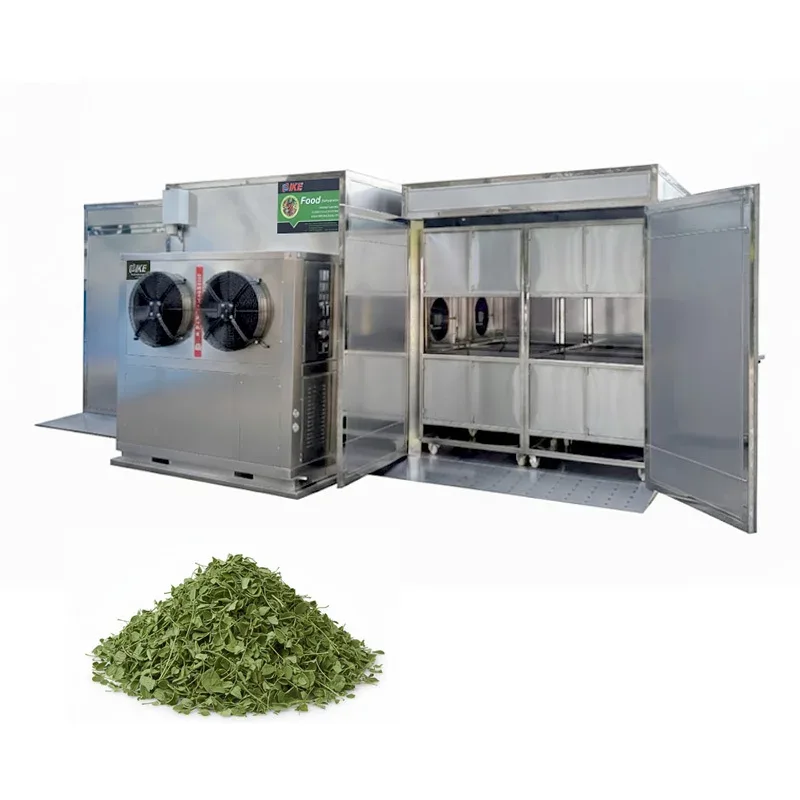
Herbs are the most fragile product in the drying hall. The valuable part is not the leaf mass but what the leaf carries — volatile oils that evaporate on a whim and chlorophyll that browns under impatience. A herb drying machine is therefore not a smaller hay dryer: it is a low-temperature, high-airflow machine that removes water slowly and politely, because the buyer’s first test is colour and the second is smell, and both are destroyed by heat applied in a hurry.
How it works
Washed, trimmed herbs are laid in shallow even layers — on trays in cabinet and tunnel dryers, or on wide-mesh belts in continuous machines. Air is heated modestly — most leaf herbs dry at 35-50 °C, well below vegetable profiles — and moved in volume across the product, with humidity vented steadily so the leaf never sits in its own damp. In multi-layer machines the product migrates top-to-bottom or the airflow alternates through layers to even the dry. Dwell runs hours; the endpoint is a leaf that crumbles at the midrib without blackening, typically down to 8-10% moisture. Cooling before packing is part of the cycle — warm herbs packed into bags sweat and discolour in the bag.
Suitable for
Culinary herb processors drying basil, parsley, mint, oregano, thyme, chives and mixes for retail and food service; medicinal and tea herb operations whose buyers specify colour and volatile content; spice blenders drying leaf components before milling; farm cooperatives adding value to herb crops that wilt unsold in two days.
Not suitable for
Essential-oil distillation, which wants steam and a still, not a dryer; high-moisture dense products — roots, barks, berries — that need vegetable-profile tunnels; artisan volumes without power supply discipline, because low-temperature drying still runs fans for hours; buyers comparing price per square metre against vegetable dryers — the airflow and control density that protect herbs are the price difference, and they are doing their job.
Material & compliance
Trays, belts and contact surfaces in SUS304 (EN 1.4301); airflow designed for even distribution across shallow layers, because a leaf dried unevenly is a two-grade product sorted by hand. Controls log temperature per zone — increasingly a documentation requirement for medicinal-grade buyers. Insulated panels keep the chamber stable against ambient swings, which matter more at 40 °C than at 70 °C.
Supplied with CE declaration of conformity and DoC on request; material certificate EN 10204 3.1 available for contact parts.
Selection notes
Ask for the machine’s airflow map or evenness figure across the drying area — herbs forgive a lot except uneven drying, which turns one tray green and the next brown. Ask the temperature floor: some cheap units cannot hold 40 °C stably, and the herbs know. Ask what the capacity number assumes — fresh leaf at what loading depth, and does the figure hold for your species. Check tray or belt cleaning and whether the design sheds leaf debris; herbs shed everywhere. Confirm cooling-before-packing is part of the offered cycle, not an afterthought.
When you should not buy this machine: If your buyer distils oil from the herb, sell to the still and skip the dryer. And if your real volumes are vegetables with a herb sideline, buy the vegetable tunnel and dry herbs in its gentlest zone — but know its floor temperature first, and accept the colour you get.
Key specifications
| Parameter | Value |
| Fresh capacity | 100-500 kg/h by model (TYPICAL, confirm with factory) |
| Drying temperature | 35-50 °C herb profile (TYPICAL) |
| Airflow | High-volume, even-distribution design |
| Dwell | 3-8 h by leaf type and loading (TYPICAL) |
| Format | Multi-tray cabinet / tunnel / continuous belt |
| Final moisture | 8-10% with cooling before pack (TYPICAL) |
| Contact material | SUS304 (EN 1.4301) |
| Power supply | 380V/3P/50Hz, 6-30 kW class |
Specification values are industry-typical ranges for this machine class and are not verified against a specific factory datasheet. Replace them with measured factory data before publication.
FAQ
Why do my dried herbs come out brown?
Heat and humidity, in that order. Too-high temperature browns chlorophyll; insufficient venting lets the leaf stew in damp air. Herbs want low heat, lots of moving air and honest humidity exhaust — check all three before blaming the leaf.
Can one dryer handle basil and roots like ginger?
Technically the machine heats air either way, but the profiles are far apart — basil at 40 °C for hours, ginger slices at 65 °C-plus. If both matter, buy a multi-zone machine and run them as different recipes, not one compromise setting.
What moisture should packed dried herbs be at?
Around 8-10%, cool to ambient before packing. Warmer than that and the bag fogs; wetter and the colour dulls in storage. Ask how the machine’s endpoint is measured and controlled — guesswork shows up in the bag.
Related equipment
This unit is one stage of a complete processing line. For the full range of drying and dehydration equipment, or to compare this model against the Heat Pump Dryer 500 kg/batch, see the complete equipment catalogue. Capacity, material grade and utility requirements can be confirmed through a quote request.
Reviews
There are no reviews yet.