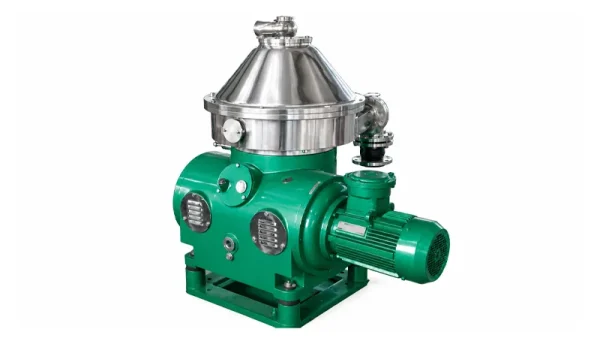
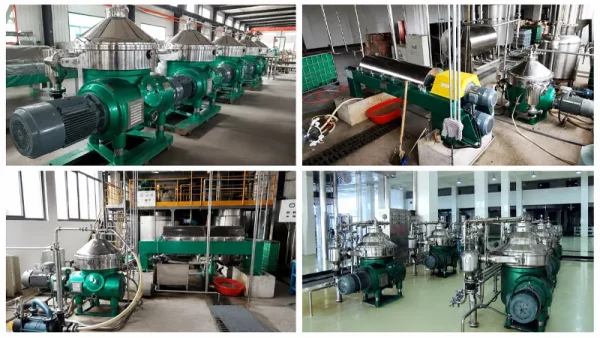
Juice Disc Separator 5000 L/h
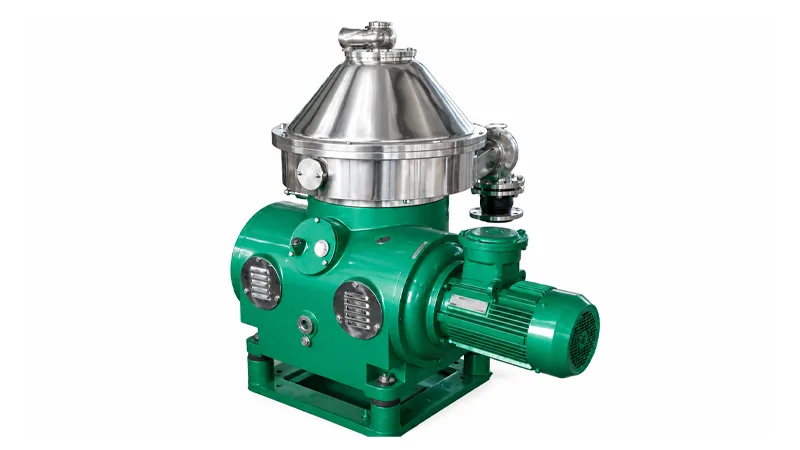
Continuous centrifugal separator that clarifies juice on the way to filtration or to the pasteuriser. Where filtration alone would blind quickly on a cloudy juice, a disc separator takes out the bulk of the suspended solids first, which is what makes a downstream filter or a sterile filter last.
How it works
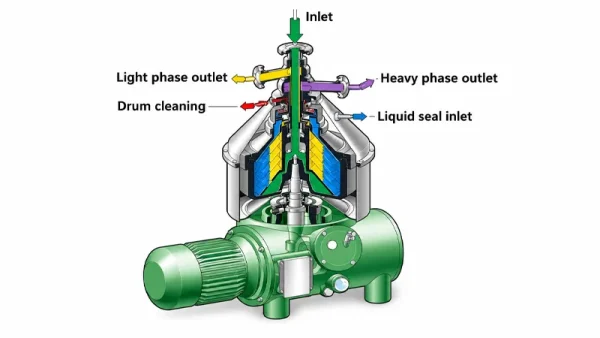
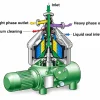
Juice enters a rapidly rotating bowl containing a stack of conical discs spaced a fraction of a millimetre apart. Under centrifugal force, the heavier suspended solids move outward along the disc surfaces and collect at the bowl wall, while the clarified juice moves inward and leaves through the top. The disc stack multiplies the effective settling area many times over, which is why the machine is compact for its throughput.
Solids have to leave the bowl eventually. Small machines are stopped and cleaned by hand; larger ones eject the accumulated solids periodically, either partially or fully, while running. The ejection interval is set against the solids load in the feed — an unusual thing to get right without measuring what is actually in the juice.
Suitable for
Clarifying pressed apple, pear and berry juice before filtration; citrus juice where the pulp level needs to be reduced to a specification; juice lines where a downstream filter or a sterile filter is protected from rapid blinding; plants that need continuous clarification rather than tank settling, which takes hours and floor space.
Not suitable for
Juice with a high or coarse pulp load, which fills the bowl faster than it can be ejected — that needs a screen or a decanter in front of it; product where the pulp is the selling point, such as a cloudy premium juice; very viscous concentrates; plants that cannot supply the utilities and the maintenance a high-speed centrifuge needs. A bowl spinning at speed is a piece of rotating equipment with real maintenance requirements, not a pump.
Material & compliance
Bowl, discs and product contact parts in SUS304 (EN 1.4301), with SUS316L (EN 1.4404) available for acidic product or high-chloride water; seals and gaskets in food-grade elastomer specified against FDA 21 CFR 175 where the destination market requires it. The bowl is a high-speed rotating assembly and must be supplied with its balancing and integrity documentation.
Supplied with CE declaration of conformity and DoC on request; material certificate EN 10204 3.1 available for contact parts.
Selection notes
Ask what inlet pulp level the machine tolerates, because that is the specification that decides whether you also need a screen or a decanter. Ask how solids are discharged and whether the ejection cycle is automatic at your solids load — a manual-clean machine on a continuous line is not a continuous machine. Check the water and air services the ejection needs, and check bowl service access, because it will be opened regularly.
When you should not buy this machine: If your juice is deliberately cloudy or high-pulp, this machine removes what you are selling. And if you have not measured the suspended solids in your feed, measure them first — every separator specification depends on that number, and guessing it is how plants end up with a machine that ejects every few minutes.
Key specifications
| Parameter | Value |
| Capacity | 3000-8000 L/h by clarity target (TYPICAL, confirm with factory) |
| Bowl speed | 6000-10000 rpm by model (TYPICAL) |
| Separation duty | Clarification; solids ejection by model |
| Solids discharge | Manual, partial or full automatic ejection |
| Inlet pulp tolerance | Limited; pre-screening usually required (TYPICAL) |
| Contact material | SUS304 (EN 1.4301); SUS316L on request |
| Power supply | 380V/3P/50Hz or 415V/3P/50Hz, customizable |
Specification values are industry-typical ranges for this machine class and are not verified against a specific factory datasheet. Replace them with measured factory data before publication.
FAQ
Is a disc separator the same as a decanter?
No. A decanter handles a high solids load and discharges a continuous stream of wet solids; a disc separator polishes a relatively clean feed to a high clarity, and holds or ejects the solids it collects. They are often used in sequence, not as alternatives.
Why does my separator eject so often?
Because the solids load is higher than the machine was sized for. Either the feed needs screening or a decanter ahead of the separator, or the bowl is set to a clarity target finer than the product requires.
Does clarification change the flavour?
It removes suspended solids, and some mouthfeel and aroma go with them. That is the point for a clear juice and the problem for a cloudy one — decide which you are making before you buy.
Related equipment
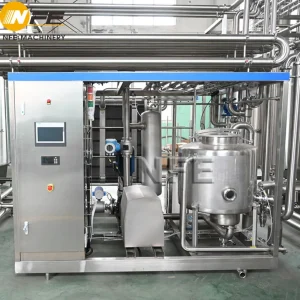
This unit is one stage of a complete processing line. For the full range of pulping and juicing equipment, or to compare this model against the Juice Decanter Centrifuge 5000 L/h, see the complete equipment catalogue. Capacity, material grade and utility requirements can be confirmed through a quote request.
Reviews
There are no reviews yet.