Kiwi Grading Machine 5000 pcs/h
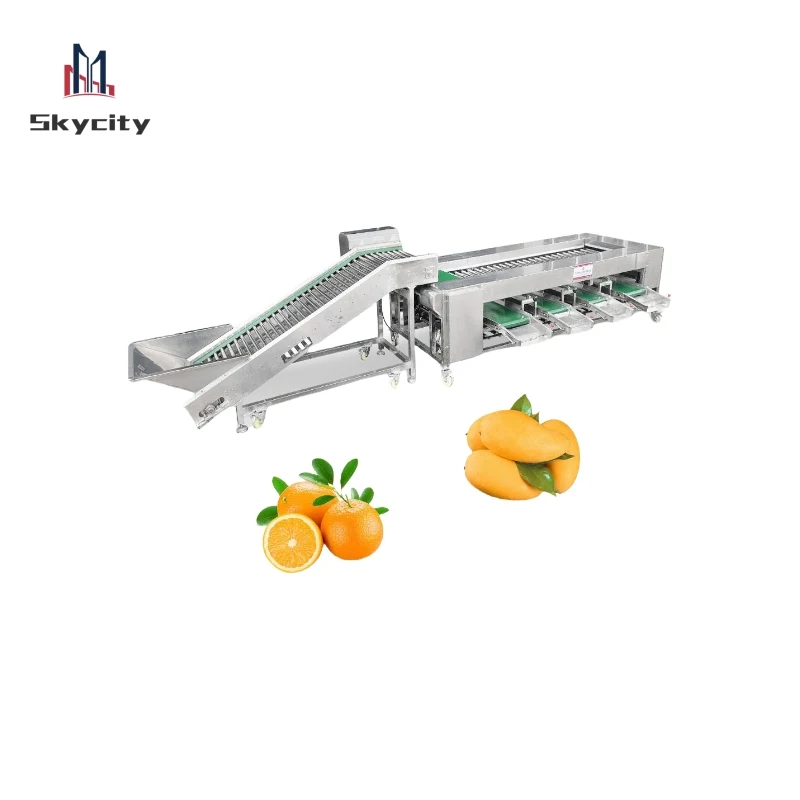
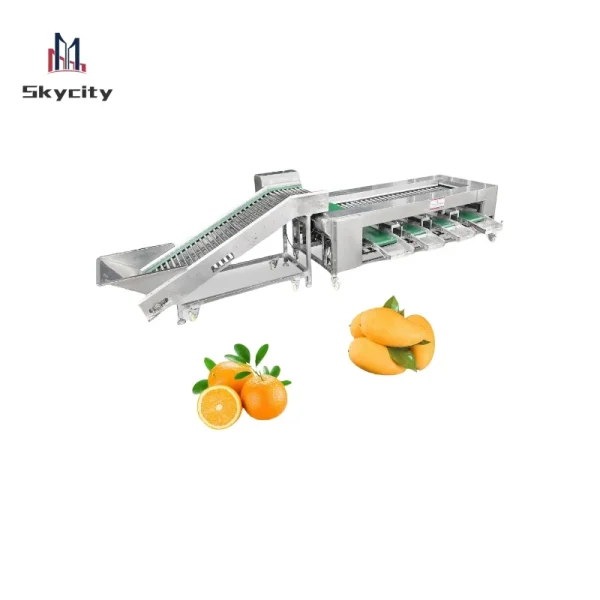
Kiwifruit makes grading machines pay for themselves quietly. Buyers buy by count weight in punnets and trays, and a pack that under-weighs is a claim; one that over-weighs is profit handed away, four berries at a time. But the fruit itself is difficult: dense for its size, covered in fuzz that grips conveyors, and quick to show every hard transfer as a dark ring by the time it reaches the shelf. A kiwi grading machine grades by individual weight through soft-handling cups — fruit enter single-file, each cup weighs as it passes the load cells, and a gate drops the fruit into the class lane where its weight belongs, without a single drop bigger than a few centimetres.
How it works
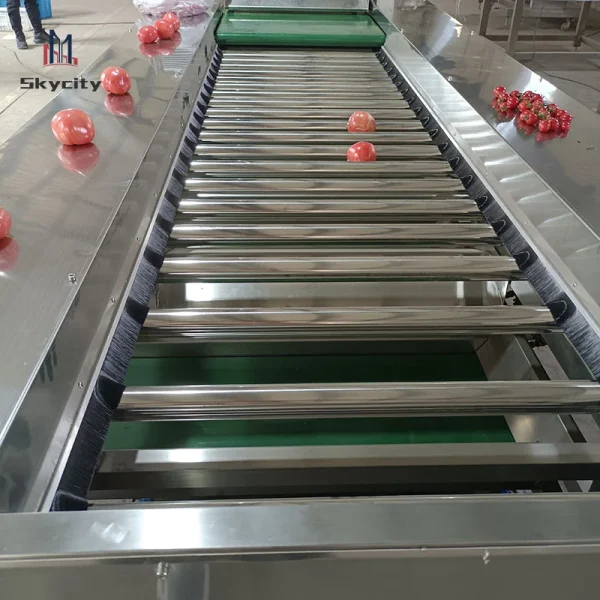
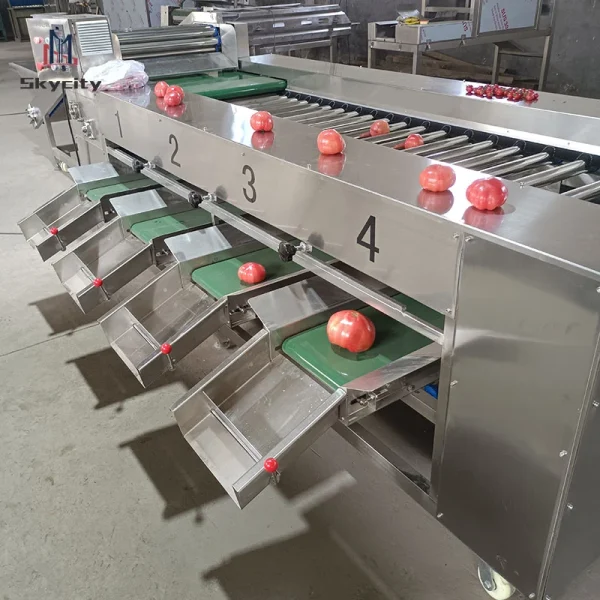
Fruit feed from a singulating elevator onto a roller conveyor that spaces them into a cup chain running past static weighing stations. Each cup’s weight is sampled; the control system tracks the cup’s position and, at the class lane assigned to that weight band, tips the cup gently or opens its floor to release the fruit onto the lane’s packing table or collection tray. Typical commercial machines run 8-12 classes; the operator sets band edges by weight or by count per pack, and the system reports distribution as it runs. Fuzz management is part of the design — brushable rollers and accessible cup chains keep the lines clean, and cup surfaces are food-grade soft polymer.
Suitable for
Kiwi packhouses grading fruit for punnets, trays and bulk cartons; exporters building count-weight-consistent pallets for long-haul shipment; co-operatives pooling member fruit into uniform commercial classes; kiwi-berry and mini-kiwi operations with a small-fruit variant and cup sizing to match; packers who also run lemon, plum or similar round fruit and want one grader for several crops.
Not suitable for
Optical defect sorting — a weight grader sees mass, not blemish, and a camera line is a different purchase; soft, overripe fruit that should have been culled upstream, since cups accelerate bruise spread; orchard-scale runs under 500 kg a day, where manual scales and sizing rings stay economical; and operations wanting stem or calyx detection, which no weight cup can deliver.
Material & compliance
Cups, rails, gates, chutes and frame in SUS304 (EN 1.4301) food-grade finish; cup surfaces food-grade polymer rated for fruit contact; sealed drives and washdown-rated electricals on wet-side sections; interlocked chain access for cup cleaning; control cabinet IP-rated for packhouse washdown.
Supplied with CE declaration of conformity and DoC on request; material certificate EN 10204 3.1 available for contact parts.
Selection notes
Weigh your economics first: count-weight accuracy pays only at pack volumes where a few grams per pack compound across a season. Cup count and line speed set throughput — check both against your peak packing day, not your average. Ask about bruise handling: cup material, transfer heights and gate action are where shelf life dies, and the honest demo is a week-old pack, not a day-one photo. Confirm class count against your market — export specifications often want finer bands than domestic trade. And if you grade more than one crop, get the changeover procedure and cup sets quoted, because fruit size difference across crops is the usual constraint.
When you should not buy this machine: If your packhouse handles under a tonne a day, sizing rings and hand scales at two workers cover the work with no capital at risk. And if your real problem is defect sorting — bruise, rot, shape — weight grading will not touch it; buy the camera line first.
Key specifications
| Parameter | Value |
| Capacity | 3000-8000 pcs/h by line length (TYPICAL, confirm with factory) |
| Grading principle | Individual cup weight with load cells (TYPICAL) |
| Classes | 8-12 weight bands (TYPICAL) |
| Fruit range | 40-150 g per fruit (TYPICAL) |
| Contact material | SUS304 (EN 1.4301) + food-grade cups |
| Power supply | 380V/3P/50Hz, 1.5-4 kW class |
Specification values are industry-typical ranges for this machine class and are not verified against a specific factory datasheet. Replace them with measured factory data before publication.
FAQ
How accurate is cup weighing on a moving line?
Modern load-cell cups weigh dynamically within about ±1-2 g at line speed (TYPICAL) — well inside commercial count-weight tolerance. Accuracy drifts with fuzz build-up on cups and rails, which is why the cleaning routine matters as much as the spec sheet. Ask for a live accuracy report from a running machine, not a datasheet claim.
Will the fuzz clog the machine?
Kiwifruit fuzz accumulates on rollers and cup chains by design of the fruit, not failure of the machine. Machines built for kiwi have accessible, tool-free cup removal and brush stations; machines built for citrus usually do not. Check the cleaning access specifically for kiwi before buying a multi-crop grader.
Can it grade other fruit besides kiwi?
Yes — weight-cup graders commonly run lemon, plum, peach and similar round fruit with cup sets changed per crop. Confirm the cup size range covers your smallest and largest crop, and get the changeover time in writing if you switch crops within a single day.
Related equipment
This unit is one stage of a complete processing line. For the full range of sorting and grading equipment, or to compare this model against the Weight Grading Machine 3000 kg/h, see the complete equipment catalogue. Capacity, material grade and utility requirements can be confirmed through a quote request.
Reviews
There are no reviews yet.