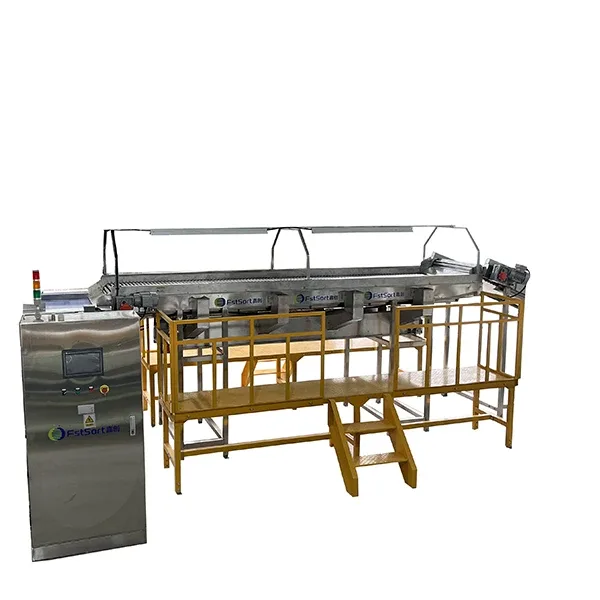
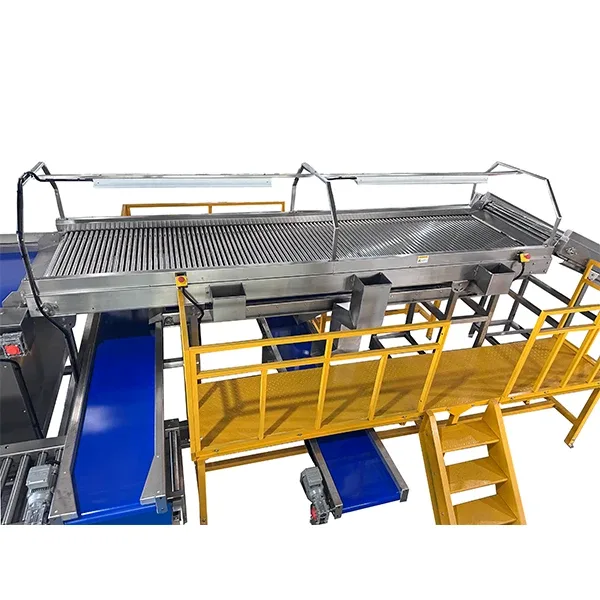
Roller Inspection Table 2 t/h
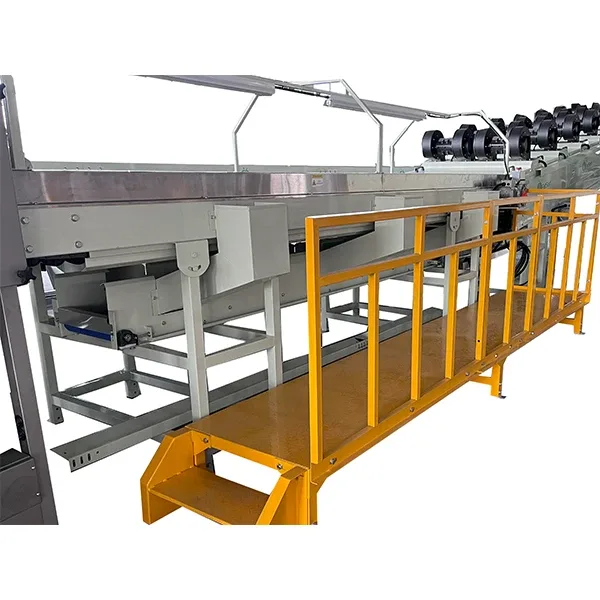
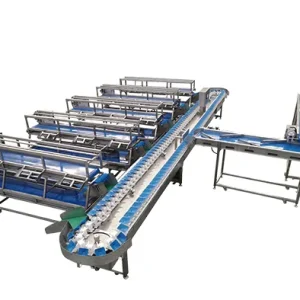
Cameras sort by what they are taught; people catch what nobody taught them — the odd bruise, the off colour, the touch of rot that optics miss until retrained. The roller inspection table is the machine that makes human inspection actually work: rows of powered rollers rotate each fruit in place as it travels past the inspectors, so the whole surface turns through view instead of one static side, and a defect half-seen is a defect removed.
How it works
Washed fruit feeds in single layer onto a bed of forward-moving powered rollers. The rollers spin about their own axes while carrying fruit along the table, so each piece rotates steadily under the inspector’s view — full-surface exposure without anyone touching the fruit. Inspectors stand or sit along both sides; a defect is lifted off by hand into a reject chute or bin, and clean fruit continues off the end to grading or packing. Roller speed and transport speed are set independently — the balance between rotation and travel is what gives eyes enough dwell on each fruit without slowing the line. Tables slot into any line as a free-standing module before graders, optics or packing.
Suitable for
Packhouse quality control before grading and packing on apple, tomato, citrus and stone-fruit lines; the manual defect-picking stage beside optical sorters, catching what the camera database has not learned; co-operatives and smaller packers running professional inspection without optic budgets; harvest-in inspection points where field lots vary lot to lot; any fruit line where the current flat belt shows inspectors the same side of every fruit all day.
Not suitable for
Full defect sorting at industrial volume with consistent criteria — optics beat people on repetition, and the roller table is the complement, not the replacement; dirty unwashed fruit, which must be washed before anyone can see anything; products too small to rotate visibly, like berries, which are sorted on belt tables instead; and operations below a few hundred kilos an hour, where a static table and two people suffice.
Material & compliance
Frame and chutes in SUS304 (EN 1.4301) or food-grade finish; food-grade PVC rollers on stainless shafts with sealed bearings; variable-speed drives for rotation and transport; reject chutes and bins positioned per operator layout; open frame design for full washdown.
Supplied with CE declaration of conformity and DoC on request; food-contact declarations for roller materials.
Selection notes
Start from the fruit and the team: diameter range, inspection criteria, and how many operators the line can genuinely staff — table width and length follow the people, not the other way round. Ask about roller speed control independently of transport speed, because that dual adjustment is what the inspection quality rides on. Confirm roller material and diameter for your fruit size; small fruit vanishes between wide rollers. Check reject handling — chutes on both sides at ergonomic height, with bins that do not block the line. And plan the position honestly: the table sees what the washer left, and it feeds the grader; its width must match both neighbours in the layout.
When you should not buy this machine: If your volumes are small and one trained person at a static bench covers the shift, spend the money on the grader instead. And if you expect a table to replace quality control standards — criteria, training, records — no roller speed fixes an undefined defect; write the standard first.
Key specifications
| Parameter | Value |
| Capacity | 1000-3000 kg/h by operator count (TYPICAL, confirm with factory) |
| Table width | 0.8-1.2 m by fruit and operator layout (TYPICAL) |
| Rollers | Powered food-grade PVC, independent rotation + transport speeds |
| Reject handling | Side chutes and bins per operator position |
| Contact material | SUS304 frame, food-grade rollers |
| Power supply | 380V/3P/50Hz, 1-2 kW class |
Specification values are industry-typical ranges for this machine class and are not verified against a specific factory datasheet. Replace them with measured factory data before publication.
FAQ
Roller table or optical sorter — do we need both?
They do different jobs: rollers give people full-surface view; optics apply consistent criteria at speed. Premium lines run the roller table beside or ahead of the optic; budget lines run the table alone with good standards. Start with what your buyers actually enforce.
How many inspectors does a table need?
Throughput and criteria decide — typically two to six along a table at pack rate, with the number rising on dirty lots or strict defect lists. Ask the factory for dwell-time figures at your fruit size, then staff to the standard, not to hope.
Will it handle wet, washed fruit?
Yes — rollers carry wet fruit well, and most tables sit right after washing and drying. Confirm roller material suits your line’s sanitizers, and plan drip management so the table stays a inspection station, not a puddle.
Related equipment
This unit is one stage of a complete processing line. For the full range of sorting and grading equipment, or to compare this model against the Inspection and Sorting Conveyor 1500 kg/h, see the complete equipment catalogue. Capacity, material grade and utility requirements can be confirmed through a quote request.
Reviews
There are no reviews yet.