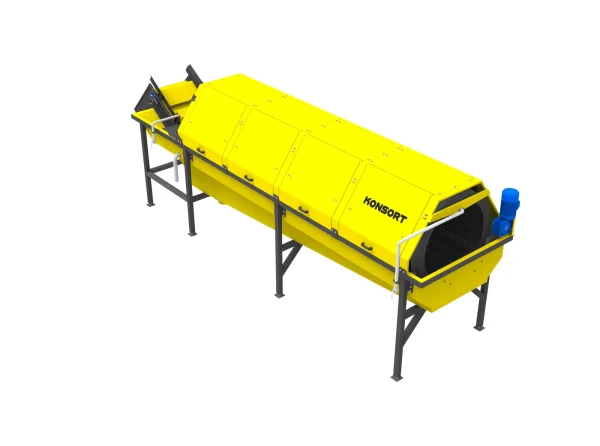
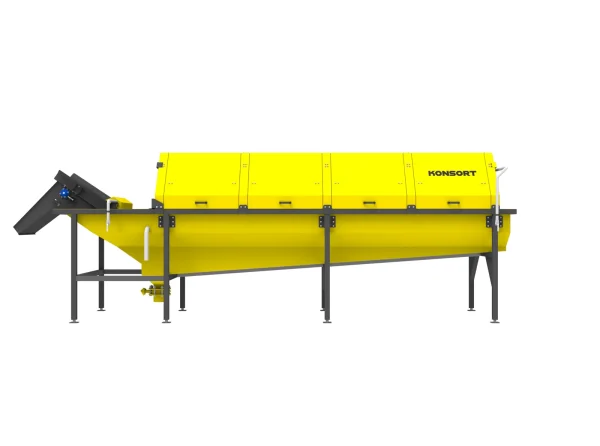
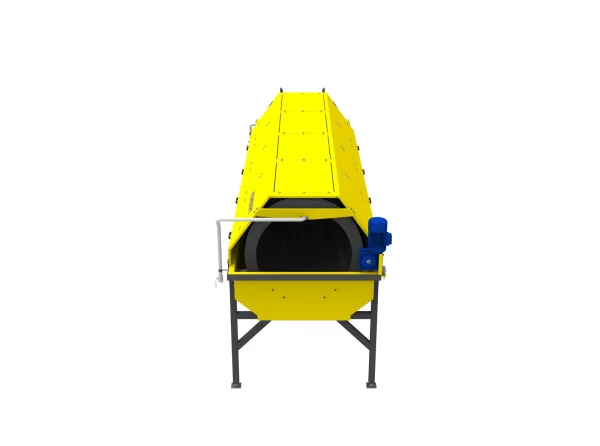
Rotary Drum Washing Machine
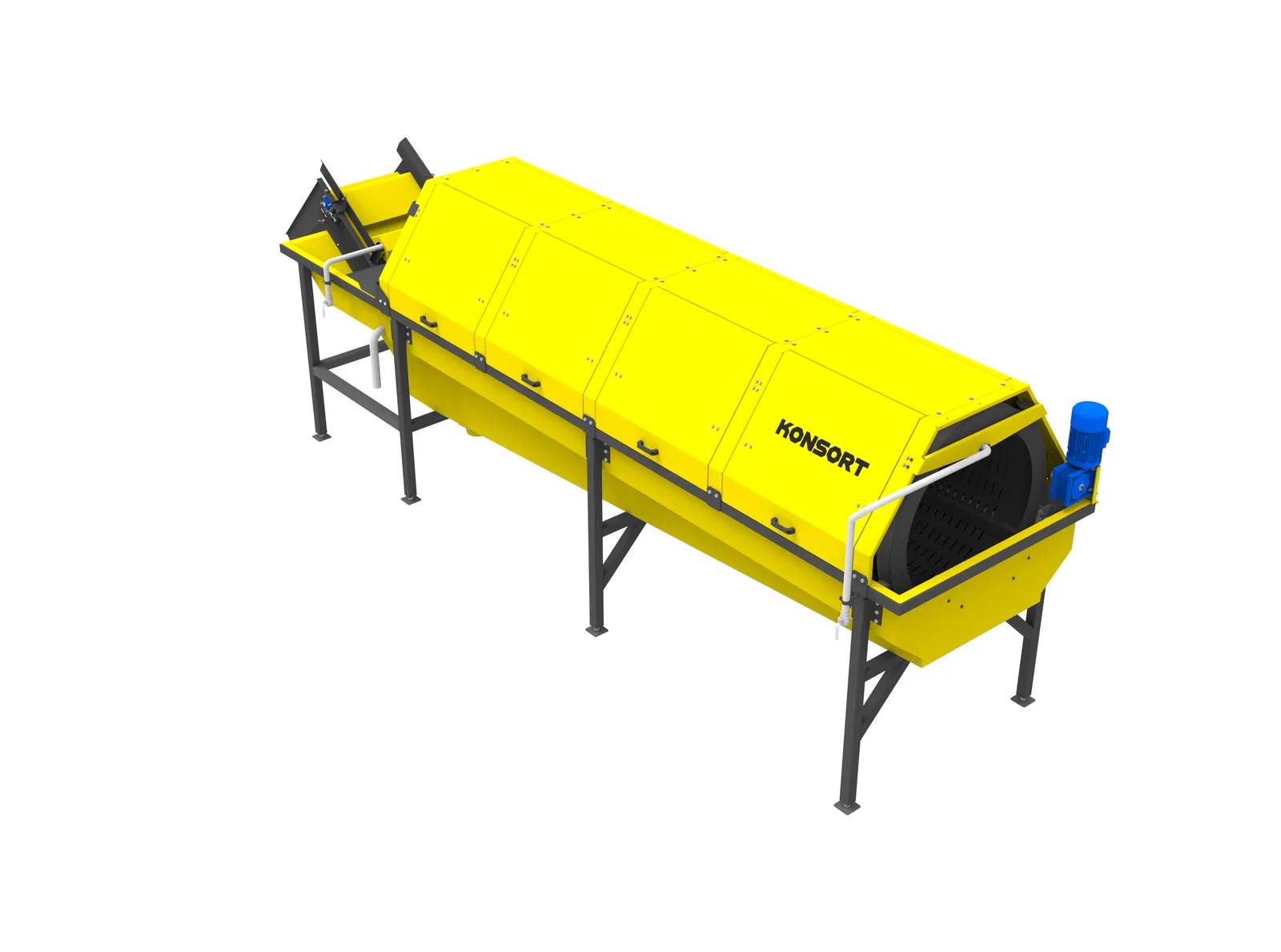
Rotary drum washer that tumbles root vegetables and firm fruit through spray or immersion zones, using product-on-product and product-on-wall contact to break soil loose before peeling or cutting.
How it works
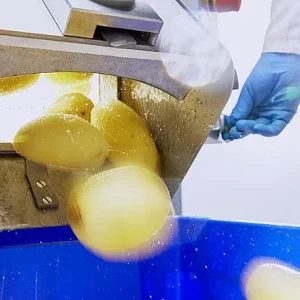
Product is fed into a slightly inclined, perforated drum that rotates on driven rollers. Internal flights or a helical rib lift and carry the product forward — either through a spray zone, where nozzle bars wash it from above, or through a water bath, where the lower part of the drum is submerged. Soil falls through the perforations into a settling tank below. At the discharge end the product either drops onto a take-away conveyor or passes into a dewatering section.
Residence time is set by drum inclination and speed, so the same drum can give a light rinse or a soak-and-scrub cycle.
Suitable for
Potatoes, carrots, beetroot and other root crops with adhered soil; onions and garlic after topping; firm fruit before crushing or pressing; product that benefits from tumbling action rather than belt transport.
Not suitable for
Leafy greens and soft berries, which bruise under tumbling; product with a delicate skin that must stay intact; very large or irregular pieces that jam between the drum and flights; dry-cleaning applications where no water is wanted.
Material & compliance
Drum shell, flights and spray bars in SUS304 (EN 1.4301); SUS316L (EN 1.4404) available for saline water. Perforations deburred on the product side. Settling tank and drain designed for washdown without dismantling the drum.
Supplied with CE declaration of conformity and DoC on request; material certificate EN 10204 3.1 available for contact parts.
Selection notes
Decide spray or immersion first: immersion removes more soil but uses more water and needs bigger settling capacity. Ask how the settling tank is cleaned, since that is where soil accumulates and where sanitation usually fails. Check drum speed control — a fixed-speed drum cannot be retuned when you change crop.
When you should not buy this machine: If your product is soft or leafy, buy a belt or bubble washer; tumbling will bruise it. Also skip a drum washer if you have no water treatment on site: the soil load it removes has to go somewhere, and an unmanaged settling tank becomes the plant’s worst hygiene point.
Key specifications
| Parameter | Value |
| Capacity | 1000-10000 kg/h by model (TYPICAL, confirm with factory) |
| Drum diameter | 600-1200 mm (TYPICAL) |
| Drum speed | Variable, by frequency inverter (TYPICAL) |
| Water consumption | 1.5-4.0 m3/h with recirculation (TYPICAL) |
| Washing mode | Spray zone, immersion bath, or combined |
| Contact material | SUS304 (EN 1.4301) |
| Power supply | 380V/3P/50Hz or 415V/3P/50Hz, customizable |
Specification values are industry-typical ranges for this machine class and are not verified against a specific factory datasheet. Replace them with measured factory data before publication.
FAQ
Drum washer or brush washer — which removes soil better?
A drum washer with an immersion zone removes more adhered soil, especially dried clay. A brush washer handles lighter soil with less water. For field-root crops straight from the ground, the drum stage is usually first.
How much water does it use?
With recirculation and a settling tank, typically 1.5-4.0 m3/h. Without recirculation the same machine uses several times more, and the soil load makes the discharge water difficult to handle.
Can it peel as well as wash?
Not really. Some abrasion occurs against the drum wall, and abrasive-sleeve variants exist, but a drum washer removes surface soil, not skin. Fit a peeling stage downstream if you need skin off.
Related equipment
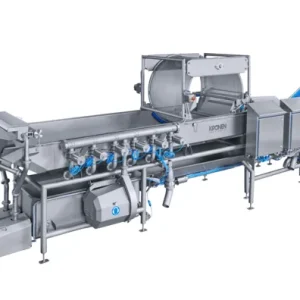
This unit is one stage of a complete processing line. For the full range of washing and peeling equipment, or to compare this model against the Bubble Washing Machine 2000 kg/h, see the complete equipment catalogue. Capacity, material grade and utility requirements can be confirmed through a quote request.
Reviews
There are no reviews yet.