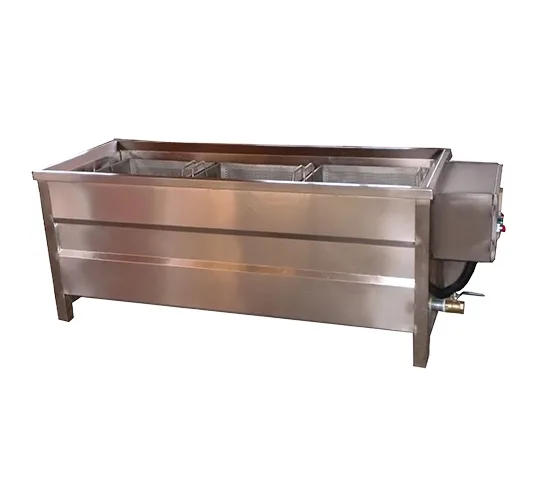
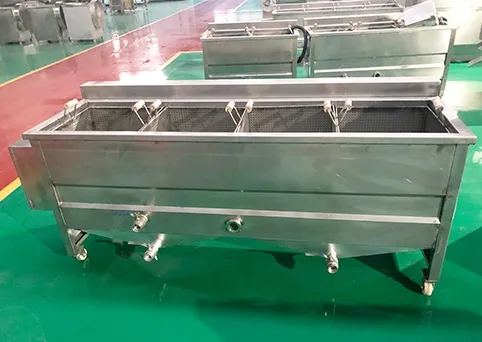
Basket Blanching Machine 500 kg/batch
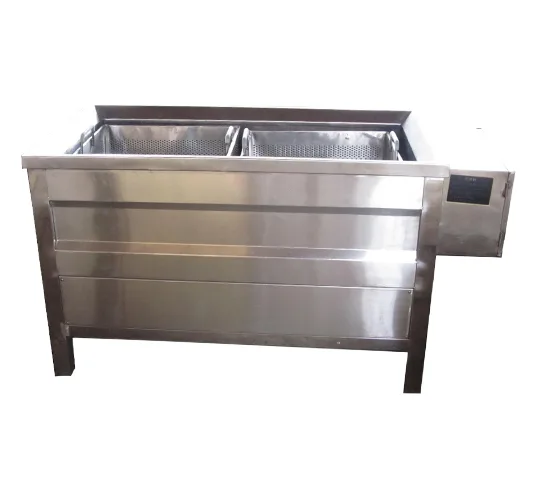
Batch blanching unit for plants that need to blanch a defined quantity, then change product. Where a continuous blancher commits you to one product and one residence time for a whole shift, a basket machine lets you run twenty minutes of peas and then twenty minutes of carrots without losing product at the changeover.
How it works
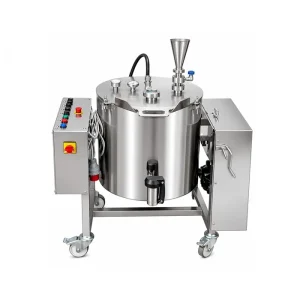
Product is loaded into perforated baskets, which are lowered into a tank of hot water or into a steam chamber. Heating is by steam injection into the water or by a steam coil; the water is circulated so the temperature recovers quickly after a cold basket goes in. After a timed dwell, the baskets are lifted — by hoist on larger machines, manually on smaller ones — and the product is discharged to cooling.
The cycle is only as consistent as the temperature recovery. A basket of cold product drops the bath temperature, and the blanching clock should start when the water is back at temperature, not when the basket goes in. Good machines measure and interlock this; cheap ones just run a timer.
Suitable for
Plants running several products per shift with frequent changeovers; seasonal processors who blanch a few hundred kilos at a time; pilot and product-development lines; operations where the downstream process is batch as well, so continuous blanching would only move the bottleneck; root vegetables, peas, beans and leafy greens where bath blanching gives an acceptable result.
Not suitable for
High-volume single-product lines, where a continuous belt or screw blancher is cheaper per tonne; product that benefits from a very short, precisely controlled exposure, which a bath with a temperature dip cannot reliably deliver; lines where the labour of loading and lifting baskets is the constraint; anyone expecting continuous throughput from a batch machine.
Material & compliance
Tank, baskets and steam manifold in SUS304 (EN 1.4301); basket mesh deburred and weld-smooth. Steam injection must be arranged so that live steam does not vent into the working area; the tank needs a drain and a clean-out, because blanching water carries starch and fine solids that build up.
Supplied with CE declaration of conformity and DoC on request; material certificate EN 10204 3.1 available for contact parts.
Selection notes
Ask where the temperature probe sits and whether the timer is interlocked to it — a timer alone will give you a product that is under-blanched on the first basket of every batch. Check the basket mesh against your smallest product, and check how the baskets are lifted, because that is the manual handling risk in the whole line. Check the water changeover: heavily loaded blanching water becomes a quality problem before it becomes a hygiene one.
When you should not buy this machine: If you run one product at high volume, buy a continuous blancher — the per-tonne cost of a batch machine, in labour and in steam, is higher. And if your product needs a tight enzyme-inactivation window, a bath with a recovery dip will not hold it consistently; go continuous.
Key specifications
| Parameter | Value |
| Batch capacity | 300-800 kg per cycle (TYPICAL, confirm with factory) |
| Blanching temperature | 85-100 °C in water (TYPICAL) |
| Cycle time | 1-8 min by product (TYPICAL) |
| Heating medium | Steam injection or hot water bath |
| Basket handling | Hoist or manual lift, by model |
| Contact material | SUS304 (EN 1.4301) |
| Power supply | 380V/3P/50Hz or 415V/3P/50Hz, customizable |
Specification values are industry-typical ranges for this machine class and are not verified against a specific factory datasheet. Replace them with measured factory data before publication.
FAQ
Should the timer start when the basket goes in?
No. Cold product drops the bath temperature, and the real blanching exposure only begins when the bath recovers. Machines with a temperature interlock handle this; with a plain timer, the first basket of every run is under-processed.
How often should blanching water be changed?
More often than most plants do. Dissolved solids accumulate, and they change both the colour and the flavour of the product long before anyone would call the water dirty. Set a changeover by conductivity or by batch count, not by eye.
Is steam blanching better than water blanching?
They suit different products. Steam loses fewer soluble nutrients and produces less effluent; water gives faster, more even heat transfer for dense pieces. The choice is a product decision, not a machine-quality one.
Related equipment
This unit is one stage of a complete processing line. For the full range of cooking and blanching equipment, or to compare this model against the Continuous Belt Blancher 2500 kg/h, see the complete equipment catalogue. Capacity, material grade and utility requirements can be confirmed through a quote request.
Reviews
There are no reviews yet.