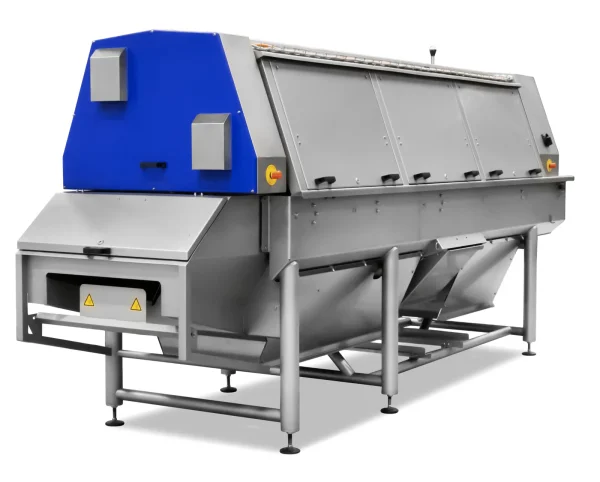
Vegetable Topping and Tailing Machine 1500 kg/h
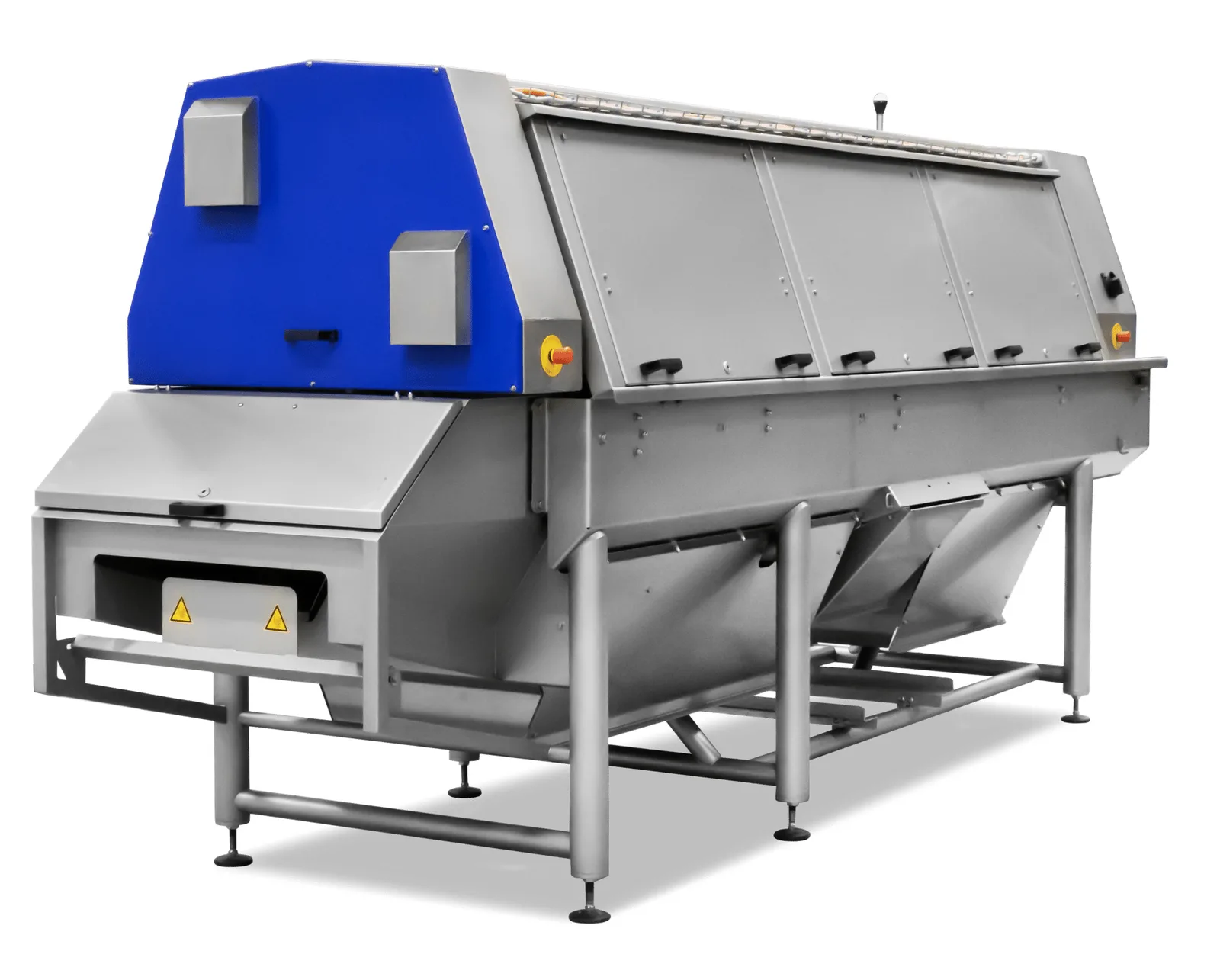
Cutting unit for the two cuts every root crop needs before anything else happens to it. The crown carries leaves, soil and field debris; the tip carries root hairs and the worst of the soil load. Taking both off in one pass, at line speed, is what makes the peeling or packing step downstream run clean.
How it works
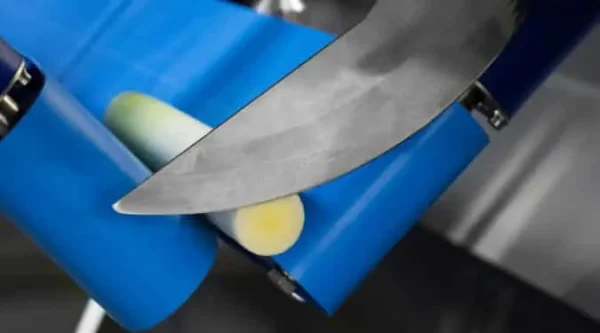
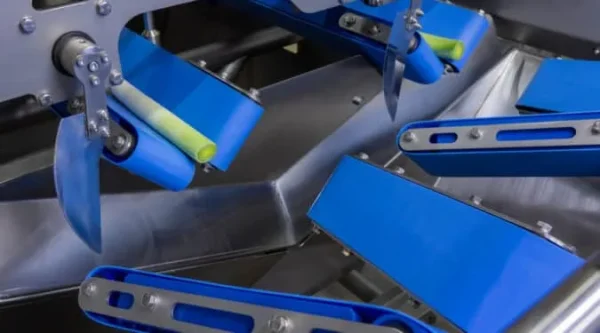
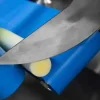
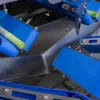
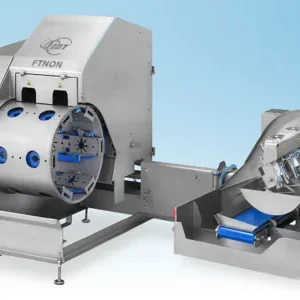
Product is fed along a channel or into singulating pockets, held to a line, and carried past two rotating blade pairs set at the cut positions. The first blade takes the crown, the second takes the tip; the trimmed product continues to the discharge and the offcuts drop to a separate waste stream. On length-set machines the cut position is a fixed distance from a registration point; on alignment machines the product is located physically by the pocket and the blades cut at the pocket edges.
The setting that matters is the cut position, and it is set against the product, not the machine. Carrots arrive in length and diameter classes after grading, and the topping machine is set per class. Feed rate matters too: over-feed the channel and product rides over the blade line, giving ragged cuts and a waste stream full of usable product.
Suitable for
Carrot, radish, beetroot and parsnip lines feeding peeling, cutting or packing; fresh-packed root vegetable operations where crown and tip removal is the finish; processing lines feeding cutters or dicers that jam on leafy crowns; plants moving labour off hand trimming, which is slow and gives inconsistent cut length; lines where tops and tips need to leave as a managed waste or feed stream.
Not suitable for
Round or irregular root crops that will not register to a line — potatoes and onions are not trimmed this way; ungraded product with a wide length spread, because the cut is set per class; very soft or wilting product, which bends instead of registering; anyone without a route for the topping stream, which is bulky, wet and continuous.
Material & compliance
Frame, channel, pockets and discharge chutes in SUS304 (EN 1.4301); blades in stainless blade steel, supplied as replaceable sets and treated as consumables. Blade stations fully guarded with interlocked access for blade change. The machine opens for wash-down, because root vegetables carry soil into every corner of the cutting area.
Supplied with CE declaration of conformity and DoC on request; material certificate EN 10204 3.1 available for contact parts.
Selection notes
Ask what fraction of usable product ends up in the waste stream, measured on your grade — a topping machine that takes a centimetre too much off every carrot costs more than the machine. Check how the cut length is adjusted between classes and whether it can be done mid-shift. Check blade changeover time and blade supply; a worn set gives ragged cuts before it gives a visible problem. Check the feed arrangement against your grader’s output, because the topping machine inherits whatever the grader mixed.
When you should not buy this machine: If your product is destined for peeling on an abrasive peeler, that machine takes care of the surface and the trim can often be done by hand at lower volume. And if your crop arrives ungraded, buy the grader first — one cut setting cannot serve a mixed length range, and the topping machine will be blamed for what grading should have solved.
Key specifications
| Parameter | Value |
| Capacity | 1000-3000 kg/h by channel count and product (TYPICAL, confirm with factory) |
| Cut method | Rotating blade pairs at a set cut length |
| Length setting | Adjustable by product class (TYPICAL) |
| Product feed | Channel feed by hand or automatic singulation |
| Waste | Separate topping and tailing stream |
| Blade type | Stainless blade steel, replaceable set |
| Contact material | SUS304 (EN 1.4301) |
| Power supply | 380V/3P/50Hz or 415V/3P/50Hz, customizable |
Specification values are industry-typical ranges for this machine class and are not verified against a specific factory datasheet. Replace them with measured factory data before publication.
FAQ
Is topping the same as peeling?
No. Topping removes the crown and tip — the ends of the vegetable. Peeling removes the skin along its length. A carrot line typically tops first and peels second, and they are separate machines.
Why does cut length drift during a shift?
Blade wear and feed rate. A blade that has dulled slightly pushes product rather than cutting it, and an over-fed channel rides product past the blade line. Blade condition is checked by looking at the cut face, not by counting hours.
What happens to the tops?
They leave as a separate wet stream, typically a low but meaningful share of intake weight. Most plants send them to feed, compost or anaerobic digestion; the requirement is a handling route, because they will not wait in the room.
Related equipment
This unit is one stage of a complete processing line. For the full range of cutting and slicing equipment, or to compare this model against the Vegetable Trimming Machine 1500 kg/h, see the complete equipment catalogue. Capacity, material grade and utility requirements can be confirmed through a quote request.
Reviews
There are no reviews yet.