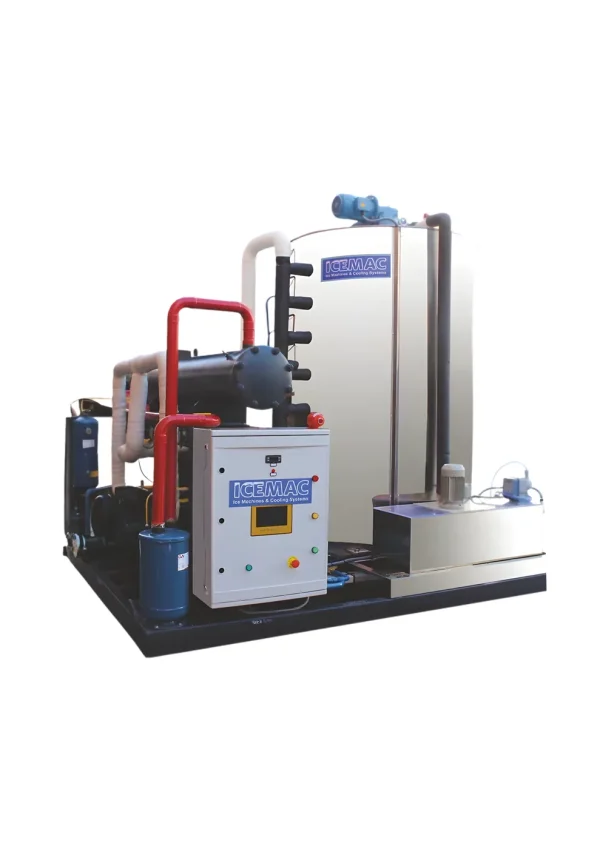
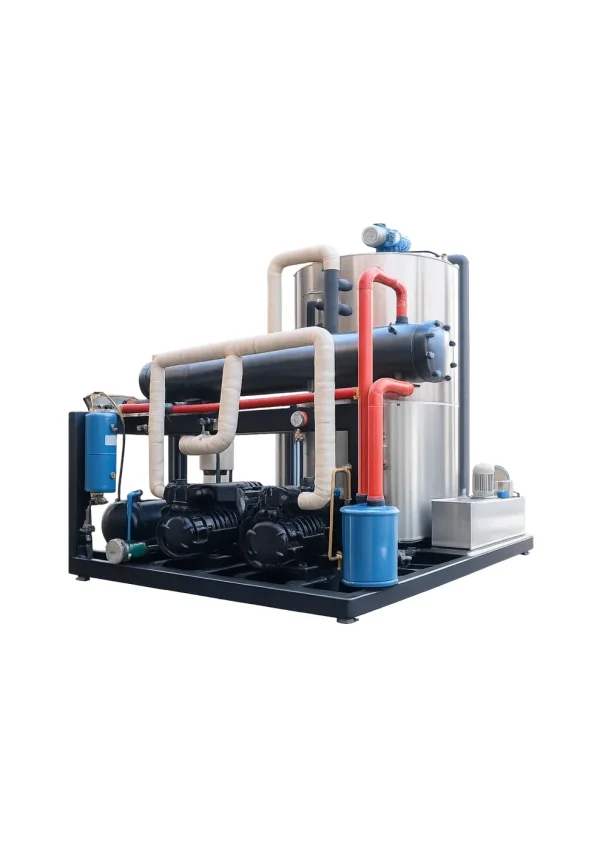
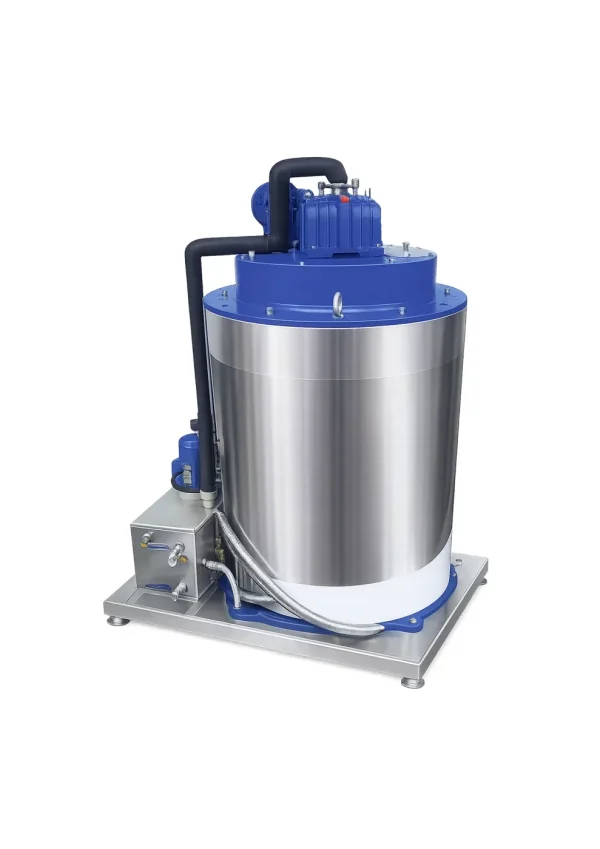
Flake Ice Machine 3000 kg/24h
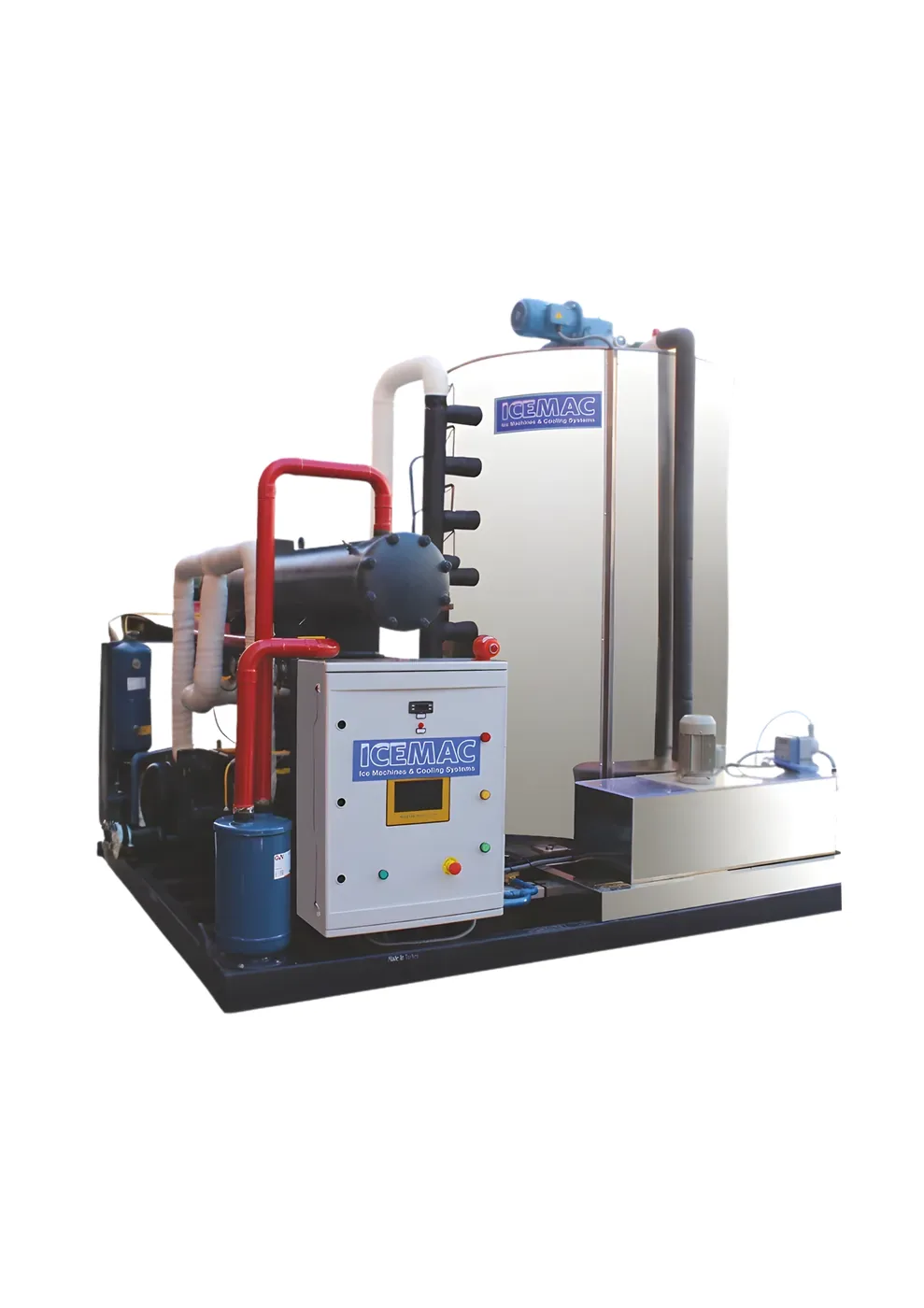
Refrigeration unit that makes the ice a produce operation actually uses. Flake ice is thin, dry and cold, it moulds around product instead of bruising it, and it melts into the cooling water it is supposed to be cooling — which is why packing houses use it rather than block ice or cube ice.
How it works
Water is distributed over the inside or outside of a chilled, vertical drum in a thin film. The film freezes against the drum surface; a rotating scraper blade peels the frozen film off as flake, and the flake drops into a bin below. Because the water freezes as a film rather than as a block, the ice comes out subcooled and dry to the touch rather than wet, and it does not clump the way wet ice does.
Output is quoted per 24 hours at a stated ambient and water temperature, and those two conditions move the number more than buyers expect — a machine rated at 30 °C ambient produces less in a 40 °C shed, which is exactly where most packing houses put it. Condenser choice, air-cooled or water-cooled, and the refrigerant, decided by local regulation and service availability, are the design decisions.
Suitable for
Hydro-cooling circuits where ice is added to the cooling water; field and packing-house cooling of leafy vegetables, broccoli, berries and stone fruit; top-icing of cartons and bins for transport; fish-free produce operations needing a clean, dry ice that will not waterlog packaging; sites where an existing chiller supplies the cold source and the ice machine is the delivery point.
Not suitable for
Operations that need ice for direct contact with food for human consumption, where potable-water and ice hygiene rules apply and the installation has to be designed for them; sites without refrigeration service capability — this is a refrigeration machine and it needs a technician; anyone sizing by peak hour rather than per 24 hours, because the ice bin is part of the system and an undersized bin runs the machine continuously; plants that only need chilled water, where a chiller is the better buy.
Material & compliance
Ice-contact surfaces — drum, scraper, bin and chute — in SUS304 (EN 1.4301). Water circuit fitted with filtration appropriate to the water source; where ice contacts product for consumption, potable water supply and hygiene design are requirements, not options. Refrigeration circuit guarded and enclosed with pressure protection; refrigerant type declared at order because F-gas rules differ by market.
Supplied with CE declaration of conformity and DoC on request; material certificate EN 10204 3.1 available for contact parts.
Selection notes
Ask for output at your ambient and water temperature, not at the catalogue condition — that single correction is the difference between an installation that holds and one that runs short every afternoon. Check the refrigerant and whether service and spares exist locally for it. Check condenser type against your site: air-cooled is simpler, water-cooled is more efficient where water is cheap. Size the ice bin to your shift, not to the machine, and ask about the water filtration requirement for your supply.
When you should not buy this machine: If what you actually need is cold water, not ice, buy a chiller — ice is a more expensive way to move the same cooling. And if you have no refrigeration technician available, every flake ice machine becomes a doorstop the first time it faults.
Key specifications
| Parameter | Value |
| Ice output | 1000-5000 kg/24h by model (TYPICAL, confirm with factory) |
| Ice type | Dry subcooled flake, about 1-2 mm thick (TYPICAL) |
| Ice temperature | About -5 to -8 °C (TYPICAL) |
| Condenser | Air-cooled, water-cooled or remote by site |
| Refrigerant | R404A, R134a or R290 by market and regulation |
| Contact material | SUS304 (EN 1.4301) ice-contact parts |
| Power supply | 380V/3P/50Hz or 415V/3P/50Hz, customizable |
Specification values are industry-typical ranges for this machine class and are not verified against a specific factory datasheet. Replace them with measured factory data before publication.
FAQ
Why flake ice rather than cube ice?
Because flake is thin, dry and moulds to the product. Cube ice is hard-edged and wet; it bruises soft produce and melts into free water that waterlogs packaging. Flake ice puts cooling where you put it.
Why is my output below the nameplate?
Almost always ambient or water temperature. Ice machine output is quoted at a stated condition — typically 25 or 30 °C ambient with 15-20 °C feed water — and every degree above that costs output. Ventilate the plant room before you blame the machine.
Does the ice need potable water?
If it contacts food that will be eaten, yes, and the installation should be designed for it. Ice used only on external cooling water or on packaging is a different case, but the distinction should be stated explicitly at purchase rather than assumed.
Related equipment
This unit is one stage of a complete processing line. For the full range of freezing equipment, or to compare this model against the Industrial Chiller Unit 200 kW, see the complete equipment catalogue. Capacity, material grade and utility requirements can be confirmed through a quote request.
Reviews
There are no reviews yet.