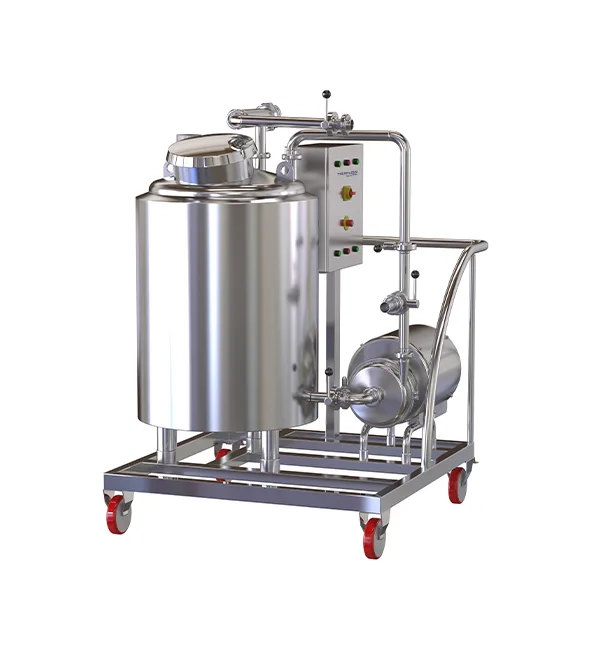

CIP Cleaning System 2000 L
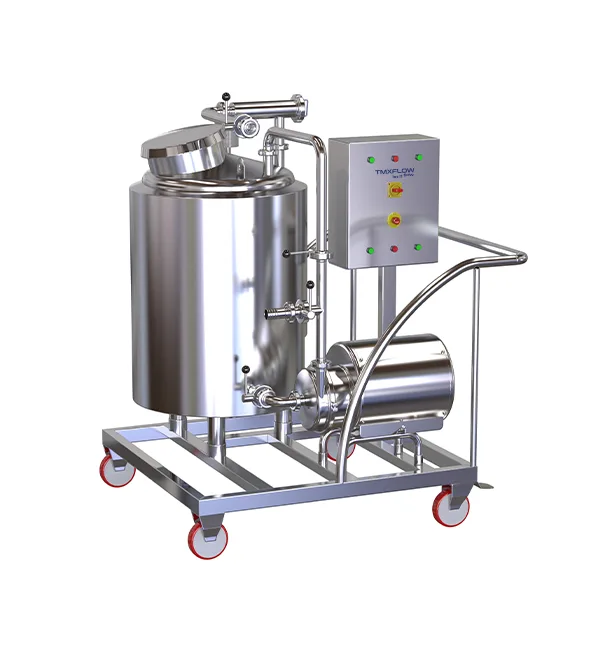
Cleaning unit for the parts of a plant nobody can reach by hand. Pipework, heat exchangers, tanks and fillers accumulate product residue on every surface they touch, and the only practical way to clean them is to pump cleaning solution through them on a controlled cycle. That is what CIP does, and it is the reason a modern juice or puree line can be cleaned in an hour rather than dismantled over a shift.
How it works
A CIP set holds one or more tanks of cleaning solution — typically a caustic detergent tank and sometimes an acid tank, plus a rinse supply. A centrifugal pump circulates solution from the tank, through the circuit being cleaned, and back to the tank. A heater, steam coil or electric element, brings the solution to its working temperature. The cycle runs in stages: a pre-rinse to remove loose product, a hot caustic circulation to remove organic soil, an intermediate rinse, optionally an acid stage to remove mineral scale, and a final rinse.
The engineering is in the delivery, not the chemistry. Cleaning depends on solution temperature, concentration, flow velocity and contact time — the four variables a CIP cycle is written against. Turbulent flow through the pipe is what removes film; a circuit where the solution coasts through at low velocity is being wetted, not cleaned. Return lines, spray balls for tank cleaning, and the route the solution takes through each circuit are designed at installation.
Suitable for
Juice, puree and paste lines where pipework and heat exchangers run product for hours between cleans; plants with plate or tubular heat exchangers, where fouling is a measurable efficiency loss; operations that need documented, repeatable cleaning for a buyer or certification audit; plants where dismantling for cleaning is the bottleneck at every product changeover; facilities consolidating cleaning from manual hoses onto a controlled cycle to reduce water and chemical use.
Not suitable for
Equipment with dead legs, uncleanable joints or non-hygienic pipework — CIP only cleans what the solution can flow through, and it will expose bad pipework rather than compensate for it; solid-handling machines like cutters and peelers, which are cleaned by wash-down, not by circulation; sites without the water, drain and chemical-handling provisions, because a CIP set moves a lot of solution; anyone expecting CIP to replace all manual cleaning — most plants run both, and the manual part does not disappear.
Material & compliance
Tanks, pipework, pump and heater in SUS304 (EN 1.4301), with SUS316L (EN 1.4404) for acidic or high-chloride service; product-contact welds finished and the circuit designed without dead legs. Chemical dosing and handling arranged for operator safety, with detergent and acid stored and dosed separately. Where the cleaned circuit carries food, rinse water quality and final-rinse drainage are part of the hygiene design, not accessories.
Supplied with CE declaration of conformity and DoC on request; material certificate EN 10204 3.1 available for contact parts.
Selection notes
Ask which circuits the set will clean and what flow velocity it achieves in each — a CIP set sized by tank volume alone is the most common way this purchase goes wrong. Ask whether control is manual, semi-automatic or recipe-driven, and whether the cycle is recorded, because documented cycles are what an auditor asks for. Check the heating route against your utilities and the drain capacity against your discharge consents. Check how the set recovers and reuses solution, and how concentration is monitored.
When you should not buy this machine: If your plant has little pipework and cleans mostly by wash-down, a CIP set will sit idle — buy better wash-down provisions instead. And if your pipework was not built hygienically, fix that first; CIP cannot clean a dead leg, and installing it will simply prove the point expensively.
Key specifications
| Parameter | Value |
| Tank volume | 500-5000 L by plant size (TYPICAL, confirm with factory) |
| Stages | Pre-rinse, caustic, intermediate rinse, acid, final rinse (TYPICAL) |
| Circulation | Centrifugal pump with flow and return control |
| Heating | Steam coil or electric element, 60-85 °C (TYPICAL) |
| Control | Manual valve, semi-automatic or PLC recipe by model |
| Contact material | SUS304 (EN 1.4301); SUS316L on request |
| Power supply | 380V/3P/50Hz or 415V/3P/50Hz, customizable |
Specification values are industry-typical ranges for this machine class and are not verified against a specific factory datasheet. Replace them with measured factory data before publication.
FAQ
Is CIP the same as wash-down?
No. Wash-down cleans external surfaces by hand or spray; CIP circulates solution through closed circuits. A plant usually needs both, because cutters, peelers and conveyors are not CIP-cleaned at all.
Why does my cleaned line still fail a swab test?
Usually flow velocity, temperature or a dead leg. Solution that coasts through a pipe at low velocity does not remove biofilm, and a section the solution bypasses is not being cleaned at all. Check velocity first, then circuit design, then chemistry.
Can one CIP set clean several circuits?
Yes, sequentially, provided the flow and volume suit each circuit. The design question is whether the set can hold turbulent velocity in the largest circuit while not over-pumping the smallest — which is why circuits are specified, not just tank sizes.
Related equipment
This unit is one stage of a complete processing line. For the full range of washing and peeling equipment, or to compare this model against the Spray Washing Machine 1500 kg/h, see the complete equipment catalogue. Capacity, material grade and utility requirements can be confirmed through a quote request.
Reviews
There are no reviews yet.