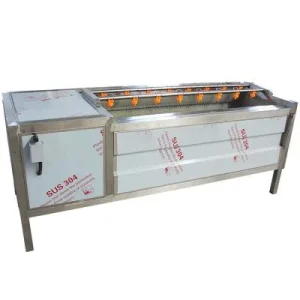
Ozone Vegetable Washing Machine 1500 kg/h
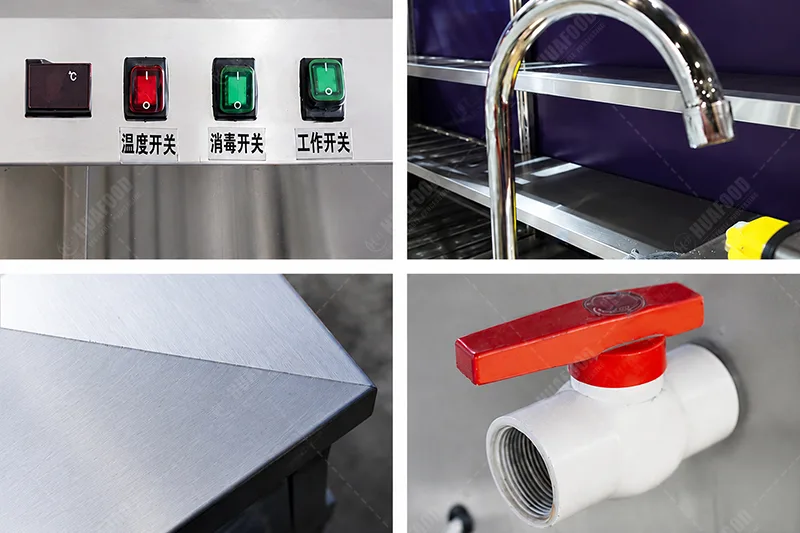
Washing unit that generates ozone on site and dissolves it into the wash water, so that produce is cleaned and surface-treated in the same pass, with residual ozone broken down before the water leaves the circuit.
How it works
An ozone generator produces ozone from dried air or from oxygen, and the gas is injected into the wash water through a venturi or a fine-bubble diffuser. Ozone dissolves and acts as a strong oxidant at the product surface, attacking microbial cell walls and oxidising some pesticide residues. Product moves through the ozonated section — a tank, a flume or a spray zone — then on to a rinse stage with clean water.
Ozone is unstable. It decays back to oxygen within minutes, so the concentration must be maintained continuously in the water rather than dosed once. Off-gas above the tank is captured and destroyed, because ozone in the room air is an exposure problem, not a benefit.
Suitable for
Leafy greens and salad where a microbial reduction step is required before packing; root vegetables arriving with soil-borne contamination; product where chlorine is restricted by the buyer or by the destination market; lines that already run a wash tank and want to upgrade the water rather than add a machine; plants that must document a sanitising step in the HACCP plan.
Not suitable for
Product that is sensitive to oxidation, where colour or surface bleaching shows at effective ozone doses; lines with high organic load in the water, which consumes ozone before it reaches the product; operations with no ventilation or off-gas control; anyone expecting a validated sterilisation step — this is a reduction step, and the log reduction depends on concentration, contact time and water quality.
Material & compliance
Tank, flume and belt in SUS304 (EN 1.4301); ozone-compatible seals in EPDM or PTFE rather than standard rubber. Generator cabinet separated from the wet zone; off-gas destructor fitted as standard; dissolved ozone monitored and interlocked.
Supplied with CE declaration of conformity and DoC on request; material certificate EN 10204 3.1 available for contact parts.
Selection notes
Ask for the dissolved-ozone concentration the machine actually holds in the water at your flow rate, not the generator’s nameplate output — the gap between the two is where most disappointment comes from. Confirm organic load handling: dirty recirculated water will eat the ozone dose. Check the off-gas arrangement before you accept a quotation, and check what the generator needs in terms of air preparation and cooling.
When you should not buy this machine: If your water is heavily loaded with organic matter, fix the filtration and the water changeover first — otherwise you buy ozone capacity and spend it on dirt. Also skip it if your buyer accepts chlorine: chlorinated water is cheaper to run and easier to control, and ozone only pays where chlorine is restricted or where you need the documented step.
Key specifications
| Parameter | Value |
| Capacity | 500-3000 kg/h by tank size (TYPICAL, confirm with factory) |
| Ozone concentration | 0.5-2.0 mg/L in water (TYPICAL) |
| Ozone output | 5-30 g/h by model (TYPICAL) |
| Contact time | 1-5 min by product (TYPICAL) |
| Water temperature | Ambient to 15 °C (TYPICAL) |
| Contact material | SUS304 (EN 1.4301) |
| Power supply | 380V/3P/50Hz or 415V/3P/50Hz, customizable |
Specification values are industry-typical ranges for this machine class and are not verified against a specific factory datasheet. Replace them with measured factory data before publication.
FAQ
Is ozonated water a sterilisation step?
No. It is a reduction step. The log reduction you get depends on dissolved concentration, contact time, temperature and organic load, and it should be validated on your own product and water.
Does ozone replace chlorine completely?
In many plants it does, and that is often the reason for buying it. But it is less forgiving: chlorine holds a residual through the line, ozone decays within minutes and must be maintained at the point of contact.
What maintenance does the generator need?
Air preparation and cooling. Generator output falls when the feed air is wet or the cell is hot, so the dryer, the filter and the cooling circuit decide whether the rated output survives a production year.
Related equipment
This unit is one stage of a complete processing line. For the full range of washing and peeling equipment, or to compare this model against the Bubble Washing Machine 2000 kg/h, see the complete equipment catalogue. Capacity, material grade and utility requirements can be confirmed through a quote request.
Reviews
There are no reviews yet.