
Fluid Bed Cooler 1 t/h
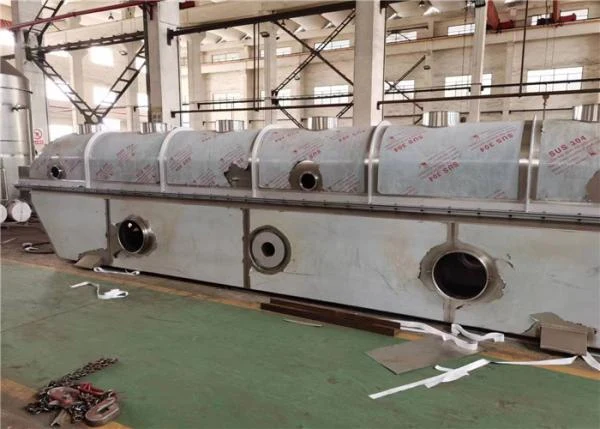
Dried, fried and blanched product comes off its machine at 60-90 °C, and packing it warm is a quiet way to lose a season — residual heat drives condensation inside the bag, condensation drives mould, and the complaint arrives after the shipment. A fluid bed cooler closes that gap: product rides a perforated deck while conditioned air blows up through it hard enough to float the pieces individually, so every surface sheds heat at the same rate and the product leaves at 5-10 degrees above the air supply, cool enough to seal. It is the plumbing between the dryer and the bag, and lines that skip it usually pay for it once, expensively.
How it works
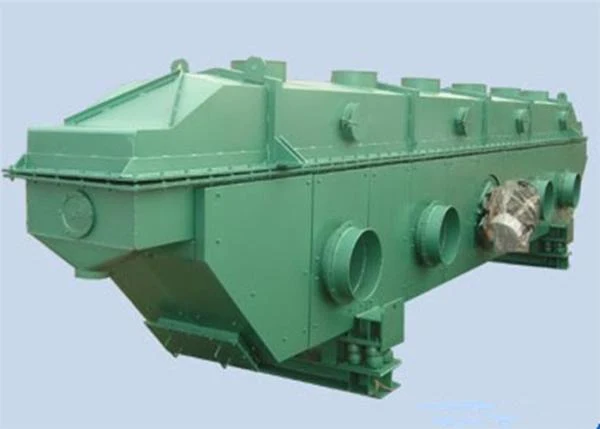
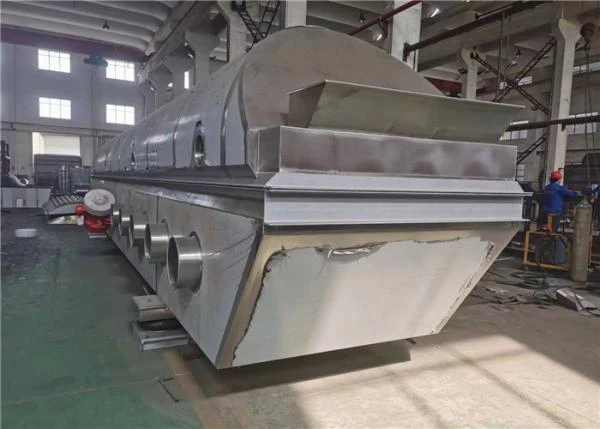
Product feeds onto a vibrating or static perforated deck inside an enclosed hood. A fan pushes filtered air — ambient, or chilled where ambient fails — through the deck; at the right air velocity the particles separate and behave like a boiling fluid, each piece surrounded by moving air instead of resting on its neighbour. Residence time, set by deck length, deck angle and vibration amplitude, gives the heat transfer time to pull the product down the temperature curve evenly. Fines and light skins pull off through the hood’s extraction and settle in a catch tray; the air recirculates or exhausts through filters. Product discharges cool and loose-flowing, ready for glazing, weighing or bagging.
Suitable for
Drying lines cooling dehydrated vegetables, herbs and fruit pieces straight off the belt dryer; frying and roasting lines cooling chips, roasted nuts and coated snacks before seasoning and packing; blanching and cooking lines tempering product before freezing or packing; powder and granule products — spices, flours from dried stock — needing cool, free-flowing discharge; any line where the packer complains about condensation, caking or weight drift on warm product.
Not suitable for
Very wet or sticky product that will bridge on the deck — free-flowing pieces are the fluid bed’s contract, and pastes need a different cooler entirely; delicate products that break by touching, since even gentle fluidization is still contact; lines with no compressed or filtered air discipline, because the deck clogs and the cooling turns uneven; and buyers expecting it to dry — a fluid bed cooler removes sensible heat, not water, and the moisture spec belongs to the machine upstream.
Material & compliance
Deck, hood and product-contact surfaces in SUS304 (EN 1.4301) with food-grade deck perforations; fans with washable filtration; vibration-isolated frame for stable floors; extraction ports sized for fines removal.
Supplied with CE declaration of conformity and DoC on request; material certificate EN 10204 3.1 available for contact parts.
Selection notes
Ask for the deck area and the air velocity range, not just kilos per hour — your product’s density and piece size decide where it sits in the fluidization band, and the honest test is a sample run with your product at your feed temperature. Check the filter grades and how the deck cleans: a cooler that cannot be opened and washed properly becomes the line’s hygiene debt. Check discharge height against the packer’s infeed — the machine is short and the interface is cheap to plan now. And ask about chilled-air options if your ambient summers defeat ambient cooling; half the year it will not matter, the other half it will.
When you should not buy this machine: If your product cools adequately on the existing conveying run and the packer sees no condensation, a cooler is a nice-to-have that will sit idle. And if your product is sticky, wet or fragile past fluidization, the deck will disappoint — ask the supplier honestly and look at spiral coolers or belt chillers instead.
Key specifications
| Parameter | Value |
| Capacity | 500-3000 kg/h by deck area (TYPICAL, confirm with factory) |
| Temperature drop | 70-80 °C to within 5-10 °C of air supply (TYPICAL) |
| Residence time | 2-6 min adjustable (TYPICAL) |
| Deck | Perforated SUS304, vibrating or static fluidization |
| Air system | Filtered fan, ambient or chilled, fines extraction |
| Contact material | SUS304 (EN 1.4301) |
| Power supply | 380V/3P/50Hz, 5-15 kW class |
Specification values are industry-typical ranges for this machine class and are not verified against a specific factory datasheet. Replace them with measured factory data before publication.
FAQ
How is this different from the fluid bed dryer upstream?
Same physics, opposite job: the dryer runs heated air to remove water, the cooler runs ambient or chilled air to remove heat only. On many lines they sit back to back and share a frame style, which is why buyers often order them together — the ducting and controls line up.
Will product break up in the bed?
Firm dried and fried pieces handle fluidization well; brittle or delicate product can abrade. The vibration amplitude and air velocity are tunable, and a sample run with your product answers the durability question before the order, not after.
Does it need chilled water or refrigeration?
Not necessarily — on most products filtered ambient air does the job, and the machine only needs chill when the ambient air cannot reach your target, typically in hot seasons. Ask the supplier to model your summer ambient before paying for a chiller you may not need.
Related equipment
This unit is one stage of a complete processing line. For the full range of drying and dehydration equipment, or to compare this model against the Fluidized Bed Dryer 800 kg/h, see the complete equipment catalogue. Capacity, material grade and utility requirements can be confirmed through a quote request.

Reviews
There are no reviews yet.