

Onion Slicing Machine 800 kg/h
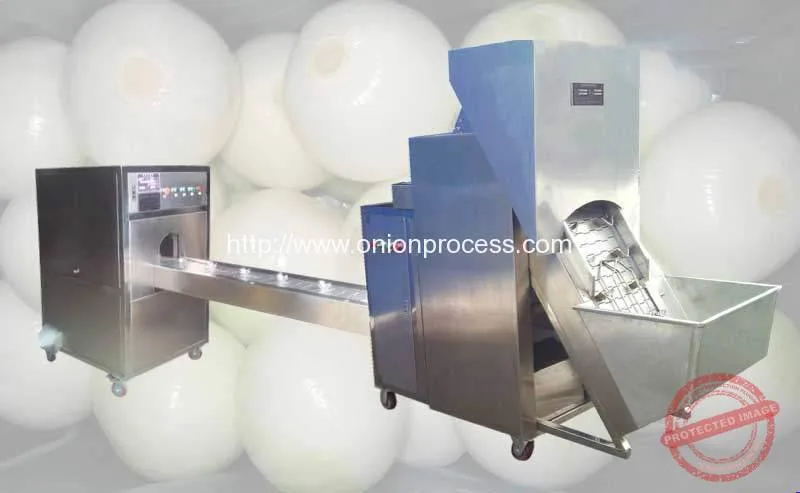
Onions fight the knife. Their layered structure tears when cut slowly, their juice irritates everything it touches, and a hand-cut ring is never the same thickness twice — which is why an onion line that still slices by hand pays three times: in labour, in yield, and in rings that fall apart in the fryer. An onion slicing machine solves all three at once — peeled onions feed into a spinning impeller that presses them against a circular blade set, cutting the whole bulb into rings of one set thickness in a single pass, at a rate no slicing table reaches.
How it works
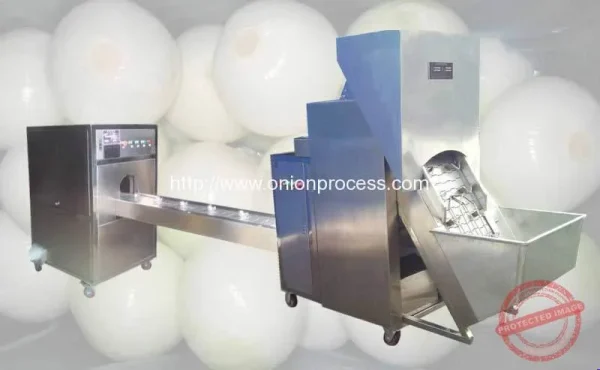
Peeled onions drop into the feed hopper onto a rotating impeller disc. Centrifugal force presses each onion flat against the inside of a cylindrical cutting chamber, where a rotating circular knife — or a set of knives at adjustable spacing — shears across the layers as the onion sweeps past. The onion is cut completely in one revolution: rings on the axis, halves and slices on anything that will not centre. Slice thickness is set by blade position or interchangeable blade carriers, typically 2 to 10 mm, and the cut rings discharge out of the base onto a takeaway conveyor with minimal handling. Because the onion is never gripped or squeezed, the layers separate cleanly instead of crushing, which is what keeps rings whole downstream.
Suitable for
Fried-onion lines feeding rings and slices to battering and frying — ring integrity is the whole product there; dehydration plants cutting uniform slices for even drying, where mixed thickness shows up as mixed moisture; frozen vegetable packers cutting rings and dicing-ready slices for IQF lines; pickle and condiment producers slicing into jars at retail thickness; any peeled-onion stream above a few hundred kilos an hour where hand slicing has become the bottleneck and the tear-gas exposure problem.
Not suitable for
Unpeeled onions — the impeller expects a clean, centred bulb, and skin and root plate throw the cut off, so the peeling machine upstream is part of this purchase, not an option; products other than layered bulbs — tomatoes, peppers and soft fruit need a different cutting principle; kitchens below roughly 200 kg/h, where a bench cutter costs a tenth as much; and buyers who need dice or strips from the same machine — this is a slicing specialist, and the dice happens in a different unit downstream.
Material & compliance
All product-contact parts — hopper, impeller, cutting chamber, discharge — in SUS304 (EN 1.4301) with food-grade surface finish for washdown; blades in hardened food-safe stainless with documented change procedure; belt materials food-grade; motor and controls sealed for the wet, acidic onion environment, which is harder on equipment than most products on the line.
Supplied with CE declaration of conformity and DoC on request; material certificate EN 10204 3.1 available for contact parts.
Selection notes
Ask what the capacity assumes — onion size, slice thickness and the peeled-percentage upstream all move the number, so quote your actual bulb spec. Confirm the thickness range and changeover time: a line running rings today and slices tomorrow needs a changeover in minutes, not an hour of tools. Check the blade set — how many knives, sharpening interval and whether spares are standard catalogue items. Ask how the machine handles out-of-spec bulbs without jamming, and what the discharge looks like — rings that arrive pre-broken cost you the yield you bought the machine for. And weigh the washdown story: onion juice is corrosive, and IP ratings on the real machine, not the datasheet, decide its second year.
When you should not buy this machine: If your onion volume is a few hundred kilos a day for fresh-pack, a bench circular slicer and one trained operator will hold tolerance at a fraction of the capital. And if you have not solved peeling first, this machine will only industrialise the mess upstream of it.
Key specifications
| Parameter | Value |
| Capacity | 500-1500 kg/h by onion size and thickness (TYPICAL, confirm with factory) |
| Slice thickness | 2-10 mm by blade set (TYPICAL) |
| Feed | Centrifugal impeller, whole peeled bulbs |
| Blades | Circular stainless set, adjustable / interchangeable |
| Discharge | Base outlet to takeaway conveyor |
| Contact material | SUS304 (EN 1.4301) |
| Power supply | 380V/3P/50Hz, 1.5-3 kW class |
Specification values are industry-typical ranges for this machine class and are not verified against a specific factory datasheet. Replace them with measured factory data before publication.
FAQ
Does it cut rings only, or slices too?
Both, from the same blade geometry — centred bulbs come out as rings, and bulbs that ride off-axis come out as slices or partial rings. For a uniform slices-only product, some lines run a matched feed or accept the mix and let grading sort it. Confirm the ring-to-slice ratio on your onion spec with the factory.
How bad is the tear gas?
The machine contains most of it — a closed chamber with extraction is the norm at this scale, and operator exposure drops far below hand-slicing. Site the extraction connection in the layout before installation, not after the first shift.
What blade maintenance should we plan for?
Onion juice is hard on edges — plan sharpening or blade-set rotation on a shift or daily cadence depending on volume, and hold a spare set so changeover is minutes. Factories quote the interval; make them commit it against your onion spec in writing.
Related equipment
This unit is one stage of a complete processing line. For the full range of cutting and slicing equipment, or to compare this model against the Onion Peeling Machine 1000 kg/h, see the complete equipment catalogue. Capacity, material grade and utility requirements can be confirmed through a quote request.

Reviews
There are no reviews yet.