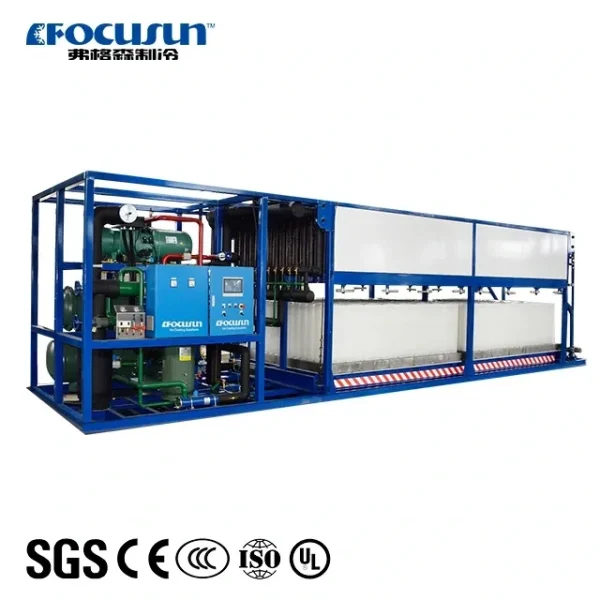
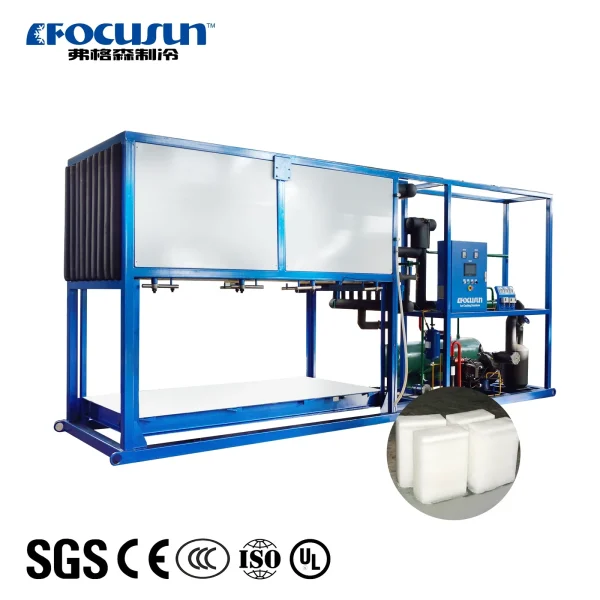
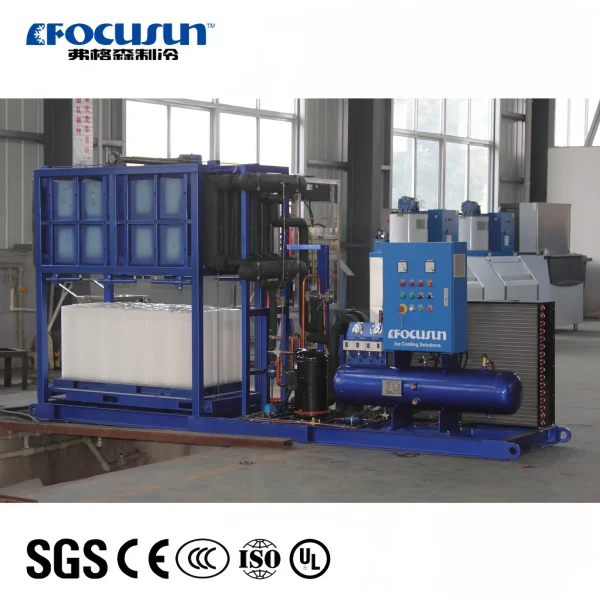
Block Ice Machine 5000 kg/day
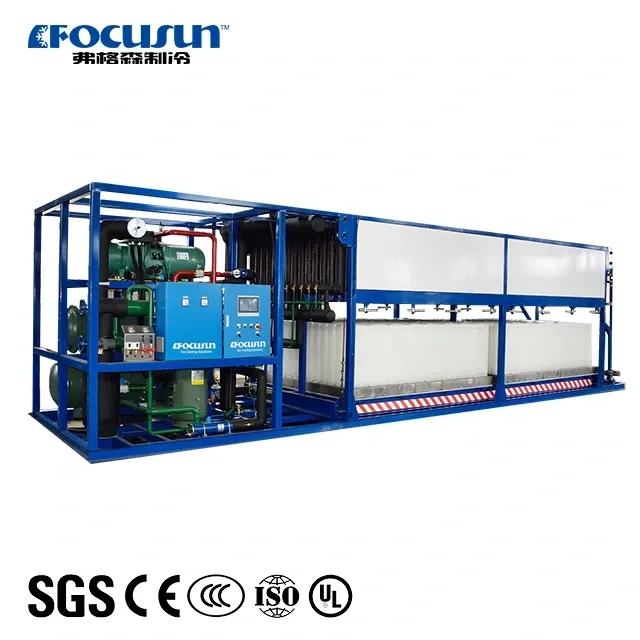
Block ice is the oldest form of artificial cooling and still the most transportable. Where a flake or slurry machine ties cooling to the site that makes it, a block can travel — by truck, by boat, by donkey — and hold its cold for days. A block ice machine is a refrigeration plant plus a mould farm: it makes cold slowly, stores it densely, and hands it over as a solid that can go wherever the produce goes.
How it works
Water is filled into moulds — aluminium or galvanised cans arranged in a tank — and frozen either by immersion in a calcium chloride brine circuit chilled to around -10 °C, or by direct expansion refrigerant in the mould walls. Freezing takes eight to twenty-four hours depending on block size, which is why a block plant is sized by tonnes per day and runs as a continuous harvest: batches of moulds are defrosted in warm water, tipped, refilled and returned to the tank while the rest keep freezing. Harvested blocks weigh 5 to 150 kg by mould choice, and a hoist or thawing tank lifts them out. The plant runs itself on timers and level controls; the human work is harvesting, stacking and crushing to the size the user wants.
Suitable for
Produce pre-cooling and top-icing in regions where crushed ice is the accepted cooling medium; transport icing for rail and truck shipments of leafy vegetables; fishing and fish-farming operations that share cooling infrastructure with a produce line; sites with cheap off-peak electricity, because a block plant is a thermal battery — it freezes when power is cheap and delivers cooling all day; buyers who need cooling that moves with the goods rather than staying at the plant.
Not suitable for
Fast pre-cooling, where hours matter — a block takes half a day to make and a hydro-cooler or vacuum cooler does in minutes what crushed ice does in half a day; operations needing pumpable or distributed cooling, which is what slurry and flake machines exist for; sites without space for the mould tank and block storage, because the footprint is the specification; anyone expecting to melt-and-recirculate — that is a chiller, not a block plant.
Material & compliance
Moulds in galvanised steel or aluminium; brine tank, tank frame and water circuit in SUS304 (EN 1.4301) on product-side parts — the brine itself is not food, but the harvest side touches ice destined for food contact, and that side stays stainless. Refrigeration circuit guarded with pressure protection; refrigerant declared at order because F-gas rules differ by market. Hoist and thaw-tank arrangement engineered so nobody hand-lifts a 100 kg block.
Supplied with CE declaration of conformity and DoC on request; material certificate EN 10204 3.1 available for contact parts.
Selection notes
Size the plant on daily harvest need, not peak — blocks store, so the plant that makes 5 tonnes a day serves a site that uses 5 tonnes a day, unevenly. Ask what the freezing cycle actually is at your water temperature and ambient, because both stretch the cycle. Ask how harvesting works — hoist, thaw tank, tipping rail — and whether it needs a second person. Check the mould size against your transport: a 50 kg block is a two-hand job, a 150 kg block is a hoist job. Check whether the quote includes the crushing or crushing mill you will need at the point of use.
When you should not buy this machine: If your cooling happens at the plant, at speed, buy a flake machine or a hydro-cooler — block ice is a logistics answer, not a speed answer. And if you cannot spare a day of lead time between deciding you need ice and having it, nothing in this machine class will please you.
Key specifications
| Parameter | Value |
| Daily capacity | 2000-15000 kg/24 h by plant size (TYPICAL, confirm with factory) |
| Block weight | 5-150 kg per mould by choice (TYPICAL) |
| Freezing cycle | 8-24 h by block size and brine temperature (TYPICAL) |
| Brine temperature | About -10 °C (TYPICAL) |
| Harvest | Thaw tank + hoist or auto tipping |
| Condenser | Air-cooled, water-cooled or evaporative by site |
| Contact material | SUS304 (EN 1.4301) harvest-side parts |
| Power supply | 380V/3P/50Hz or 415V/3P/50Hz, customizable |
Specification values are industry-typical ranges for this machine class and are not verified against a specific factory datasheet. Replace them with measured factory data before publication.
FAQ
Why choose block ice over flake ice?
Transportability and hold time. A block travels without refrigeration and melts slowly; flake ice must be used near where it is made. If your cooling moves with the goods — rail cars, trucks, market stalls — block wins. If your cooling happens at a fixed point, flake wins on speed and labour.
How long does a block take to freeze?
Eight to twenty-four hours depending on block size and brine temperature. That lead time is the class’s defining constraint, which is why plants run as continuous harvests with moulds at various stages of freezing.
Can it use off-peak electricity effectively?
Yes, and it is one of the class’s real advantages. Ice made overnight at cheap tariffs is cooling delivered all day — a block plant is effectively a thermal storage battery, and sizing the plant slightly larger than daily need lets you shift most of the load off-peak.
Related equipment
This unit is one stage of a complete processing line. For the full range of freezing equipment, or to compare this model against the Plate Freezer 800 kg/h, see the complete equipment catalogue. Capacity, material grade and utility requirements can be confirmed through a quote request.

Reviews
There are no reviews yet.