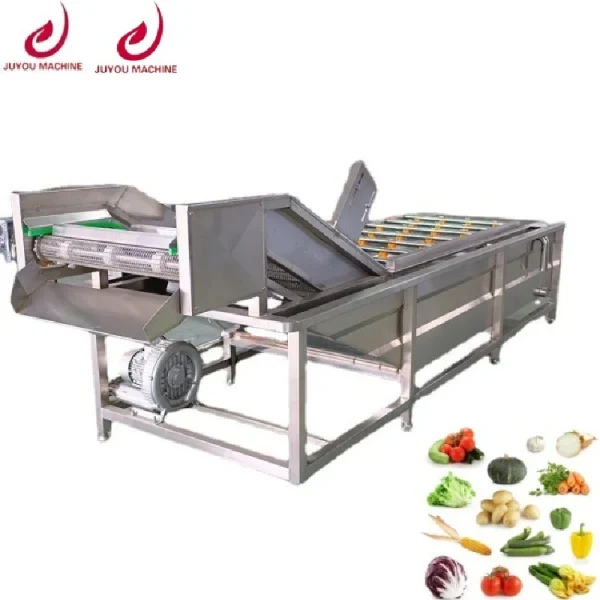
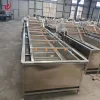
Cabbage Washing Machine 2 t/h
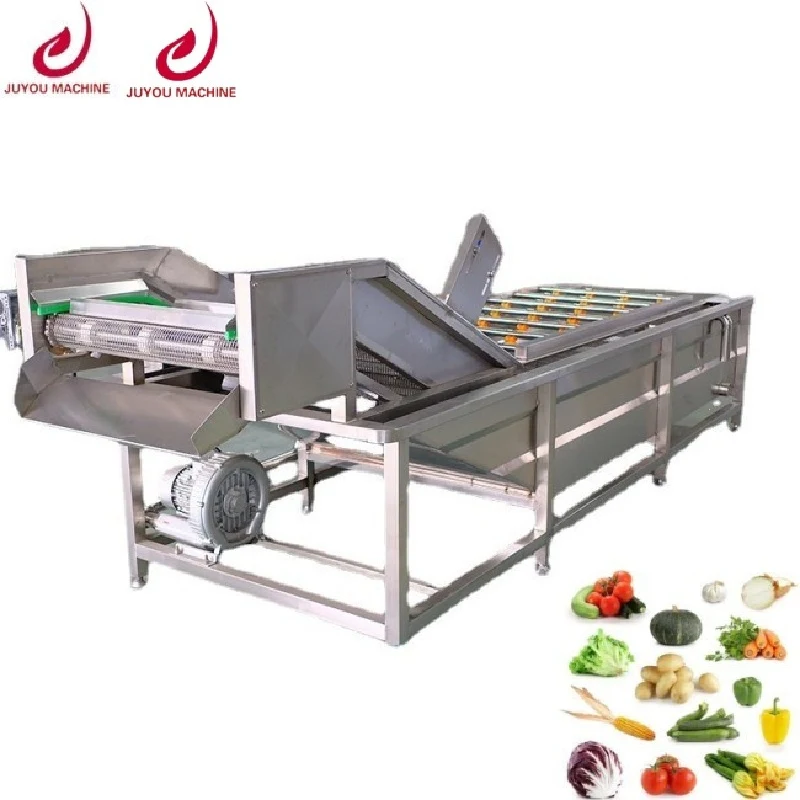
Cabbages cheat ordinary washers. The head is bulky and buoyant, so it floats high and half-rotates while the dirt between outer leaves rides along; the loose wrapper leaves carry field soil into the shredder; and the core dirt shows up later, in the shred, where washing can no longer reach it. The cabbage washing machine is sized for the head itself: a deep wash tank with strong bubbling that tumbles whole heads, spray zones that open the leaf layers, and a discharge that leaves the wrapper leaves in the tank instead of the product stream.
How it works
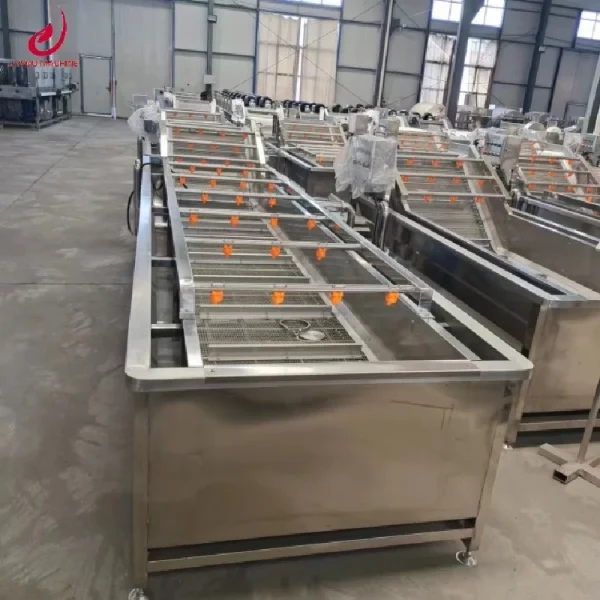
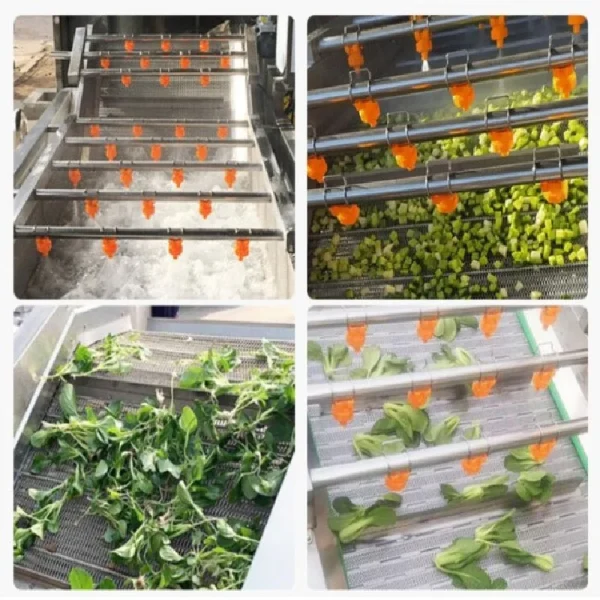
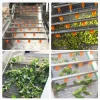
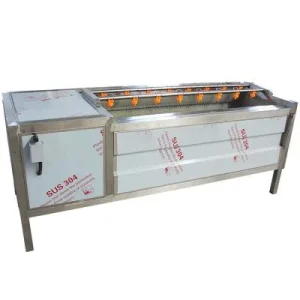
Heads feed into a wash tank where air bubbled from the bottom creates rolling turbulence — the tumbling opens the leaf layers and lets water reach the surfaces a static soak never touches. Spray bars over the tank drive water into the head as it rolls; loose wrapper leaves separate and float to an overflow or weir section for removal. The heads advance through the tank by water flow and an elevator against a second fresh-water spray, exiting clean and drained to the trimming or shredding station. Water recirculates through filtration with overflow control, and tank geometry — deeper and wider than a fruit washer — keeps the buoyant heads fully wetted instead of riding the surface.
Suitable for
Sauerkraut and kimchi plants washing whole heads ahead of coring and shredding; fresh-cut processors feeding washed cabbage to shredders and salad lines; coleslaw and ready-meal vegetable preparation at kitchen scale; Chinese cabbage and leafy-head lines where the wrapper leaves must go before packing; any head-crop stream where dirt between leaves is surviving the current wash.
Not suitable for
Shredded or cut cabbage, which washes on a leaf-and-flake line, not a whole-head tank; root vegetables and dense tubers, which need different turbulence and a destoner; delicate berries and soft fruit, for which this agitation is violence; and tiny volumes, where a two-sink soak with a spray wand covers the shift honestly.
Material & compliance
Tank, elevator and spray plumbing in SUS304 (EN 1.4301) food-grade finish; bubble fans and pipework designed for continuous immersion duty; filtration and overflow management for recirculated water; variable-speed elevator and spray controls matched to head size.
Supplied with CE declaration of conformity and DoC on request; material certificate EN 10204 3.1 available for contact parts.
Selection notes
Bring your heads, not your tonnage: cabbage size, tightness and how much field dirt rides in decide tank depth, bubble strength and line speed. Ask how the machine handles the loose wrapper leaves — separation at the wash is the difference this machine exists to make. Confirm water management: recirculation volume, filtration, and how often the tank dumps, because leafy washing loads water fast. Check the discharge height and draining against your shredder infeed; wet cabbage carries water weight into the next step’s energy bill. And test with your dirtiest field lot, not washed samples — the demo that matters is the mud demo.
When you should not buy this machine: If your cabbage arrives from storage relatively clean and your shredder has a small pre-wash, extend that instead. And if your real problem is the shredder, not the wash, buy the shredder first — clean heads through a bad shred still make bad product.
Key specifications
| Parameter | Value |
| Capacity | 1000-3000 kg/h by head size (TYPICAL, confirm with factory) |
| Wash principle | Deep tank, bottom-bubble tumbling + overhead sprays |
| Wrapper-leaf handling | Float-off separation to overflow weir |
| Water system | Recirculation with filtration and overflow |
| Contact material | SUS304 (EN 1.4301) |
| Power supply | 380V/3P/50Hz, 3-7 kW class |
Specification values are industry-typical ranges for this machine class and are not verified against a specific factory datasheet. Replace them with measured factory data before publication.
FAQ
How is it different from a bubble washer for fruit?
Geometry and duty: the tank is deeper and the bubbling stronger, because whole heads are bulky, buoyant and hold dirt between layers. Fruit washers treat surfaces; a cabbage washer has to open the head with water. Buying a fruit washer for cabbage is the classic under-spec.
Does it remove the outer leaves?
It separates the loose wrapper leaves that float off during tumbling — tight leaves on the head stay. Full leaf-stripping is the trimming or coring machine’s job; the wash makes that job cleaner and faster.
What water treatment does it need?
Leafy washing loads organic matter quickly — plan filtration, overflow control and scheduled tank dumps through the shift. Water quality varies by site, so confirm the make-up and drain arrangement against your supply rather than assuming the default loop holds.
Related equipment
This unit is one stage of a complete processing line. For the full range of washing and peeling equipment, or to compare this model against the Bubble Washing Machine 2000 kg/h, see the complete equipment catalogue. Capacity, material grade and utility requirements can be confirmed through a quote request.
Reviews
There are no reviews yet.