



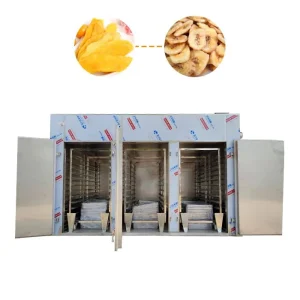
Cabinet Tray Dryer

Batch cabinet dryer that circulates heated air over stacked trays, suited to fruit, vegetables and herbs where product mix changes often and throughput is modest.
How it works
Trays of product are loaded onto racks inside an insulated cabinet. A fan draws air across a heater bank — electric elements or a steam coil — and pushes it through the tray stack, either cross-flow or through-flow depending on the design. A damper bleeds off moist air and admits fresh air. Temperature and, on better units, humidity are controlled to a set programme.
Uniformity is the recurring issue: trays nearest the air inlet dry faster than those at the far end, so most cabinets need tray rotation or a reversing fan to even out the batch.
Suitable for
Herbs, spices and medicinal plants; fruit slices and rings; vegetables for dried ingredients; pilot runs and product development; plants handling many products in small batches.
Not suitable for
Single-product high-volume drying, where a belt or tunnel dryer is far cheaper per kg; product needing very tight moisture uniformity batch to batch; heat-sensitive product that needs low-temperature drying, where a heat pump dryer performs better.
Material & compliance
Trays, racks and chamber in SUS304 (EN 1.4301); food-grade door gaskets. Chamber floor sloped to drain; trays and racks removable without tools.
Supplied with CE declaration of conformity and DoC on request; material certificate EN 10204 3.1 available for contact parts.
Selection notes
Ask how air is distributed — a cabinet with poor distribution gives you a batch where the top trays are over-dried and the bottom ones are not finished. Check tray material and whether trays are solid or perforated, because through-flow needs perforated trays. Confirm the control: at minimum a temperature controller, and ideally humidity or a timed damper programme.
When you should not buy this machine: If you dry one product continuously, a cabinet is the wrong shape — you will pay in labour per kg what a belt dryer saves. Also skip it if you need repeatable moisture within a narrow band; batch cabinets vary, and a continuous dryer with zone control holds target moisture far better.
Key specifications
| Parameter | Value |
| Batch capacity | 50-600 kg/batch by model (TYPICAL, confirm with factory) |
| Drying temperature | 40-90 °C adjustable (TYPICAL) |
| Tray count | 24-96 trays by model (TYPICAL) |
| Heating source | Electric elements or steam coil (TYPICAL) |
| Installed power | 9-30 kW by model (TYPICAL) |
| Contact material | SUS304 (EN 1.4301) |
| Power supply | 380V/3P/50Hz or 415V/3P/50Hz, customizable |
Specification values are industry-typical ranges for this machine class and are not verified against a specific factory datasheet. Replace them with measured factory data before publication.
FAQ
Why do trays dry unevenly?
Air distribution. Trays near the inlet see hot dry air and finish first; trays downstream see cooler, wetter air. Rotate trays during the cycle, or buy a unit with reversing or cross-flow air.
Can I dry several products at once?
Physically yes if the temperature and target moisture match. In practice different products finish at different times, and holding finished product at temperature degrades it. Dry one product per batch unless you have tested otherwise.
How do I know when drying is finished?
By target moisture measured on a sample, not by time. Time-based cycles drift with load size, ambient humidity and product moisture at loading. Weigh a sample tray periodically and stop on moisture.
Related equipment
This unit is one stage of a complete processing line. For the full range of drying and dehydration equipment, or to compare this model against the Belt Hot Air Dryer 1 t/h 30 kW, see the complete equipment catalogue. Capacity, material grade and utility requirements can be confirmed through a quote request.

Reviews
There are no reviews yet.