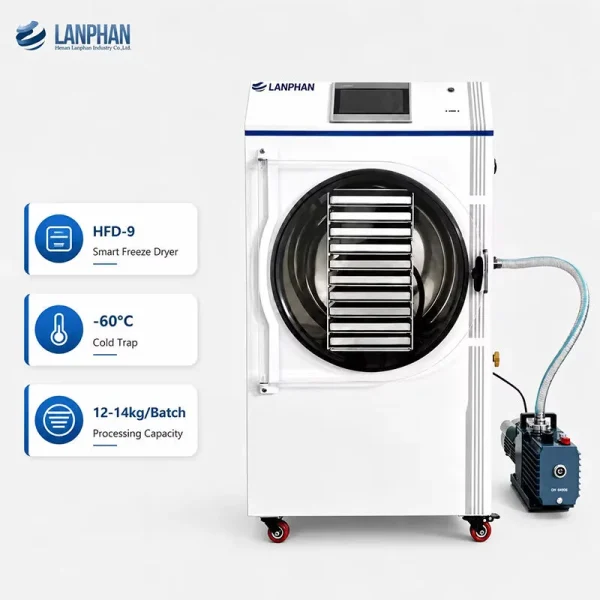



Vacuum Freeze Dryer
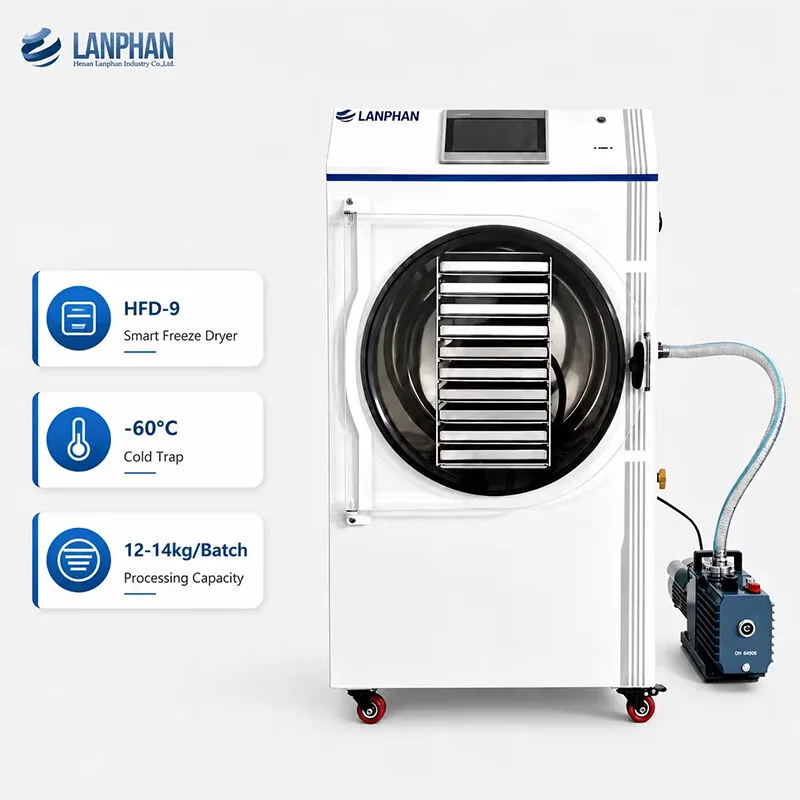
Lyophiliser that freezes product solid and then removes the water by sublimation under vacuum, so the product never passes through a liquid phase.
How it works
Product is frozen to well below its eutectic point, then the chamber is evacuated. Shelves are heated gently, supplying the latent heat of sublimation, and ice turns directly into vapour. The vapour is captured on a condenser held colder than the product, so the vacuum pump is not asked to handle water vapour. Once the bound moisture is driven off, the chamber is backfilled and the dry product unloaded.
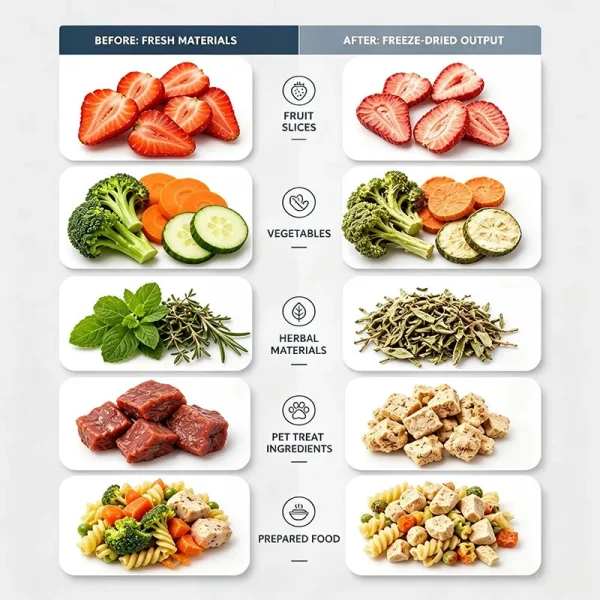
Structure survives because the ice framework that supported the product is removed as vapour: what is left is the original cellular structure with the water taken out.
Suitable for
Berries and soft fruit sold whole on appearance; premium fruit powders and ingredients; herbs where volatile aroma must survive; instant soup and ready-meal components; product where rehydration behaviour is part of the specification.
Not suitable for
Product where capital cost per kg matters most — freeze drying is the most expensive drying method per kg of water removed; very high-moisture product without pre-concentration; applications where a crisp hot-air dried texture is preferred over a porous freeze-dried one.
Material & compliance
Chamber, shelves and condenser in SUS304 (EN 1.4301); door and port gaskets food-grade and rated for vacuum. Chamber and condenser designed for washdown; vacuum and refrigeration systems documented with the unit.
Supplied with CE declaration of conformity and DoC on request; material certificate EN 10204 3.1 available for contact parts. Pressure vessels and refrigeration plant carry the documentation required.
Selection notes
Size on water removed per batch and on cycle time, not on batch weight alone — two products of the same weight can differ by hours if their moisture and structure differ. Ask for a measured cycle on your own product to your target moisture. Check condenser capacity carefully: an undersized condenser is the most common cause of a cycle that never finishes.
When you should not buy this machine: If your product does not command a price premium for appearance, aroma or rehydration, freeze drying will not pay for itself — a heat pump or hot-air dryer costs a fraction per kg. Also skip it if you cannot pre-freeze reliably; the freeze step sets the structure that everything else depends on.
Key specifications
| Parameter | Value |
| Batch capacity | 20-2000 kg/batch by model (TYPICAL, confirm with factory) |
| Shelf temperature range | -50 to +70 °C programmable (TYPICAL) |
| Chamber vacuum | Typically below 100 Pa (TYPICAL) |
| Cycle time | 18-40 h by product and load (TYPICAL) |
| Heating source | Electric shelves and condenser (TYPICAL) |
| Contact material | SUS304 (EN 1.4301) |
| Power supply | 380V/3P/50Hz or 415V/3P/50Hz, customizable |
Specification values are industry-typical ranges for this machine class and are not verified against a specific factory datasheet. Replace them with measured factory data before publication.
FAQ
Why is freeze-dried product better at rehydrating?
Because the ice that formed during freezing is removed as vapour, leaving the original pore structure open and connected. Water goes back into a structure that is still there, rather than into collapsed, shrunken cells.
How long does a cycle take?
Commonly 18-40 hours depending on product, load depth and target moisture. Cycle time is governed by heat transfer into the product and vapour flow out, so thinner loads and higher shelf temperature shorten it — within the limit where the product stays frozen.
Can I freeze-dry anything?
Almost anything that can be frozen, but economics differ sharply. High-value, heat-sensitive product justifies the cost; commodity vegetables usually do not.
Related equipment
This unit is one stage of a complete processing line. For the full range of drying and dehydration equipment, or to compare this model against the Belt Hot Air Dryer 1 t/h 30 kW, see the complete equipment catalogue. Capacity, material grade and utility requirements can be confirmed through a quote request.

Reviews
There are no reviews yet.