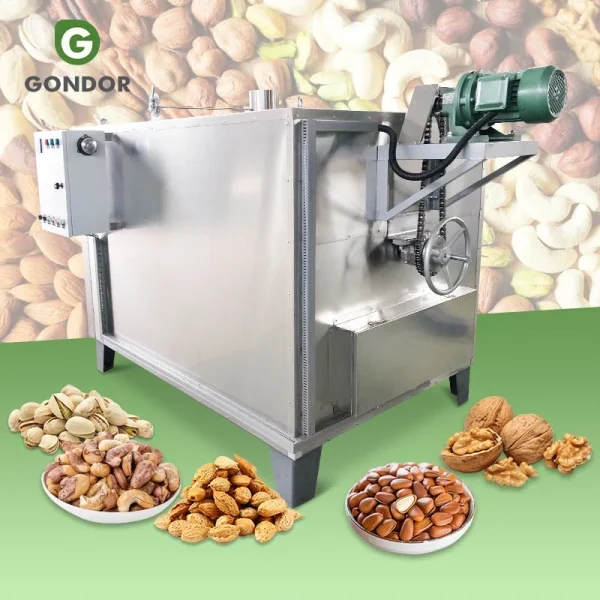


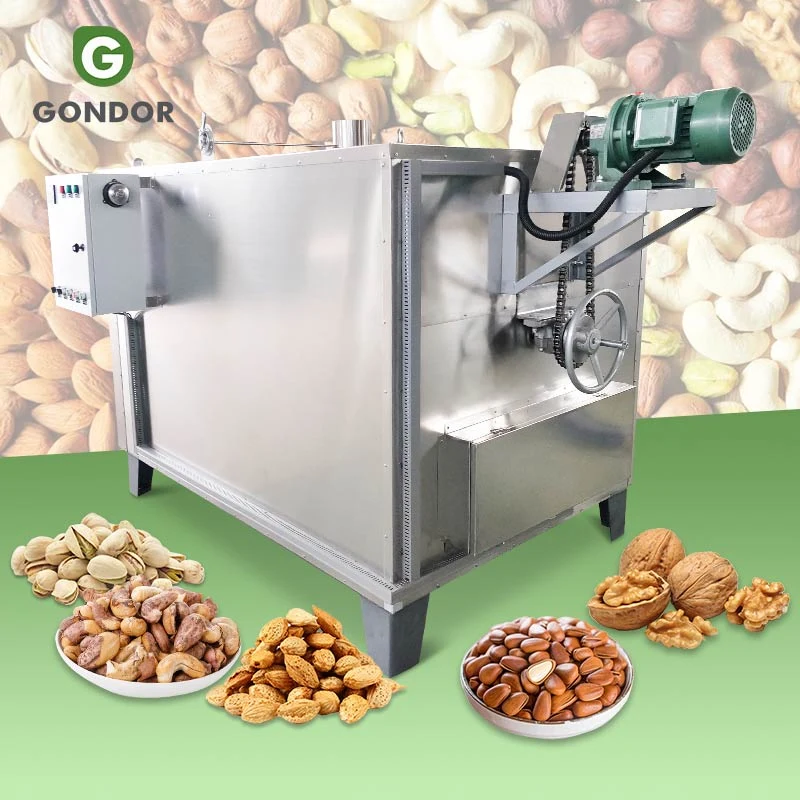
Chestnut Roasting Machine 500 kg/h
Roasting chestnuts at industrial scale is a heat-uniformity problem wearing a food costume. A drum over hot air must bring every nut through the same curve — shell drying, starch gelatinisation, sugar caramelisation, shell splitting — and take it off before the kernel scorchs. Hand-roasted chestnuts swing wildly; street-drum roasters are a different trade than a processing line. A chestnut roasting machine industrialises the curve: nuts with pre-cut scores feed a slowly rotating, heated drum where tumbling replaces stirring, temperature is zoned and logged, and discharge timing is a setting rather than a judgement. What leaves is shell-split, peel-ready nut with the aroma curve consistent batch to batch.
How it works
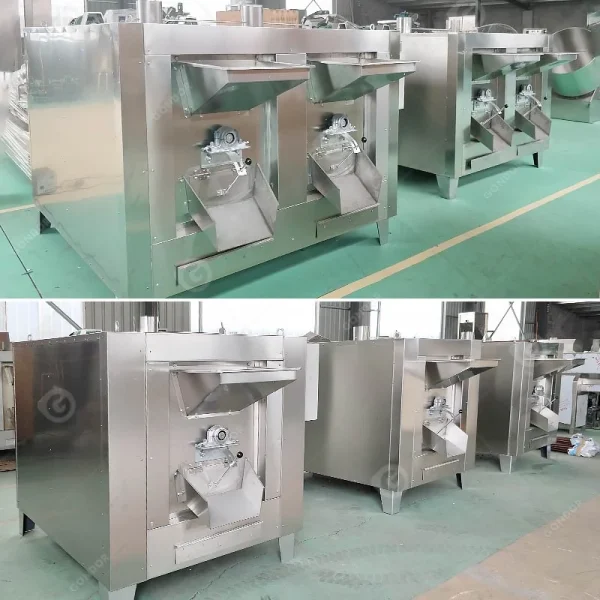
Scored chestnuts feed by elevator into a horizontal drum rotating slowly on rollers, heated along its length by gas burners or electric elements under zoning control. Tumbling flights turn the nut mass continuously so every surface sees the heat; drum temperature, rotation speed and dwell together define the roast. Near discharge, a cooling section or ambient-drum zone drops nut temperature and fixes the roast, and the split shells travel with the nuts to a peeling or shell-separation station. Controls log drum temperature and dwell per batch; recipes are stored and recalled by nut size, which is the largest single variable in the whole process.
Suitable for
Roasted-chestnut snack producers feeding peeling and vacuum-packing lines; chestnut paste and purée factories roasting before milling; frozen roasted-kernel operations blanching the peel step; nut processors adding chestnut to an almond or peanut roasting line; export packers roasting to order for retail-ready shell-split packs.
Not suitable for
Raw-kernel drying before storage — that is a low-temperature drying job, not a roast; unscored nuts, which explode under heat and jam the drum; tiny volumes for farm stalls, where a small batch roaster or the classic drum over coals remains honest equipment; and processes wanting smoke-flavoured roast from open flame contact — zoned clean-heat machines do not replicate it.
Material & compliance
Drum, flights, chutes, hopper and frame in SUS304 (EN 1.4301) food-grade finish; drum shell food-grade with accessible interior for carbon and oil clean-down; burner or element zones fully isolated from the product stream; sealed drives; temperature logging with over-temperature cutout; insulated outer shell for operator safety.
Supplied with CE declaration of conformity and DoC on request; material certificate EN 10204 3.1 available for contact parts.
Selection notes
Start with your nut size distribution: roasting curves shift measurably between small and large calibre, and recipes must exist per size — ask how the control system stores them. Decide gas versus electric on your site’s services and the local energy price, then confirm burner or element zoning matches your drum length. Check the discharge cooling story; nuts that hold heat in a pile keep cooking and darken. Ask about shell splitting rates at your score pattern, because the peeling line downstream inherits every unsplit shell. And verify temperature logging meets your food-safety documentation, since roast records are the audit trail buyers ask for.
When you should not buy this machine: If you roast under 50 kg a day for direct farm or market sale, a small batch drum or commercial nut roaster covers it. And if your real product is boiled or steamed chestnut for paste, a jacketed cooker at lower cost fits the process better than a roast.
Key specifications
| Parameter | Value |
| Capacity | 200-800 kg/h by nut size (TYPICAL, confirm with factory) |
| Heating | Gas burner or electric zoned (TYPICAL) |
| Drum temperature | 120-220 °C range, logged (TYPICAL) |
| Dwell | 15-40 min by recipe (TYPICAL) |
| Contact material | SUS304 (EN 1.4301) |
| Power supply | 380V/3P/50Hz, 8-30 kW class |
Specification values are industry-typical ranges for this machine class and are not verified against a specific factory datasheet. Replace them with measured factory data before publication.
FAQ
Do the nuts need to be scored before roasting?
Yes — a cut or score through the shell is what lets steam escape and the shell split clean; unscored nuts build pressure and burst, splattering kernel into the drum. Scoring is usually an upstream machine or hand step. Confirm whether the supplier offers a matching scoring unit rather than leaving it as your problem.
Gas or electric heating — which is better?
Gas is cheaper to run where a safe gas supply and extraction exist; electric offers finer control, simpler installation and no combustion air handling. The roast result can be matched with good zoning — decide on your site services and energy cost, then demand the same temperature-logging standard either way.
How consistent is shell splitting at discharge?
Well-tuned lines reach the mid-90s in percent split at the right score pattern and dwell (TYPICAL); the remainder is a hand or peeling-line reject. Splitting depends heavily on nut moisture and score depth, so stabilise the upstream steps before blaming the roaster. Ask the factory for split-rate data at your nut size.
Related equipment
This unit is one stage of a complete processing line. For the full range of cooking and blanching equipment, or to compare this model against the Rotary Roasting Oven 300 kg/h, see the complete equipment catalogue. Capacity, material grade and utility requirements can be confirmed through a quote request.


Reviews
There are no reviews yet.