Rotary Roasting Oven 300 kg/h
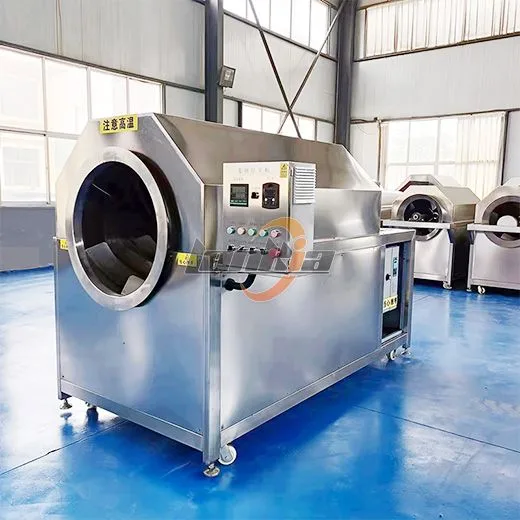
Roasting is a flavour process, and flavour is a uniformity problem. In a static oven, the seeds nearest the heat colour first and the batch gets stirred by hand to catch up; the result is a roast with a standard deviation. A rotary roaster removes the hand: the drum turns, the product tumbles through the hot air continuously, and every piece sees the same heat for the same time. Uniform colour is not a bonus of the design — it is the design.
How it works
Product feeds continuously into a perforated drum inclined a few degrees. The drum rotates slowly, lifting and cascading the product through a stream of heated air that flows through the perforations — hot air through the falling curtain of seeds, not hot metal under a stationary tray. Residence time is set by drum inclination and speed, and temperature by the burner or elements; the three together are the roast profile. At the drum’s low end the roasted product discharges continuously and passes to a cooling section — essential, because carry-over heat keeps roasting a product that has left the drum. Aiming at colour consistency means aiming at feed consistency: the machine roasts whatever it is given, at the rate it is given.
Suitable for
Peanut, sesame, sunflower seed and other nuts roasting ahead of oil pressing, butter grinding or snack packing; vegetable pieces and cubes for roasted-ingredient products; spice and seed toasting where aroma uniformity is the product claim; continuous production replacing batch tray ovens, where labour and consistency both improve at once.
Not suitable for
Products needing contact with a hot surface for marks or texture — this is air roasting, and it leaves no grill lines; very small batches of many recipes, where changeover and purge cost more than a batch oven would; operations without gas supply, if the quote is gas-fired — electric variants exist but price differently; anything requiring a moisture-controlled roast below what air flow can hold, where a vacuum or microwave process fits better.
Material & compliance
Drum, product guides and discharge in SUS304 (EN 1.4301); insulation and outer cladding arranged so surface temperatures stay safe to touch. Burner section separated from the product zone so combustion products do not touch food — indirect-fired designs exist and are the right answer where that matters. Drum drive and guards per CE; emergency stops at both ends. Cooling section (where included) in stainless with filtered air.
Supplied with CE declaration of conformity and DoC on request; material certificate EN 10204 3.1 available for contact parts.
Selection notes
Ask for colour uniformity data — pictures of the roast output at batch end, not the brochure hero shot. Ask whether the design is direct or indirect fired, and whether combustion air can touch product; for nuts destined for premium retail this matters more than price. Check residence time adjustability and how roast profile is changed between products. Check that a cooling section is part of the quote — roasters sold without one are only half a machine. Check drum access for cleaning, because oil vapour condenses inside every roaster.
When you should not buy this machine: If your volumes are small and your recipes many, a batch oven with disciplined trays outperforms a rotary machine fought at every changeover. And if your product is pre-oiled or coated, the drum will slowly build a lacquer that no cleaning schedule fully beats — coated products want a different machine class.
Key specifications
| Parameter | Value |
| Capacity | 100-600 kg/h by drum size (TYPICAL, confirm with factory) |
| Heating | Gas burner or electric, direct or indirect |
| Drum | Perforated stainless, adjustable speed and inclination |
| Roast temperature | 120-220 °C by product (TYPICAL) |
| Residence time | 5-30 min adjustable (TYPICAL) |
| Cooling | Discharge cooling section recommended |
| Contact material | SUS304 (EN 1.4301) |
| Power supply | 380V/3P/50Hz or 415V/3P/50Hz, customizable |
Specification values are industry-typical ranges for this machine class and are not verified against a specific factory datasheet. Replace them with measured factory data before publication.
FAQ
Why does uniformity matter more in roasting than in baking?
Because roasting is the flavour step, and buyers taste the standard deviation. A roast that is 10 % dark and 90 % right reads as inconsistency in the pack; the same spread in baking hides inside the crumb. The rotary drum exists to collapse that spread.
Direct or indirect firing — does it matter?
If combustion products touch the product, they add moisture and trace compounds, and premium buyers increasingly specify otherwise. Indirect-fired designs cost more and remove the question. For oil-roasting nuts for export retail, the indirect premium is usually worth paying.
Can it roast oil-coated or seasoned product?
Not well. Coatings transfer to the drum surface and build up, and the tumbling action abrades the coating off. Coated products want belt or pan roasting where the product sits still relative to the heat.
Related equipment
This unit is one stage of a complete processing line. For the full range of cooking and blanching equipment, or to compare this model against the Continuous Roasting Machine 500 kg/h, see the complete equipment catalogue. Capacity, material grade and utility requirements can be confirmed through a quote request.
Reviews
There are no reviews yet.