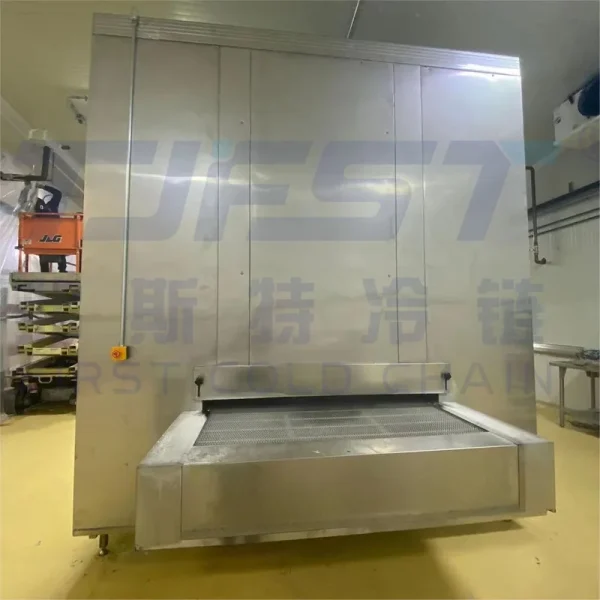
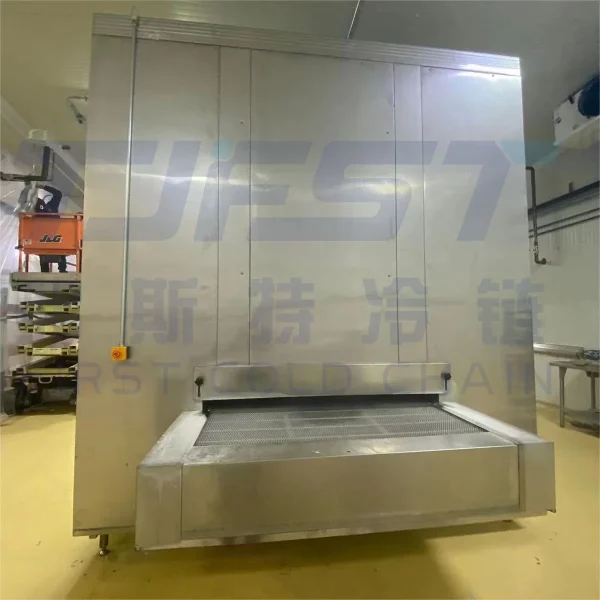
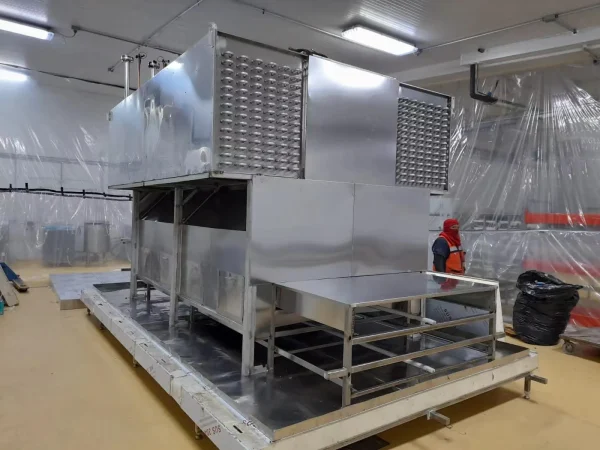

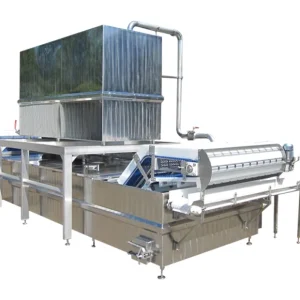
Impingement Freezer 1 t/h
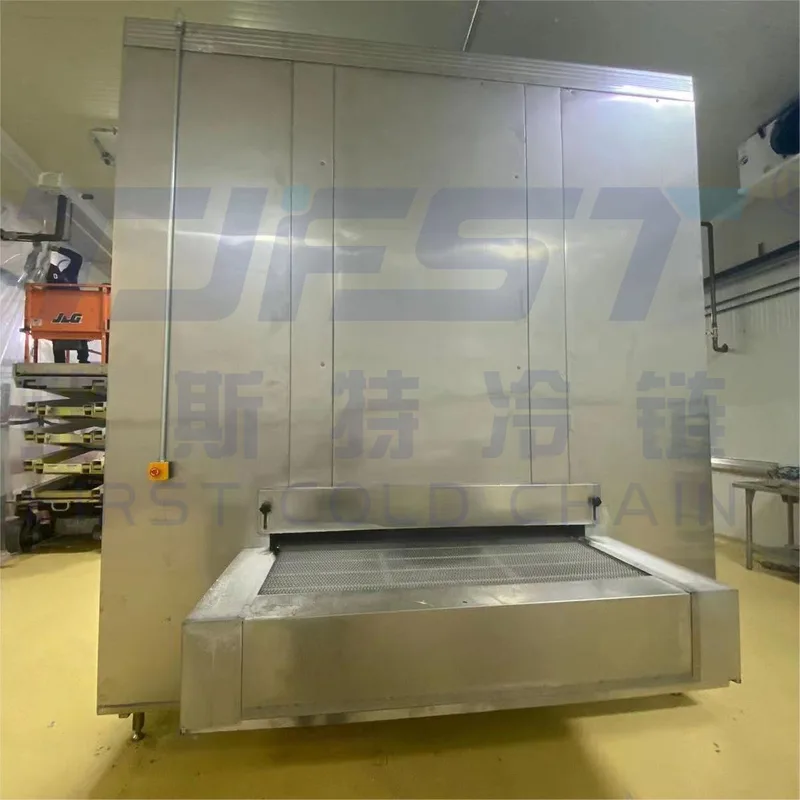
Thin products freeze slowly in ordinary tunnels for one reason: the boundary layer of still air that clings to every surface and insulates the product from the cold. Impingement freezing attacks that layer directly — arrays of high-velocity nozzles blast air perpendicularly onto the product surface, stripping the film and driving surface heat transfer coefficients several times higher than tunnel airflow manages. For patties, slices, dice on trays and other thin formats, an impingement freezer cuts freezing time close to half, and shorter freezing means smaller ice crystals, better texture and more tonnes per metre of line.
How it works
Product travels on a belt or tray conveyor through an insulated tunnel where nozzle arrays above and below blast air at -35 °C class and high velocity straight onto the product faces. The perpendicular impact is the engineering — jet velocity, nozzle spacing and stand-off distance are tuned so jets impinge without evading the surface, breaking down the insulating film on both sides at once. Zone controls hold different jet speeds through the freeze, and exit temperatures verify against -18 °C core. Product freezes fast enough that thin items pass in minutes rather than the hour-plus a tunnel needs, and the line holds IQF behaviour for loose dice because each piece chills before it can bond to neighbours.
Suitable for
Frozen vegetable dice, slices and leaf products where IQF quality and rate both matter; fruit slice and berry processors freezing thin single layers; ready-meal components on trays; producers with short freezing windows on heat-sensitive cut fruit; lines adding capacity in limited floor space, since impingement tunnels are short for their tonnage.
Not suitable for
Bulk or deep-bed products — impingement works on surfaces, and a deep bed’s inner product never sees the jets; irregular tumbling IQF at very high tonnage, where fluidized-bed tunnels remain the standard; products that dehydrate visibly under high-velocity air without cover or glaze management; and buyers without refrigeration plant capacity — the jets demand serious evaporator power per tonne.
Material & compliance
Tunnel, belts and nozzle plenums in SUS304 (EN 1.4301) food-grade finish; food-grade belts with washdown access; nozzle assemblies designed for clean-in-place access; temperature and jet-speed instrumentation for HACCP records.
Supplied with CE declaration of conformity and DoC on request; refrigeration plant per applicable safety codes.
Selection notes
Start from product thickness: impingement’s advantage shrinks as product gets thicker, and the honest crossover against a tunnel sits around 25-40 mm. Bring your tray or belt format to the trial and ask for the freezing curve — minutes to -18 °C core on your product, not a datasheet patty. Confirm dehydration and glaze strategy, since high-velocity air dries exposed surfaces; some products need a pre-glaze or cover film. Check the belt width and loading density against your upstream rate, and verify CIP access to the nozzle arrays — jets clog with debris and frost, and a freezer you cannot clean properly fails audit within a season.
When you should not buy this machine: If your product is bulk or deep-bed frozen in cartons, a blast cell or tunnel freezes the inside that impingement jets can never reach. And if your volume is small and batch-shaped, a blast room holds the flexibility you need at a fraction of the plant cost — impingement earns its capital on continuous thin-product rate.
Key specifications
| Parameter | Value |
| Capacity | 500-2000 kg/h by product and belt width (TYPICAL, confirm with factory) |
| Air temperature | -35 °C class at nozzles (TYPICAL) |
| Jet velocity | High-velocity perpendicular arrays, top and bottom (TYPICAL) |
| Freeze time | Minutes for thin products vs 1 h+ tunnel (TYPICAL) |
| Contact material | SUS304 (EN 1.4301) |
| Power supply | 380V/3P/50Hz, refrigeration plant sized per duty |
Specification values are industry-typical ranges for this machine class and are not verified against a specific factory datasheet. Replace them with measured factory data before publication.
FAQ
How much faster is impingement than a tunnel freeze?
For thin products, surface heat transfer rises several-fold and total freeze time commonly drops by 40-50%. The honest number comes from a trial curve on your product at your bed depth — ask for it before comparing prices, because the freeze time is the capacity.
Will high-velocity air dry out my product?
Exposed surfaces lose moisture faster under jets. Thin products freeze before visible loss matters, but cut fruit and open surfaces may need a glaze, cover film or faster belt loading. Discuss dehydration strategy in the trial — it is a process decision, not a defect to discover later.
Can it replace our fluidized-bed IQF freezer?
For dice and slices on belts, impingement achieves IQF behaviour with shorter tunnels; for loose product that needs tumbling to separate, fluidized beds still lead. Match the machine to the format — many plants run both across product lines.
Related equipment
This unit is one stage of a complete processing line. For the full range of freezing equipment, or to compare this model against the IQF Tunnel Freezer 1500 kg/h, see the complete equipment catalogue. Capacity, material grade and utility requirements can be confirmed through a quote request.

Reviews
There are no reviews yet.