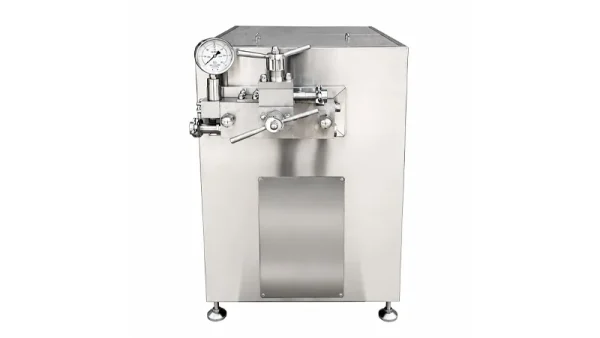
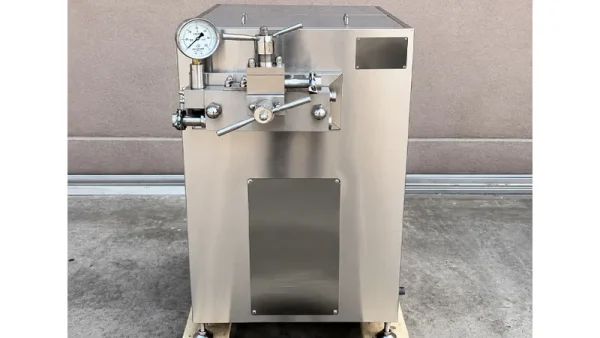

Juice Homogenizer
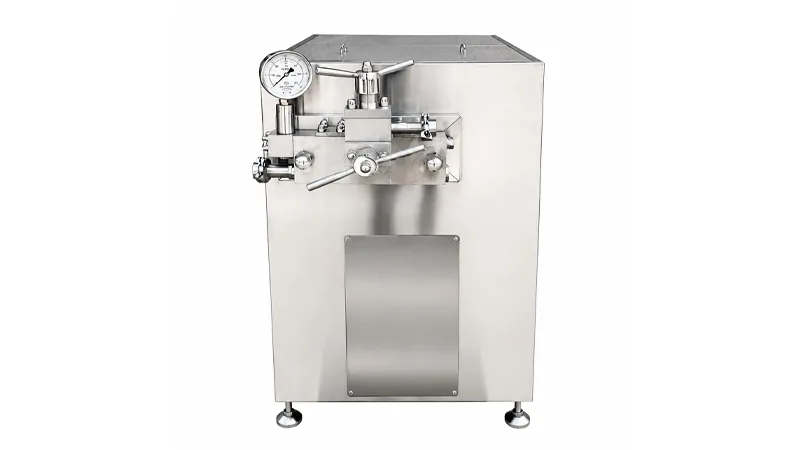
High-pressure homogenizer that forces juice through a narrow valve gap at pressure, breaking particles and droplets down so the product stays uniform and the cloud does not separate.
How it works
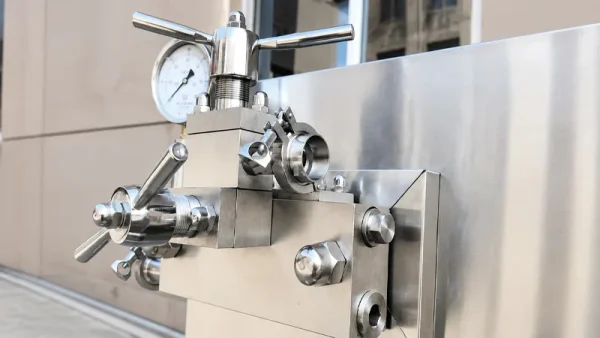
A high-pressure plunger pump delivers juice to a homogenising valve held at the working pressure. As the product passes through the narrow gap, the pressure drop, shear and cavitation break particles and droplets into much smaller ones. A second stage, where fitted, runs at lower pressure and breaks up the clusters that the first stage leaves behind. Pressure is the setting: higher pressure gives smaller particles and a more stable product, at the cost of energy and wear.
Homogenising does not remove pulp — it changes its size distribution, which is what changes the mouthfeel and the settling behaviour.
Suitable for
Cloudy juices where separation in the pack is the complaint; fruit nectars and puree-based drinks where texture must be uniform; tomato juice and vegetable juices where serum separation is a defect; product before pasteurising and filling, as a stabilising step.
Not suitable for
Clear juice, where there is nothing to stabilise; product where a coarse, natural texture is the selling point; very high-pulp or fibrous feed that will block the valve without preparation; low-value product where the energy cost per litre is not justified.
Material & compliance
Pump block, valve and pipework in SUS304 (EN 1.4301); SUS316L (EN 1.4404) on request for acidic product. Valve seats and seals specified for the pressure, the product and the temperature; high-pressure section guarded and interlocked. CIP connections designed for the circuit.
Supplied with CE declaration of conformity and DoC on request; material certificate EN 10204 3.1 available for contact parts. Food-contact elastomers can be supplied to FDA 21 CFR 175 where required.
Selection notes
Specify the outcome you want — particle size or cloud stability — then set the pressure from a trial, because pressure alone is not a product specification. Ask about valve and seat life on your product; abrasive pulp wears the valve, and wear shows up as a pressure that will not hold rather than as an alarm. Check whether one or two stages suit you, since the second stage costs pressure but often fixes the separation problem.
When you should not buy this machine: If you make clear juice, a homogenizer does nothing for you. Also skip it if your feed is coarse and unprepared: a homogenizing valve is a precision gap, and fibrous material blocks it rather than passing through it.
Key specifications
| Parameter | Value |
| Capacity | 500-30000 L/h by model (TYPICAL, confirm with factory) |
| Working pressure | 100-400 bar by product (TYPICAL) |
| Stages | Single or two-stage valve (TYPICAL) |
| Motor power | 15-45 kW by model (TYPICAL) |
| Product temperature | Typically 20-70 °C at inlet (TYPICAL) |
| Contact material | SUS304 (EN 1.4301); SUS316L on request |
| Power supply | 380V/3P/50Hz or 415V/3P/50Hz, customizable |
Specification values are industry-typical ranges for this machine class and are not verified against a specific factory datasheet. Replace them with measured factory data before publication.
FAQ
Homogenizer or deaerator — which do I need first?
Deaerate first. Removing air before homogenising avoids foaming and gives a more stable result; homogenising aerated product is working against yourself.
Why will the pressure not hold?
Usually valve or seat wear, or a blocked gap. Check the valve condition before suspecting the pump, because wear is the normal cause on abrasive fruit pulp.
Does it change the flavour?
Not directly, but it changes the texture and the stability, which is perceived as a difference. Running a trial at two pressures is the cheapest way to find the point where stability stops improving.
Related equipment
This unit is one stage of a complete processing line. For the full range of pulping and juicing equipment, or to compare this model against the Juice Vacuum Deaerator 5000 L/h, see the complete equipment catalogue. Capacity, material grade and utility requirements can be confirmed through a quote request.
Reviews
There are no reviews yet.