Belt Press Extractor
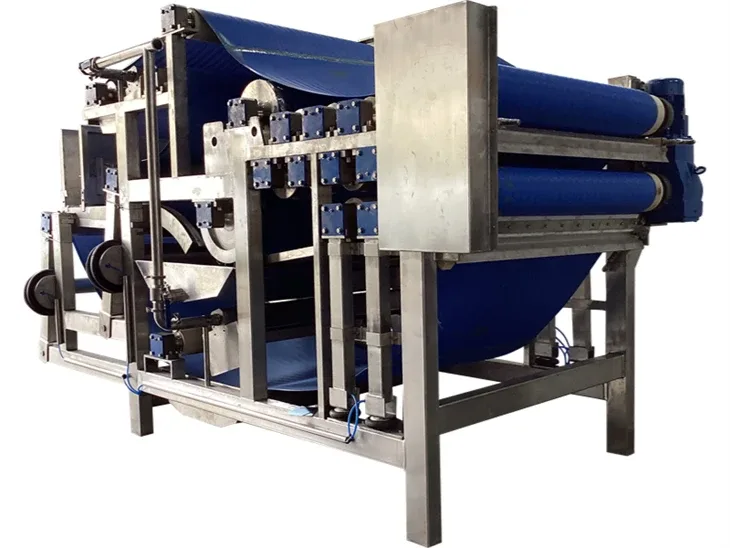
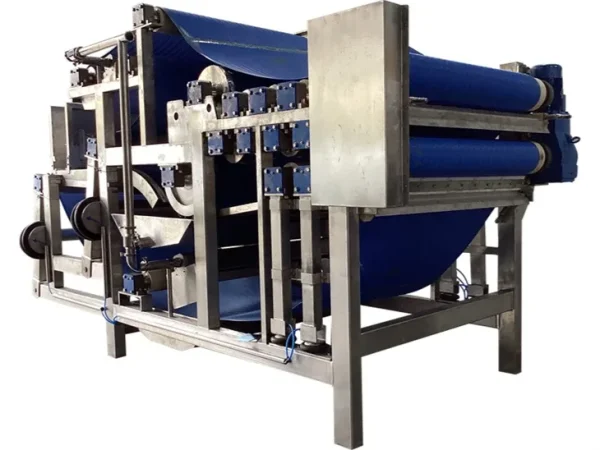
Continuous belt press that carries mash between two converging belts over a series of rollers, squeezing juice out progressively while the pomace stays on the belt.
How it works
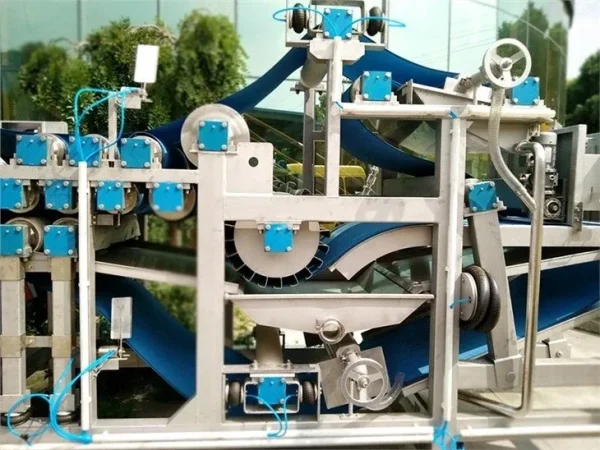
Mash is spread evenly onto the lower belt and covered by the upper belt. The pair passes over a sequence of rollers of decreasing diameter; each roller bends the belts, and the resulting wedge action squeezes the mash. Pressure increases along the machine as roller diameter decreases, so juice is drawn off gently at first and more firmly toward the discharge. Several machines add a final high-pressure stage before the belts separate and the pomace is scraped off.
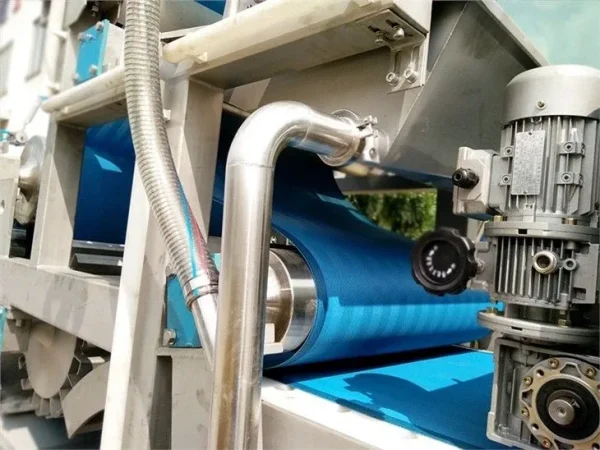
Belt permeability matters: juice must escape through the belt, so belt type is chosen against the mash, and a belt that blinds stops producing juice no matter how hard the press squeezes.
Suitable for
Apples and pears in high-volume juice plants; berries after enzymatic treatment; tomatoes for juice and paste; grapes and soft fruit; lines where low suspended solids in the juice matters more than the last point of yield.
Not suitable for
Very small volumes where a batch press is cheaper; product with hard pits or stones, which damage the belts; mash that is too liquid to hold on the belt; operations that cannot maintain belt washing discipline.
Material & compliance
Belts food-grade and specified for the product and temperature; frame, rollers and juice pans in SUS304 (EN 1.4301), SUS316L (EN 1.4404) on request for acidic product. Belt washing system integrated; pans sloped and drainable.
Supplied with CE declaration of conformity and DoC on request; material certificate EN 10204 3.1 available for contact parts. Food-contact elastomers can be supplied to FDA 21 CFR 175 where required.
Selection notes
Ask for measured yield and juice clarity on your own mash — belt presses trade a little yield for much cleaner juice, and that trade only makes sense if your downstream step benefits. Check belt washing: a belt press that is not washed in operation loses capacity hour by hour. Confirm mash preparation requirements, since a belt press needs mash spreadable enough to form an even bed.
When you should not buy this machine: If maximum yield is your only objective, a screw press usually extracts slightly more. Also skip it if you cannot commit to belt maintenance and washing — belts are consumables, and a plant that treats them as fit-and-forget will have poor yield and short belt life.
Key specifications
| Parameter | Value |
| Capacity | 1000-20000 kg/h by belt width (TYPICAL, confirm with factory) |
| Juice yield | Product dependent, test on own fruit (TYPICAL) |
| Belt width | 800-2000 mm (TYPICAL) |
| Pressing stages | Multi-roller with increasing pressure (TYPICAL) |
| Motor power | 3.0-7.5 kW (TYPICAL) |
| Contact material | SUS304 (EN 1.4301); SUS316L on request |
| Power supply | 380V/3P/50Hz or 415V/3P/50Hz, customizable |
Specification values are industry-typical ranges for this machine class and are not verified against a specific factory datasheet. Replace them with measured factory data before publication.
FAQ
Belt press or screw press — which gives cleaner juice?
A belt press generally produces juice with fewer suspended solids, because the mash is squeezed gently and progressively rather than forced against a screen. A screw press usually gives slightly higher yield with more fines.
Why does yield fall during a run?
Belt blinding. Solids lodge in the belt weave and juice can no longer escape. Continuous belt washing is the fix; without it, capacity and yield both decline through the shift.
How even does the mash need to be?
Even enough to form a uniform bed across the belt width. Uneven feed causes the belts to track badly and gives wet patches in the pomace, which is the usual sign of a feed distribution problem.
Related equipment
This unit is one stage of a complete processing line. For the full range of pulping and juicing equipment, or to compare this model against the Fruit Crusher 3000 kg/h, see the complete equipment catalogue. Capacity, material grade and utility requirements can be confirmed through a quote request.
Reviews
There are no reviews yet.