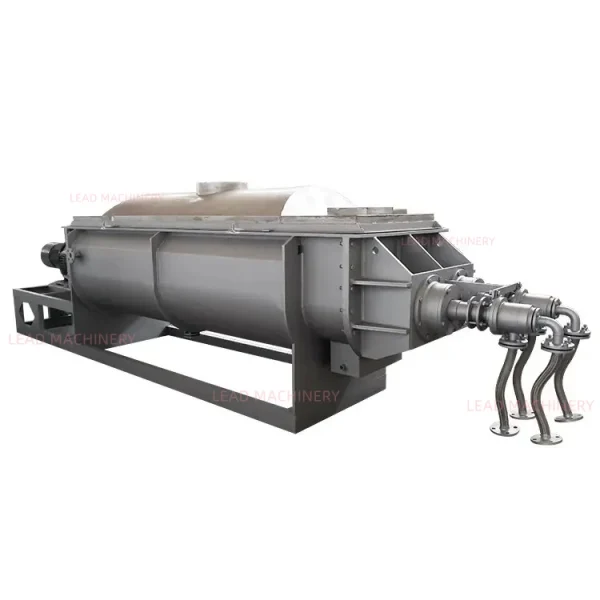
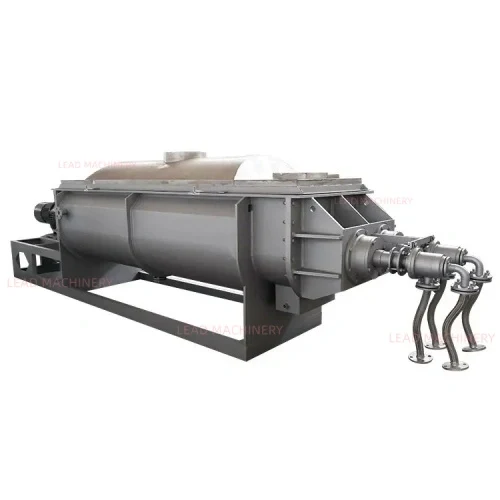

Hollow Paddle Dryer 300 kg/h
Every juicing and canning line makes two products: the one it sells and the one it pays to dump. Wet pomace, peel and process sludge leave the plant at 70-85% moisture and cost freight on every point of water they carry. The hollow paddle dryer attacks that economics directly — heated paddle shafts knead the wet cake through a trough, transferring heat by contact, so water leaves without heating tonnes of air. What was disposal becomes a dry, stable solid that stores, burns or sells.
How it works
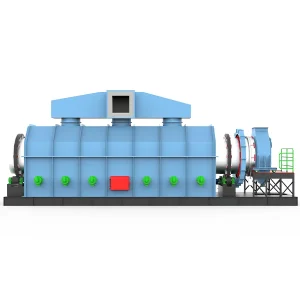
A wedge-shaped trough carries two (or four) parallel hollow shafts fitted with overlapping paddle discs. Steam or thermal oil circulates through the shaft cores and the paddles themselves; as the shafts turn, the paddles self-clean each other and knead product against the heated surfaces continuously. Heat passes by conduction — almost no process air is involved, so exhaust volume is a fraction of a convective dryer’s and dust handling shrinks with it. Product travels the trough progressively drier, its residence set by weir height and shaft speed, and exits as a dry granular solid while vapour pulls off through a small vent line to a scrubber or condenser. Moisture falls from 80% to 10-15% in one pass through a machine that occupies a few square metres.
Suitable for
Fruit pomace lines — apple, grape, carrot, citrus — turning press cake into dry animal-feed or pectin-feed material; vegetable-processing plants dewatering peel and trim waste before disposal or valorisation; herb and spice extraction residues dried for further processing; any site whose effluent bill is calculated per wet tonne and whose dryer should pay for itself in disposal savings; plants with steam or thermal-oil utilities already installed, where the dryer simply plugs into the heat loop.
Not suitable for
Premium food product — this machine dries by hot metal contact and kneading, and it is built for waste valorisation and feed-grade output, not table-grade appearance; sticky, sugar-heavy cakes without back-mixing dry product, which ball up on the paddles; very low-tonnage sites, where a skip bin of wet waste costs less than the dryer’s utilities; and sites with no steam or thermal-oil source, because electric heating at this scale is an expensive compromise.
Material & compliance
Trough, shafts, paddles and product-side parts in SUS304 (EN 1.4301); drive and heating utilities isolated from product space with proper seals; exhaust line to scrubber or condenser as part of the supply scope. For feed-grade output, ask for the food-contact finish and documentation your market requires — drying waste into feed makes it a food-chain material again, and paperwork follows.
Supplied with CE declaration of conformity and DoC on request; material certificate EN 10204 3.1 available for contact parts.
Selection notes
Ask for the evaporation rate per square metre of heat surface on your actual pomace — starches and pectins behave very differently from fibrous peel, and the quoted number on demo material flatters. Ask what exhaust and condensate equipment ships with the machine versus what you must build. Check paddle clearance and whether the self-cleaning geometry handles your particle size, seeds included. Confirm utility interface — steam pressure or thermal-oil temperature — matches your plant. Ask about back-mixing dry product into the feed for sticky cakes; on sugar-rich pomace this option decides whether the machine runs or cakes.
When you should not buy this machine: If your waste volume is a few tonnes a week, disposal fees do not justify capital — recalculate at your real tonnage, honestly. And if your goal is a table-grade dried product, the belt, vacuum or freeze dryers earlier in this catalogue are the right tools; the paddle dryer’s customer is the waste stream, not the retail shelf.
Key specifications
| Parameter | Value |
| Evaporation capacity | 100-1000 kg/h water by model (TYPICAL, confirm with factory) |
| Feed moisture | 60-85% wet cake |
| Exit moisture | 10-15% controlled by dwell (TYPICAL) |
| Heat source | Steam 0.3-1.0 MPa / thermal oil |
| Heat transfer | Indirect conduction via hollow paddles |
| Exhaust volume | Minimal vs convective drying (TYPICAL) |
| Contact material | SUS304 (EN 1.4301) |
| Power supply | 380V/3P/50Hz, 5.5-30 kW class |
Specification values are industry-typical ranges for this machine class and are not verified against a specific factory datasheet. Replace them with measured factory data before publication.
FAQ
Can the dried pomace be sold?
Commonly yes — dried fruit pomace goes to animal feed, pectin extraction and fibre ingredients, depending on origin and drying hygiene. What it can legally be sold as depends on your market’s feed or food rules; the machine makes it dry and stable, and your paperwork decides what it becomes.
Why not just use a rotary dryer for pomace?
A rotary dryer heats tonnes of air to dry tonnes of pomace; the paddle dryer heats the product directly, so fuel per kilo of water drops sharply and the exhaust — with its odour and dust — shrinks with it. On wet, sticky cakes the paddle machine also avoids the rotary’s wall-buildup problem.
What moisture should we dry the waste to?
Stable handling usually starts around 10-15%, low enough to store without mould and light enough to freight. Going drier costs energy for no logistical gain — ask for the cost curve at 15%, 10% and 5% before choosing a setpoint.
Related equipment
This unit is one stage of a complete processing line. For the full range of drying and dehydration equipment, or to compare this model against the Belt Hot Air Dryer 1 t/h 30 kW, see the complete equipment catalogue. Capacity, material grade and utility requirements can be confirmed through a quote request.
Reviews
There are no reviews yet.