
Microwave Thawing Machine 500 kg/h
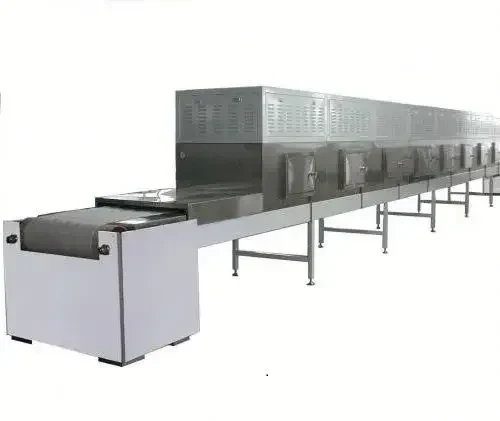
Every frozen line pays a hidden tax at its start: the thaw. Air thawing takes one to three days of chilled-room time and surface product sits in the growth zone long before the core frees; water thawing trades speed for leaching and a wet product that weighs its loss out of your yield. A microwave thawing machine attacks the whole block at once — electromagnetic energy heats the ice itself throughout the mass, turning a two-day defrost into a fifteen-minute temper, and the product arrives at the next machine cool, whole and dry-skinned instead of half-cooked at the edges. For plants feeding pulpers, dicers and press lines from frozen raw material, it is usually the fastest yield upgrade on the floor.
How it works
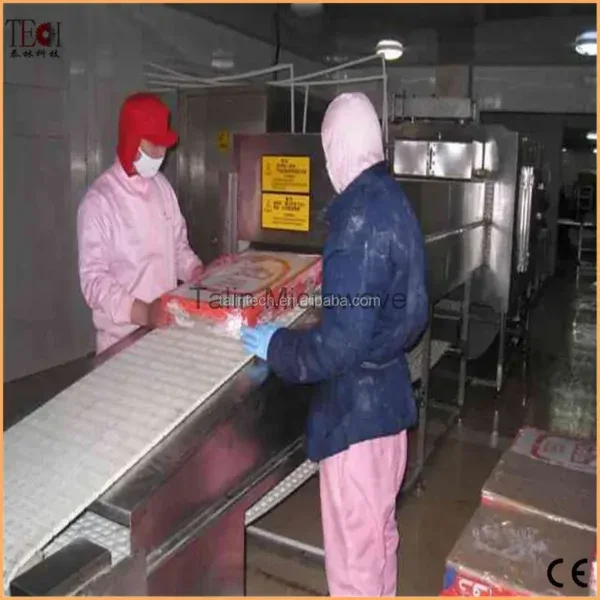
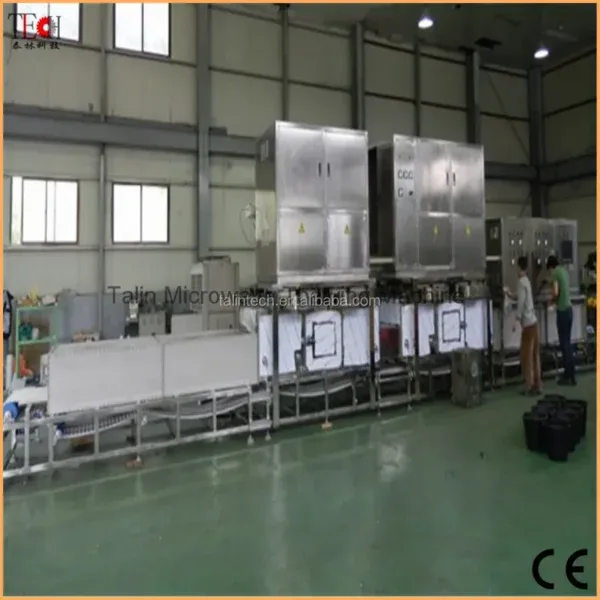
Frozen blocks or cartons feed on a conveyor through a tunnel lined with microwave energy ports — industrial systems run at 915 MHz for deep penetration on big blocks or 2450 MHz for finer control on smaller pieces. Magnetrons energize sections in zones; each zone’s power is set by recipe, and an infrared camera plus product-probe feedback lets the controller taper energy as the product approaches its target temper — typically -4 to -2 °C for cutting and pulping work, where the product is firm enough to machine but no longer brittle. Rotating turntables or field stirrers even out hot spots; the tunnel’s suppression system keeps leakage at the entry and exit below safety limits. Product leaves the tunnel at a uniform temper, ready for the next stage within minutes of arriving frozen.
Suitable for
Fruit processors tempering frozen blocks of pulp, purée and whole fruit ahead of pulping, blending and filling lines; vegetable plants thawing IQF or block-frozen product for dicing, mixing and ready-meal assembly; juice plants feeding frozen fruit to presses without the two-day lead a cold room demands; central kitchens and ready-meal factories thawing component blocks on a service schedule; any frozen-input line whose start-of-day bottleneck is product that is still solid.
Not suitable for
Products where partial cooking is fatal — microwave energy will pass cook thin edges if the recipe is wrong, so fragile raw product needs zone-level recipe work and honest trials; very large dense blocks beyond the tunnel’s penetration depth, which thaw outside-in anyway; plants hoping to fully cook as they thaw, because tempering and cooking are different recipes and this machine is built for the first; and buyers without electrical infrastructure — a half-megawatt-class machine asks real power, and the local grid connection decides feasibility before the price list does.
Material & compliance
Tunnel chamber, conveyor and product-contact surfaces in SUS304 (EN 1.4301); microwave components (magnetrons, waveguides, stirrers, suppressors) rated for continuous industrial duty; door interlocks and leakage suppression to recognized industrial-microwave safety practice, with the leakage test report part of delivery documentation.
Supplied with CE declaration of conformity and DoC on request; material certificate EN 10204 3.1 available for contact parts.
Selection notes
Demand a thaw trial on your blocks — the vendor’s demo product is not yours, and the honest number is time-to-temper on your carton size, your fat content, your frozen core. Ask how the machine handles cartons versus naked blocks and whether packaging stays on in your process. Check the power draw and your site’s supply in the same conversation: kVA, not just kilos per hour. Ask what the leakage measurements are at the tunnels’ mouths with and without product, and confirm the interlock philosophy in writing. And price magnetron replacement — they are consumables, and their rated hours plus spares policy decide your year-three cost more than the purchase price does.
When you should not buy this machine: If your thaw volume is a few hundred kilos a day and a chilled room already exists, disciplined air thawing costs nothing extra and the machine never pays back. And if your product tolerates water thawing without leaching — whole roots, sealed bags of pulped fruit — the water bath is a fraction of the price. The microwave earns its keep on yield, time and hygiene where those genuinely count.
Key specifications
| Parameter | Value |
| Capacity | 300-1000 kg/h by tunnel length and power (TYPICAL, confirm with factory) |
| Frequency | 915 MHz (deep blocks) / 2450 MHz (fine control) |
| Temper target | -4 to -2 °C uniform core (TYPICAL) |
| Thaw time | 10-20 min per pass vs 1-3 days air (TYPICAL) |
| Zones | 2-8 power zones with IR + probe feedback |
| Contact material | SUS304 (EN 1.4301) |
| Power supply | 380V/3P/50Hz, 50-300 kW class by model |
Specification values are industry-typical ranges for this machine class and are not verified against a specific factory datasheet. Replace them with measured factory data before publication.
FAQ
Does the microwave partially cook the product?
It can if the recipe is aggressive — that is exactly why temper targets sit below 0 °C and why the controller tapers power near the end. On a correct recipe the product leaves firm and cool, and the surface shows no cook colour. A trial on your blocks settles it before purchase.
Can packaging stay on through the tunnel?
Usually yes for microwave-transparent films and cartons, and most plants thaw in primary packaging for hygiene. Metallic labels or foil trays are the exception — they arc. Confirm your packaging with the trial.
How does it change drip loss?
Dramatically, in most trials: slow thawing lets cell fluids weep out for days, while a fast even temper keeps them in the tissue. Plants feeding presses and dicers commonly report a yield gain of a few percent — which is where the payback usually hides.
Related equipment
This unit is one stage of a complete processing line. For the full range of cooking and blanching equipment, or to compare this model against the IQF Tunnel Freezer 1500 kg/h, see the complete equipment catalogue. Capacity, material grade and utility requirements can be confirmed through a quote request.
Reviews
There are no reviews yet.