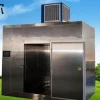
Vacuum Thawing Machine 1000 kg/h
Thawing is the step frozen-food plants schedule around, and badly. Air thawing takes a day or more for a block and cooks its outer layer while its core is still frozen; water thawing washes yield away and drains bacteria into the plant; microwave handles batches, not tonnage. The vacuum thawing machine changes the physics: under vacuum, water boils near room temperature, and that low-temperature vapour condenses directly onto the frozen surface, delivering its latent heat exactly where the thaw front is. Blocks thaw edge-to-core at product temperature never far above 20 °C — drip loss stays low, the surface never cooks, and a tonnage-scale thaw becomes a same-shift operation.
How it works
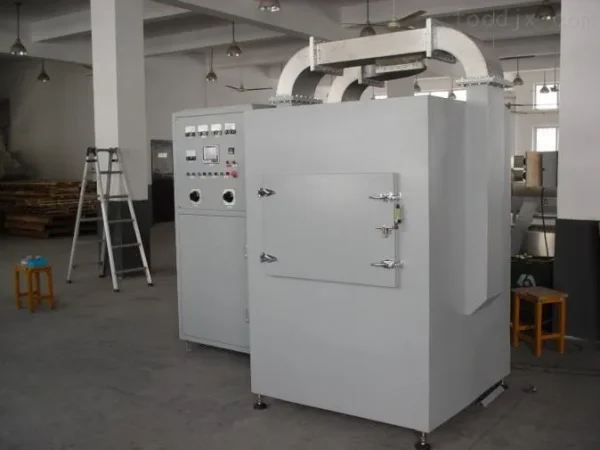
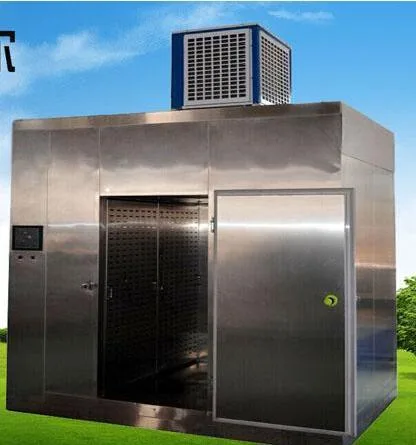
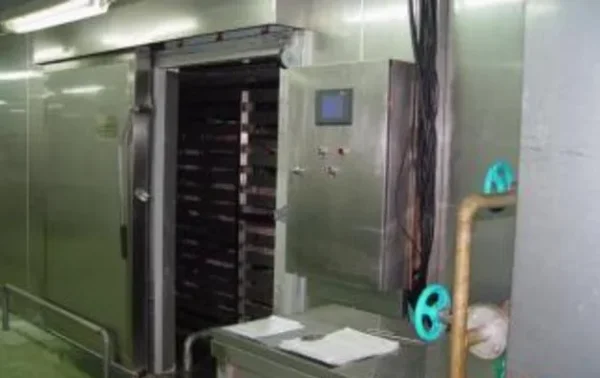
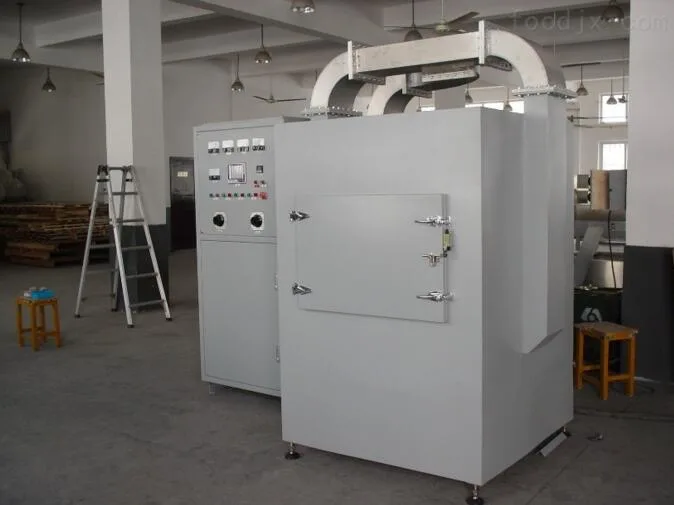
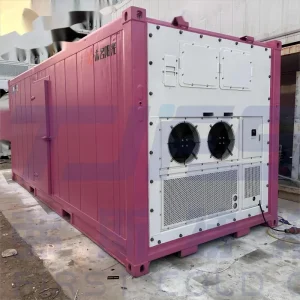
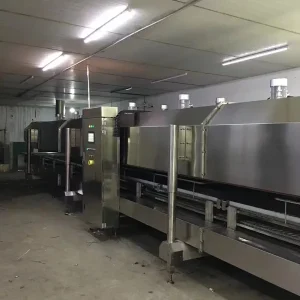
Frozen blocks or cartons load onto trolleys or racks inside an insulated vacuum chamber. A vacuum system pulls the chamber down to the pressure where water vapourises at the set temperature; a steam generator feeds low-temperature vapour, which condenses onto the coldest surface in the chamber — the frozen product itself — releasing latent heat into the thaw front. Product temperature sensors track the core through the cycle; when the set core temperature is reached, the chamber vents, and the load rolls out to cutting, mixing or cooking. Cycles for a full rack of blocks typically run 1-3 hours depending on block thickness, against a day or more in air.
Suitable for
Frozen vegetable and fruit block processors feeding cooking, purée or repacking lines; meat-adjacent mixed-vegetable plants synchronising thaw with their cooking schedule; frozen-block repackers dividing bulk blocks into retail formats; ready-meal factories pulling vegetable blocks on demand instead of scheduling yesterday’s thaw; cold-store operators adding a thaw service for customers.
Not suitable for
IQF loose product, which thaws fast in air and does not justify vacuum-cycle capital; products where added surface moisture matters — condensation adds a small water gain that some specs must account for; whole-carcass or very dense blocks beyond chamber rack design; and plants whose thaw volume is a few crates a day, where a chill-room thaw is free and adequate.
Material & compliance
Chamber, racks, trolleys and frame in SUS304 (EN 1.4301) food-grade finish; chamber welded, polished and pressure-rated with certified vessel documentation; steam system food-quality with condensate management; vacuum pumps isolated from the product space; temperature and pressure logging with cycle records for HACCP; interlocked door safety per pressure-vessel practice.
Supplied with CE declaration of conformity and DoC on request; material certificate EN 10204 3.1 available for contact parts.
Selection notes
Size the chamber around your block format, not a tonnage headline — block thickness sets cycle time more than any spec sheet number. Ask for the drip-loss comparison on your product: the vacuum cycle’s selling point is yield, and it should be demonstrated, not asserted. Confirm the vessel documentation: this is a pressure-rated machine, and local inspection requirements vary by country. Check cycle records export — HACCP audits want the temperature curves, not a memory. And verify steam quality and condensate handling, because the water that condenses onto your product must be as clean as your process standard claims.
When you should not buy this machine: If your thaw is a nightly chill-room job with no schedule pressure, capital here buys speed you do not need. And if your blocks are small enough for the cooking vessel directly, thaw-in-kettle may erase the separate step entirely.
Key specifications
| Parameter | Value |
| Capacity | 500-2000 kg/h by block format (TYPICAL, confirm with factory) |
| Cycle time | 1-3 h per rack load (TYPICAL) |
| Thaw temperature | Product core below 20 °C (TYPICAL) |
| Chamber | Insulated vacuum vessel, rack or trolley loading (TYPICAL) |
| Contact material | SUS304 (EN 1.4301) |
| Power supply | 380V/3P/50Hz, 10-40 kW class |
Specification values are industry-typical ranges for this machine class and are not verified against a specific factory datasheet. Replace them with measured factory data before publication.
FAQ
How does vacuum thawing keep the surface from warming first?
Because heat arrives as vapour condensing at the product’s own surface temperature — under vacuum, water vapourises below 25 °C, so the driving temperature difference is small and the thaw front advances evenly. There is no hot-air boundary layer cooking the outside while the core waits. That is the entire principle, and the reason drip loss stays low.
Does the product gain water weight during the cycle?
A small surface condensation gain is normal — typically a fraction of a percent, far below the drip loss saved (TYPICAL). If your specification counts added water, ask the factory for the measured gain on your block format during the acceptance test and write it into the protocol.
What products is it most worth buying for?
Dense blocks on a schedule: vegetable purée blocks, fruit blocks for repacking, any product where air-thaw delay costs a shift or surface warming fails a spec. Loose IQF product rarely justifies the chamber. Run your block format and schedule against the cycle time before committing capital.
Related equipment
This unit is one stage of a complete processing line. For the full range of freezing equipment, or to compare this model against the Water Immersion Thawing Machine 1 t/h, see the complete equipment catalogue. Capacity, material grade and utility requirements can be confirmed through a quote request.

Reviews
There are no reviews yet.