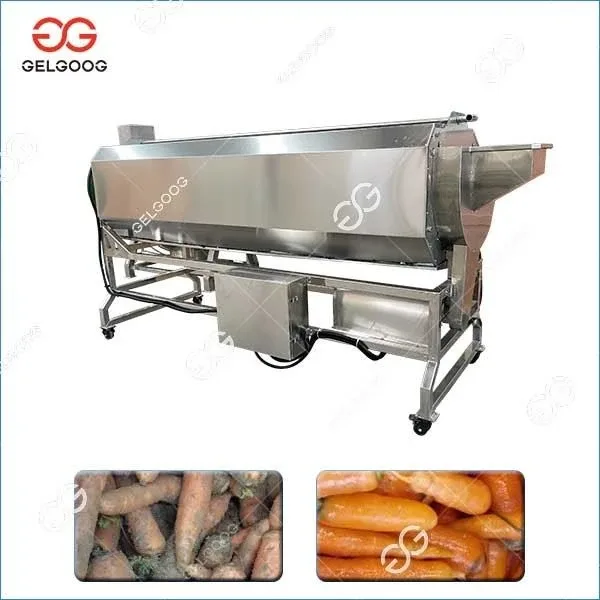
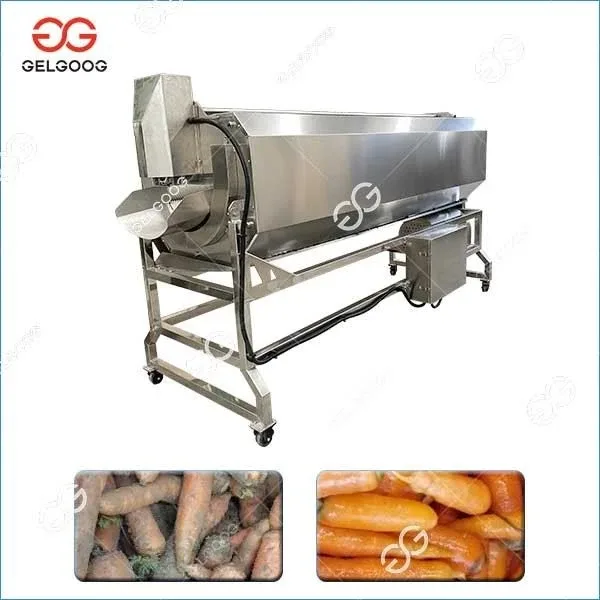
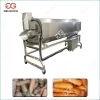
Carrot Washing and Peeling Machine 1500 kg/h
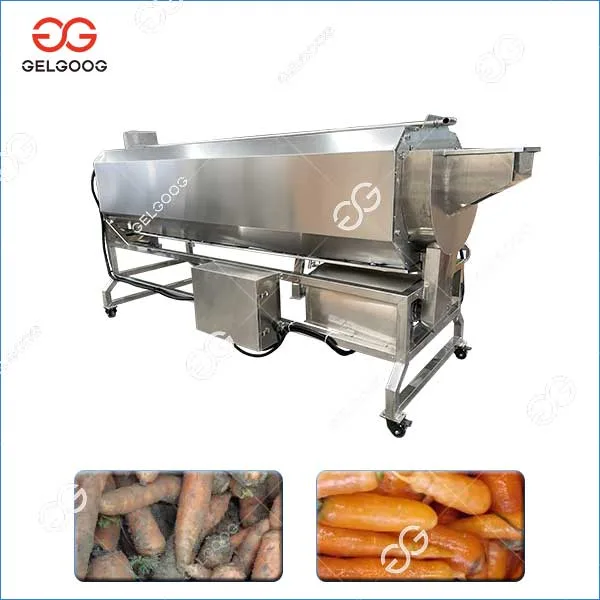
Carrots arrive from the field carrying more dirt than carrot — soil compacted into the grooves, hair roots in every crevice, sometimes a green shoulder that buyers will not accept. Washing them is easy; peeling them without eating yield is the craft. A carrot washing and peeling machine does both in one drum, using the difference between a brush that polishes and an abrasive roller that strips, so the carrot that comes out is the carrot the packer — or the cutting line downstream — actually specified.
How it works
Carrots feed into a U-shaped trough lined with parallel rotating rollers. Under a washing-peeling configuration the roller set mixes two types: hard nylon brush rollers that scrub soil and loose skin, and emery or carbide abrasive rollers whose gritty surface sands the thin periderm off without cutting flesh. High-pressure spray bars above the rollers flush debris away continuously while the carrots roll against each other and the brushes — the friction does the peeling, the water does the carrying. Roll time and roller mix decide the result: a short gentle pass polishes a washing-grade carrot, a longer abrasive pass peels it to the bright orange the fresh-cut market wants. Discharge is continuous, usually up an incline or onto a picking conveyor where an inspector eyes the odd forked root the machine could not judge.
Suitable for
Carrot packing lines feeding whole, polished or cello-pack product; fresh-cut plants whose dice, stick and slice lines need peeled input, because a carrot that goes to the cutter wet-peeled cuts cleaner and browns slower; root vegetable processors handling beetroot, taro, celeriac or radish on the same frame with a roller change; growers washing harvest dirt off before hydro-cooling or storage, where soil load shortens refrigeration life.
Not suitable for
Produce bruised by handling — soft or sprouted carrots pulp under abrasive rollers and the loss rate outruns the labour saved; baby carrots and premium whole-crop where even slight surface scuffing kills the grade, these need softer lamination peeling or hand finishing after the machine; sites without drainage and a water source, because a wet peeler moves tonnes of water with the carrots; buyers hoping one roller set suits every root — the difference between scrubbing a beet and peeling a carrot is the difference between two quotations.
Material & compliance
Trough, frame, rollers and covers in SUS304 (EN 1.4301); food-contact brush filaments in food-grade nylon, abrasive rollers on food-safe resin. Spray plumbing in stainless with filterable nozzles so recirculated water never sprays grit back onto product. Full welds, sloped floors, hinged covers — everything that touches a wet, soil-laden root must drain, open and scrub down, or the machine becomes a hygiene liability within a season.
Supplied with CE declaration of conformity and DoC on request; material certificate EN 10204 3.1 available for contact parts.
Selection notes
Ask what the quoted capacity assumes — dirty field carrots or pre-washed stock, because the soil load can halve throughput. Ask which rollers are fitted as standard and what a peeling-rate guarantee looks like on your carrot variety, sandy soil and all. Check water consumption and whether a recirculation tank with sediment traps is included; on a 1500 kg/h line the water bill is a running cost, not a detail. Check roller removal — brush rollers wear and abrasive sleeves wear faster, and a machine that needs two men and a crane to change a roller will run on worn ones.
When you should not buy this machine: If your carrots go straight into juice or pulp, buy a washer only — paying for abrasive peeling to feed a pulveriser is paying twice. And if your volume is a few hundred kilos a day for a local market, a two-roller bench unit or honest hand-washing remains the better machine for you.
Key specifications
| Parameter | Value |
| Capacity | 1000-3000 kg/h by length (TYPICAL, confirm with factory) |
| Rollers | 5-13 parallel nylon brush + abrasive rollers |
| Roller length | 1500-3000 mm by model (TYPICAL) |
| Spray system | High-pressure stainless bars, recirculation option |
| Peeling rate | 95%+ on mature carrots (TYPICAL) |
| Contact material | SUS304 (EN 1.4301), food-grade nylon brushes |
| Water consumption | 0.5-2 t/h depending on recirculation (TYPICAL) |
| Power supply | 380V/3P/50Hz, 2.2-4 kW class |
Specification values are industry-typical ranges for this machine class and are not verified against a specific factory datasheet. Replace them with measured factory data before publication.
FAQ
Will abrasive rollers damage the carrot flesh?
Abrasive rollers remove the periderm by sanding, not cutting — on a firm carrot the loss is the skin layer plus a few points of polish. Damage shows up on soft, split or sprouted roots, which is why a picking conveyor before the machine pays for itself.
Can the same machine handle beetroot and potatoes?
Yes, with roller and dwell adjustments — beetroot wants more abrasive, potatoes less. Confirm the roller mix option at quotation rather than assuming one setting serves every root.
How much water does it actually use?
A straight-through machine runs roughly 1-2 t/h at 1500 kg/h; a recirculation tank with double sediment traps cuts fresh water dramatically. Ask for the figure at your soil load — sandy soil loads the traps fast.
Related equipment
This unit is one stage of a complete processing line. For the full range of washing and peeling equipment, or to compare this model against the Brush Roller Peeling Machine 800 kg/h, see the complete equipment catalogue. Capacity, material grade and utility requirements can be confirmed through a quote request.
Reviews
There are no reviews yet.